
Zombie · Interactive story
Concrete Labyrinth: Survival in the Dead City
The skyscraper is your fortress, but the street level is a mass grave.
Start as a guest. Choose your character before the story begins.
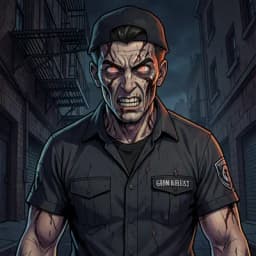
Meet the sample character
The skyscraper shadow is the only thing keeping you alive.
Try a scene · No signup
Concrete Chokehold
A short sample of this world. Your own version starts with your character.
The metal grating beneath your boots groans, a high-pitched protest against the weight of two people. Below, the horde ripples through the intersection like spilled ink. They aren't mindless; they're hungry, their heads snapping toward every creak of the rusted structure. You press your forehead against the cold brick, watching a woman in a tattered business suit tear at the asphalt with fingernails worn to the quick.

“If that bolt snaps, we’re just another snack for the crowd down there. Keep your breathing shallow.”

Your lungs burn, but you hold the air, forcing your heart rate to steady. The smell of copper and rot rises from the street, thick enough to coat your throat. You glance down at your forearm, feeling the rhythmic throb of the infection beneath your bandage, then look at the gap between this building and the one across the alley. It's a six-foot jump, but the landing is slick with rain and oil.
“The bolt won't hold. If we stay, we die. I’m going to make the jump, then catch you when you follow.”
The fire escape shudders violently as a massive, bloated creature below slams its shoulder against the wall, dislodging a cascade of bricks. The structure tilts precariously toward the abyss. You have seconds before the platform shears off the wall entirely, sending you both into the center of the undead swarm. The jump is your only exit, but the distance looks wider than it did a moment ago.
The platform drops another inch, screaming as the bolts rip through the masonry. How do you move?
Your character. Your next move.
The Skyline Is Falling. Will You?
The sun is setting behind the skyscrapers, and the dead are waking up. You are trapped in the center of the district with only a rusted pipe and your wits. Every choice you make in these streets defines your survival. Do you move now while you have the light, or wait for the darkness to hide your path?
Enter the Dead CityYour Story, Your Way
Everything is customizable. Pick any genre, setting, or character — the AI builds a world around exactly what you want.
Any Character
Design your appearance, personality, backstory — every detail
Any World
Fantasy kingdoms, sci-fi stations, modern cities — you choose
Branching Paths
No two playthroughs are the same. Your choices reshape everything
Full Immersion
AI images, voice acting, sound effects — a living story
Decide whether to scavenge high-risk pharmacies or stick to low-yield residential apartment blocks.
Manage your noise level while navigating through narrow alleyways filled with urban debris.
Choose which fire escape to scale when a horde blocks your primary exit route.
Distribute limited ammunition between your primary weapon and a desperate, last-resort backup.
The siren died three days ago. Now, the only sound in the downtown district is the wet, rhythmic shuffle of boots on cracked asphalt. You crouch behind a rusted sedan, the smell of ozone and decay clinging to your throat. Above, the office towers look like hollowed-out teeth against the bruised twilight sky. A horde clusters near the subway entrance, their heads snapping toward the faint scrape of your boot against the concrete. You have a half-empty canteen, a heavy crowbar, and three floors of fire escapes to reach before the light fails. Every movement is a gamble. Your choices dictate whether you make it to the rooftop or become just another stain on the sidewalk.
What is Overrun City Streets in Zombie?
An Overrun City Streets setting focuses on the claustrophobia of modern urban decay. Unlike rural zombie fiction, the city offers verticality—fire escapes, service ladders, and high-rise apartments—but it also traps you in a dense, inescapable maze. Think of the visceral tension in The Last of Us or the claustrophobic dread of Max Brooks’ World War Z. You aren't just fighting monsters; you are fighting the environment itself. The city is a resource trap: malls, pharmacies, and grocery stores are prime looting spots, but they are also death traps where the undead congregate in the dark. It is about the transition from a civilized hub to a hunting ground where every alleyway acts as a potential choke point. This setting forces you to think like a scavenger, constantly weighing the risk of entering a building against the necessity of finding water or medical supplies. It is the ultimate test of urban survival.
Why play Overrun City Streets as an interactive story?
In this environment, your agency is your primary weapon. You decide whether to risk a sprint across an open plaza to reach a medical cache or take the long way through a pitch-black parking garage. You’ll face tactical decisions that carry permanent consequences: do you clear a barricade to secure a vantage point, knowing the noise will draw a swarm? Or do you conserve your stamina, hide in a supply closet, and hope the moaning outside subsides? The constant tension comes from the limited visibility of city streets. You can never see what's around the next corner, and the AI tracks your sound, your scent, and your pathing. A single misstep on a loose metal grate can turn a stealth mission into a frantic chase through a labyrinth of locked doors and dead ends.
What makes Overrun City Streets work: the worldbuilding
Urban settings provide a unique storytelling architecture. The environment acts as a character, constantly forcing the player to choose between safety and resources. The conflict is inherently vertical. In films like 28 Days Later, the emptiness of London creates a sense of profound loneliness, while the claustrophobia of Train to Busan highlights how quickly public infrastructure becomes a cage. The 'Overrun City' archetype excels by limiting the player's horizon. You are rarely seeing the big picture; you are seeing the next ten feet of pavement. This forces a grounded, tactical mindset. Sensory details are vital here—the rattle of a chain-link fence, the smell of burning trash, the reflection of a neon sign flickering in a puddle of stagnant water. These details build a world that feels lived-in and dying. When writing for this setting, focus on the verticality of survival. Can you climb? Can you jump? Can you lure them into a dead-end street? The city is not a static backdrop; it is a complex machine that has stopped working, and you are the gear trying not to get crushed in its teeth. By emphasizing the contrast between the cold, unfeeling steel of the architecture and the frantic, heat-driven desperation of the survivor, you create a narrative that stays with the player long after they log off.
FAQ
Can I fight my way through every horde I encounter?
Combat is rarely the smartest choice. Ammunition is scarce, and noise draws more of the infected. Survival often favors stealth, navigation, and knowing when to run.
Does the city environment change based on my decisions?
Yes. If you clear a building, it may become a safe base. If you trigger an alarm, that sector of the city becomes significantly more dangerous for your future travel.
How do I manage supplies in the city?
You must prioritize. Carrying too much gear slows you down, making it harder to escape when a street becomes overrun. Scavenge only what you can carry comfortably.
What makes this setting different from a rural zombie story?
Rural stories focus on isolation and distance. City stories focus on density and claustrophobia. You are always surrounded, and there is nowhere truly far away to hide.
Explore more Zombie stories like Zombie Outbreak Day Zero, Safe Zone Search, Zombie Horde Siege.
More Zombie Stories
Zombie Outbreak Day Zero
The first reports are hitting the news and nobody believes them yet. You witness the initial chaos firsthand and must decide whether to warn others, stockpile supplies, or run before the city falls.
TropeSafe Zone Search
Rumor has it there is a safe zone still standing, but the road there is crawling with the undead. You must navigate hostile territory, decide who to trust, and find sanctuary before your supplies run out.
TropeZombie Horde Siege
They are pressing against every barricade and your defenses are crumbling. You must rally your group, ration ammunition, and make brutal sacrifices to survive the night.
TropeCure Quest
A scientist claims there is a cure hidden in a facility overrun with the undead. You must brave impossible odds, gather the components, and decide whether the cost of saving humanity is worth paying.
TropeZombie Evolution
These are not the shambling corpses you expected. The undead are evolving, learning, and adapting to your defenses. You must stay one step ahead of a threat that grows smarter with every passing day.
TropeFast vs Slow Zombies
Some shuffle and some sprint. You are caught between two terrifying variants of the undead, each demanding a different survival strategy. One wrong assumption about what is chasing you could be your last.