
Zombie · Interactive story
The Resurrection That Never Should Have Been
Four days in the tomb was not enough. Now, the hunger has followed him back.
Start as a guest. Choose your character before the story begins.
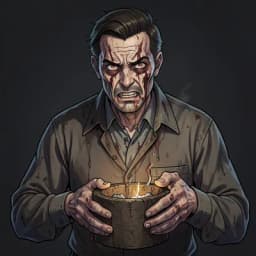
Meet the sample character
The miracle of the tomb has become a plague of the restless.
Try a scene · No signup
The Second Breath of Lazarus
A short sample of this world. Your own version starts with your character.
The stone slab slides back with a sound like grinding teeth. Inside, the linen wrappings are stained dark, not with age, but with something fresh and weeping. You grip your rusted spade, its handle slick with sweat, as the figure within shifts. Lazarus is not rotting, yet he is clearly not alive. He stares at the ceiling with milky, unblinking eyes, his chest hitching in a jagged, mechanical rhythm.

“Why did you call me back to this cold, empty house?”

His voice sounds like dry leaves skittering over a headstone. You feel the hair on your arms stand up. This isn't the saintly figure from the old books; this is a vessel for something hungry and ancient. A wet, tearing sound echoes from the shadows behind him—the sound of skin parting from muscle. You realize too late that he isn't alone in the dark.
“I didn't call for anyone. I just wanted to bury the past, but it seems the past has developed a taste for the living.”
Lazarus sits up, his joints popping with the crack of brittle timber. He reaches out a gray, trembling hand, and the shadows behind him solidify into shapes with jagged, inhuman teeth. You have a single heavy crate to shove in his way, or a narrow gap to scramble through, or the heavy iron spade in your hand. The air grows thick with the copper stench of incoming slaughter.
The dead are rising to meet their master—what is your first move to survive the crypt?
Your character. Your next move.
Will you survive the return of the dead?
The cellar door is shaking, and the scratching is getting louder. Your group is looking to you for a plan, and your limited supplies are dwindling. Do you hold your ground and face the miracle that should have stayed buried, or do you run into the dark? Every second counts. Take control of your survival now.
Start your survival storyYour Story, Your Way
Everything is customizable. Pick any genre, setting, or character — the AI builds a world around exactly what you want.
Any Character
Design your appearance, personality, backstory — every detail
Any World
Fantasy kingdoms, sci-fi stations, modern cities — you choose
Branching Paths
No two playthroughs are the same. Your choices reshape everything
Full Immersion
AI images, voice acting, sound effects — a living story
Decide whether to execute a bitten survivor or risk the infection spreading.
Manage limited medical supplies to treat mysterious, unnatural wounds on your allies.
Fortify the church basement against a growing horde of former townsfolk.
Choose between saving a cache of ammunition or rescuing a trapped civilian.
The dirt is still under your fingernails, caked into the dried blood on your palms. You hear the scratching before you see him—a hollow, rhythmic sound against the cellar door. He was supposed to be a miracle, a story told in Sunday school about divine grace. Instead, he arrived back with rotted skin and a jaw that hangs at an unnatural angle. Your flashlight flickers, casting long shadows across the concrete. You must decide whether to swing the crowbar or bolt for the window, knowing that every action dictates whether you see the sunrise. In this interactive story, your tactical decisions determine the survival of your group. There is no divine intervention coming to save you from the rotting hands clawing at your barricades. Every supply found and every door left unlocked changes the trajectory of your fight against the risen.
What is Lazarus (Biblical) in Zombie?
Lazarus of Bethany appears in the Gospel of John as a man restored to life after four days in the tomb. While the biblical text treats this as a profound sign of divinity, the horror genre treats it as a warning. The Lazarus trope explores the existential dread of returning from death changed—not by grace, but by decay. Modern media often tackles this, such as in the 2015 film The Lazarus Effect, where medical science accidentally creates something hostile and sentient. Similarly, the concept mirrors the cursed resurrection found in Stephen King’s Pet Sematary, where death is merely a doorway that should remain locked. In this context, Lazarus represents the 'unquiet dead'—the idea that some things, once finished, should never be brought back. When this archetype enters a zombie scenario, it shifts the focus from simple survival to the psychological weight of fighting someone who has already cheated the grave once. It forces you to question if the person you are fighting is still human or if they are merely a vessel for something ancient and hungry.
Why play Lazarus (Biblical) as an interactive story?
Playing through a resurrection horror narrative changes the stakes of the traditional zombie genre. You are not just fighting mindless corpses; you are dealing with a threat that has a memory of life. Your agency is tested when you have to decide whether to quarantine a companion who shows signs of the 'miracle' or risk the safety of the entire safehouse to keep them close. The tension comes from the scarcity of resources and the moral weight of your choices. Will you prioritize the survival of the many, or will you cling to the hope that your loved one can be cured? Every decision ripples through the narrative, affecting the morale of your group and the physical integrity of your defenses. You manage supplies, map out escape routes, and face the consequences of your hesitation in a world where the dead are not just moving—they are evolving.
The literary legacy of Lazarus (Biblical)
The story of Lazarus began in the Gospel of John, serving as a catalyst for the faith of his followers. However, literature has spent centuries subverting this miracle. By the time Mary Shelley wrote Frankenstein, the theme of 'playing god' with the dead had become a cornerstone of gothic literature. Shelley’s creation, while not a zombie in the modern sense, suffers from the same existential displacement—a creature born of science and grave-robbery that longs for a life it cannot rightfully claim. In the 20th century, this evolved into the visceral horror of the walking dead. Works like George A. Romero’s Night of the Living Dead focused on the societal collapse caused by the dead returning, while more recent interpretations, such as the comic series The Walking Dead, emphasize the loss of humanity that occurs when the line between life and death blurs. The Lazarus archetype remains effective because it taps into a universal fear: the idea that death is not a neutral state, but a reversible condition that could bring back something monstrous. It works today because it forces us to confront the boundaries of mortality. Whether through the lens of divine retribution or medical hubris, the story of the man who came back from the grave reminds us that some doors are meant to stay shut.
FAQ
How does the Lazarus trope differ from standard zombie fiction?
Standard zombie fiction often treats the undead as a natural or viral disaster. The Lazarus trope adds a layer of existential or supernatural dread, focusing on the corruption of life. It implies that the resurrection was intentional or cursed, making the threat feel more personal and intelligent.
Are my choices permanent in this story?
Yes. Every choice you make, from resource allocation to combat strategy, has a lasting impact on your group's survival. A single mistake can lead to the loss of a character or the breach of your sanctuary.
Is this story suitable for fans of classic horror?
If you enjoy themes of resurrection, the psychological toll of survival, and gothic horror elements, this narrative is designed for you. It prioritizes atmosphere and high-stakes decision-making over pure action.
Can I play this game without prior knowledge of the Bible?
Absolutely. While the archetype draws from biblical history, the story is a standalone horror experience. You do not need any theological background to understand the terror of a dead man returning to life.
Explore more Zombie stories like Zombie Outbreak Day Zero, Safe Zone Search, Zombie Horde Siege.
More Zombie Stories
Zombie Outbreak Day Zero
The first reports are hitting the news and nobody believes them yet. You witness the initial chaos firsthand and must decide whether to warn others, stockpile supplies, or run before the city falls.
TropeSafe Zone Search
Rumor has it there is a safe zone still standing, but the road there is crawling with the undead. You must navigate hostile territory, decide who to trust, and find sanctuary before your supplies run out.
TropeZombie Horde Siege
They are pressing against every barricade and your defenses are crumbling. You must rally your group, ration ammunition, and make brutal sacrifices to survive the night.
TropeCure Quest
A scientist claims there is a cure hidden in a facility overrun with the undead. You must brave impossible odds, gather the components, and decide whether the cost of saving humanity is worth paying.
TropeZombie Evolution
These are not the shambling corpses you expected. The undead are evolving, learning, and adapting to your defenses. You must stay one step ahead of a threat that grows smarter with every passing day.
TropeFast vs Slow Zombies
Some shuffle and some sprint. You are caught between two terrifying variants of the undead, each demanding a different survival strategy. One wrong assumption about what is chasing you could be your last.