Zombie · Interactive story
The Sands Hunger: A Ghoul Survival Tale
The desert heat is nothing compared to the hunger of what waits beneath the sand.
Start as a guest. Choose your character before the story begins.

Meet the sample character
The dunes have eyes, and they are hungry.
Try a scene · No signup
Salt and Marrow
A short sample of this world. Your own version starts with your character.
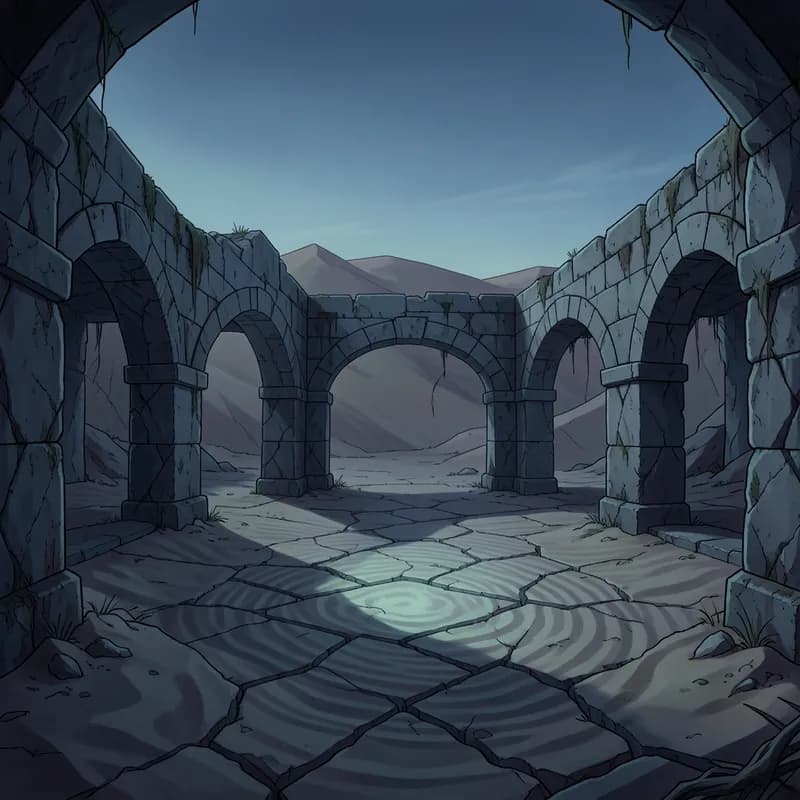
The clicking sound hits you before the movement does. In the courtyard of Al-Madiq, the sand shifts as if boiled from beneath, though the desert air remains deathly still. A stench of ozone and rancid meat hangs thick, coating your tongue. You tighten your grip on the rusted scimitar, watching a shadow near the well stretch and knot into a shape that has no business standing.

“Don't look at the eyes, Qasim. If you meet their gaze, you’re already part of their feast.”

Zaynab’s warning is thin, brittle as sun-bleached parchment. You know the stories—these creatures are not merely mindless corpses; they are shape-shifters that feed on the memories of the living. The shadow at the well reaches for a discarded pack, its fingers elongating and calcifying into jagged, serrated talons. It is not just hungry; it is observing, learning your rhythm.
“They are getting faster, Zaynab. We cannot stay in the open while they mimic our own movements.”
The creature pivots, its face a grotesque mask of shifting features—half-formed, flickering between the likeness of a fallen guard and a snarling, lupine snout. It mimics your stance, waiting for you to commit. To your left, the rusted iron gate of the storehouse hangs by a single hinge. Behind you, the open desert offers a frantic, exposed escape. The beast lunges, its form blurring into the heat haze.
The creature is mid-leap, closing the distance between you and the well. How do you react?
Your character. Your next move.
Will you survive the desert night?
The sun is setting, and the sounds of the dunes are changing. A voice calls out from the dark, sounding exactly like your lost companion. Do you answer, or do you keep your rifle raised? Your choice determines who sees the sunrise.
Begin your survival storyYour Story, Your Way
Everything is customizable. Pick any genre, setting, or character — the AI builds a world around exactly what you want.
Any Character
Design your appearance, personality, backstory — every detail
Any World
Fantasy kingdoms, sci-fi stations, modern cities — you choose
Branching Paths
No two playthroughs are the same. Your choices reshape everything
Full Immersion
AI images, voice acting, sound effects — a living story
Calculate the caloric cost of fleeing versus the risk of defending your temporary shelter.
Distinguish between the cries of a human survivor and a ghoul’s deceptive, vocal mimicry.
Manage your limited water supply while tracking the movement of a stalking, intelligent predator.
Sand grit catches in your teeth as you huddle behind a crumbling limestone wall. Outside, the wind howls, masking a wet, tearing sound. It is not the wind. It is a ghoul, a shape-shifter born from ancient Arabian nightmares, dragging a fresh kill toward the ruins. You check your canteen—half full—and the rusting bolt-action rifle in your lap. Every choice you make here carries weight. Do you risk a shot to save the scavenger trapped in the courtyard, or do you conserve your dwindling ammo and wait for the creature to lose interest? Your survival depends on reading the environment and reacting before the hunger finds you.
What is Ghoul (Arabian Folklore) in Zombie?
In Arabian folklore, the ghoul is a demonic entity that dwells in burial grounds and desolate places. Unlike the slow-moving reanimated corpses of modern cinema, these beings are cunning, often mimicking the voices of the lost to lure prey into traps. They are gluttonous, consuming the flesh of the dead—and the living. You see echoes of this terror in works like the 'One Thousand and One Nights', where travelers encounter these shape-shifting monsters, and in modern games like 'Dungeons & Dragons', where they are reimagined as paralyzing undead threats. They do not just rot; they hunt with intent, adapting their tactics to exploit human fear and desperation. Understanding the lore is critical to your survival; these are not mindless walkers, but predators that understand the layout of the ruins better than you do.
Why play Ghoul (Arabian Folklore) as an interactive story?
You are not just reading about survival; you are managing the thin margin between life and death. The ghouls adapt to your behavior. If you build a fire, they track the light. If you scavenge in silence, they listen for your heartbeat. You will decide which supplies to carry and which to abandon, whether to trust a wounded stranger who might be bait, and when to fight or flee. The pressure is constant. One wrong turn in the ruins leads to a shallow grave. Every decision locks out other possibilities, forcing you to prioritize your group's survival over your own morality.
The literary legacy of Ghoul (Arabian Folklore)
The ghoul finds its roots in pre-Islamic Arabian mythology, documented extensively in classical texts like the 'One Thousand and One Nights'. These creatures were originally viewed as a type of Jinn—supernatural beings capable of assuming various forms. Over centuries, the legend migrated from the desert to global literature. Writers like William Beckford featured them in the gothic novel 'Vathek', cementing the ghoul as a figure of horrific, insatiable consumption. Unlike the mindless zombies found in George A. Romero’s 'Night of the Living Dead', the classic ghoul is a predator with agency. It possesses a dark, perverse intelligence. Today, the ghoul remains a potent symbol of the fear of the unknown. It represents the ultimate violation of the sanctity of the grave, turning the resting place of ancestors into a hunting ground. This makes them perfect for intense, choice-driven narratives where the enemy is not just a monster, but a hunter that understands your weaknesses. They remain terrifying because they bridge the gap between supernatural entity and physical threat.
FAQ
What is a ghoul in Arabian folklore?
A ghoul is a type of Jinn that dwells in graveyards and desolate desert areas. They are known for shape-shifting and consuming human flesh, often luring victims into traps by mimicking the voices of their loved ones.
How do ghouls differ from standard zombies?
Standard zombies are typically mindless and driven by a basic urge to bite. Ghouls are intelligent, cunning, and capable of speech or deception, making them significantly more dangerous in a tactical survival scenario.
Can I use stealth to avoid combat?
Yes. Stealth is often the most viable strategy. Because ghouls are hunters, making noise or leaving a light source visible will draw them directly to your position, often leading to a fatal encounter.
Is this story suitable for fans of historical horror?
Absolutely. This story focuses on the intersection of ancient folklore and brutal, grounded survival. If you enjoy narratives that prioritize resource management and historical atmosphere, you will find this setting challenging.
Explore more Zombie stories like Zombie Outbreak Day Zero, Safe Zone Search, Zombie Horde Siege.
More Zombie Stories
Zombie Outbreak Day Zero
The first reports are hitting the news and nobody believes them yet. You witness the initial chaos firsthand and must decide whether to warn others, stockpile supplies, or run before the city falls.
TropeSafe Zone Search
Rumor has it there is a safe zone still standing, but the road there is crawling with the undead. You must navigate hostile territory, decide who to trust, and find sanctuary before your supplies run out.
TropeZombie Horde Siege
They are pressing against every barricade and your defenses are crumbling. You must rally your group, ration ammunition, and make brutal sacrifices to survive the night.
TropeCure Quest
A scientist claims there is a cure hidden in a facility overrun with the undead. You must brave impossible odds, gather the components, and decide whether the cost of saving humanity is worth paying.
TropeZombie Evolution
These are not the shambling corpses you expected. The undead are evolving, learning, and adapting to your defenses. You must stay one step ahead of a threat that grows smarter with every passing day.
TropeFast vs Slow Zombies
Some shuffle and some sprint. You are caught between two terrifying variants of the undead, each demanding a different survival strategy. One wrong assumption about what is chasing you could be your last.