
Zombie · Interactive story
When the First Undead Faces the End of Days
The creature was never meant to die. Now, it has plenty of company.
Start as a guest. Choose your character before the story begins.
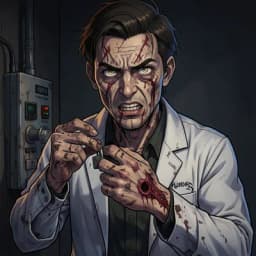
Meet the sample character
The dead don't stay buried, and neither do their creations.
Try a scene · No signup
Galvanized Rot
A short sample of this world. Your own version starts with your character.
You crouch behind a rusted turbine housing. The air tastes of ozone and copper. Beyond the partition, the shambling dead crowd the hallway, but one stands apart—a hulking figure with skin like parchment, patches of necrotic flesh held together by thick, rusted wire. It isn't mindless; it tears through the infected, its movements jerky but precise, fueled by a dying battery implanted in its neck.

“Don't blink, Silas. That thing isn't looking for a meal, it's looking for parts.”

The monster pauses, its oversized head snapping toward your hiding spot. One yellow eye flares with a dull, flickering current, scanning the shadows. It lets out a guttural sound—a low, mechanical grinding that vibrates through the floorboards. It knows you are here, and the pack of infected is closing in on both of you.
“It's not just a corpse, Jonas. It's a prototype. If we can disable it, we might harvest that battery to power our perimeter.”
The creature rips the head off a nearby walker and tosses it aside like a ragdoll. It steps closer, the heavy thud of its boots echoing against the concrete. The infected are bottlenecking at the doorway, while the monster turns its gaze directly toward your chest. You have seconds before the horde breaches the station or the creature decides you are the next spare part.
The creature is closing the distance while the infected swarm the entrance. How do you handle this?
Your character. Your next move.
Will you survive the creature's hunt?
The monster is watching from the shadows of the ruins, and his patience is wearing thin. You have the supplies, but you lack the strength to face him alone. Will you offer him a pact, or will you sharpen your blade for a fight you are destined to lose? The choice is yours, but remember: he knows more about death than any living person ever could. Start your survival story now.
Face the creature todayYour Story, Your Way
Everything is customizable. Pick any genre, setting, or character — the AI builds a world around exactly what you want.
Any Character
Design your appearance, personality, backstory — every detail
Any World
Fantasy kingdoms, sci-fi stations, modern cities — you choose
Branching Paths
No two playthroughs are the same. Your choices reshape everything
Full Immersion
AI images, voice acting, sound effects — a living story
Determine if you should trade your last medical supplies for the creature's temporary protection.
Navigate a crumbling laboratory to find a way to disable the monster's electrical enhancements.
Choose to join forces with the creation to clear a path through the undead swarm.
Decide whether to reveal your hiding spot to lure the monster into an ambush.
The smell of ozone and wet earth clings to the air, sharper than the rot of the shambling horde nearby. You crouch behind a rusted sedan, your breath hitching as you watch a hulking figure move through the fog. It is seven feet of mismatched, stitched flesh, skin gray and taut over massive bone. This is no mindless biter. As the creature tosses a decaying corpse aside with a single, brutal shove, it pauses, its mismatched eyes locking onto your hiding spot. In this landscape, the line between the living and the dead has vanished, and the first of the reanimated is now hunting in a world that has finally caught up to his misery. Every decision you make—whether to stand your ground, attempt a desperate parley, or flee into the dark—determines if you become another scrap of meat for the swarm or a footnote in the creature's grim history.
What is Frankenstein's Monster (Undead) in Zombie?
Frankenstein's monster is the original reanimated horror, first introduced in Mary Shelley’s 1818 novel, Frankenstein. Unlike the viral, mindless zombies found in modern media like The Walking Dead or World War Z, Shelley’s creation is sentient, articulate, and burdened by a profound sense of isolation. He is an artificial construct brought to life through electricity and alchemy, possessing immense strength and a tragic, vengeful soul. When placed in a zombie-infested setting, this classic archetype gains a new, terrifying dimension. The creature is no longer just a misunderstood outcast; he is an apex predator in a landscape where death is no longer permanent. His experience with reanimation makes him uniquely suited to a world overrun by the infected. In various adaptations, such as the 1931 Boris Karloff film or the gritty portrayal in the show Penny Dreadful, the monster has been depicted as both a victim of hubris and a manifestation of pure, physical rage. By placing him in a survival horror scenario, the focus shifts from his creator's guilt to the raw, tactical reality of surviving a monster who does not need to breathe, sleep, or fear the bite of the undead.
Why play Frankenstein's Monster (Undead) as an interactive story?
Playing through an interactive narrative featuring the creature forces you to confront the limits of human morality. You are not just fighting for survival; you are interacting with a being that knows the secrets of the grave. The tension arises from the uncertainty of his motives. Is he a potential ally against the mindless hordes, or is he waiting for the perfect moment to tear your defenses apart? You will face moments that demand tactical precision, such as rationing limited ammunition while the creature stalks your perimeter, or deciding whether to sacrifice your supplies to appease a being that views the apocalypse as his natural kingdom. The agency offered here allows you to test your wits against a legendary foe, where your choices dictate whether you negotiate with the monster or attempt to destroy a creature that has already defied the laws of nature. Every encounter requires you to assess his mood, his hunger, and his erratic intellect.
The literary legacy of Frankenstein's Monster (Undead)
The creature has haunted the collective imagination for over two centuries. Born from a nightmare experienced by Mary Shelley, the character was originally a reflection of 19th-century anxieties regarding scientific advancement and the sanctity of life. Throughout the 20th century, the monster transitioned from the page to the screen, most notably in James Whale’s 1931 film, which cemented the visual iconography of the flat-headed, neck-bolted giant. Later interpretations, such as the 1994 film Mary Shelley's Frankenstein, returned to the source material to emphasize his intelligence and his capacity for profound suffering. The modern reinterpretation of the monster as an undead survivor is a natural evolution of his origins. Because he was constructed from scavenged parts and animated by lightning, he occupies a middle ground between the living and the dead. This makes him the perfect antagonist or uneasy companion for a zombie-themed narrative. While the zombies represent the mindless, biological end of humanity, the monster represents the terrifying continuation of consciousness beyond the grave. He remains relevant today because he forces us to ask what it truly means to be alive. In a world where the living are dying and the dead are walking, the creature stands as a reminder that some things, once created, can never truly be put back to rest. His endurance in popular culture is a result of his duality: he is both a monster to be feared and a reflection of the human condition, stripped of all comfort and cast into a world that has no place for him.
FAQ
Is the creature in this story the same one from the original book?
The story features a version of the creature that respects his original literary roots—he is intelligent, articulate, and deeply cynical—but adapted to fit the harsh, survival-focused environment of a zombie apocalypse.
How does the creature differ from a standard zombie?
A standard zombie is a mindless, decaying biological threat. The creature is a sentient, super-humanly strong construct who can think, plan, and communicate. He is a thinking adversary, not just a biological hazard.
Can I choose to kill the creature?
Yes. Depending on your choices, your access to weaponry, and how you manage your environment, you can attempt to neutralize the monster, though doing so is significantly more difficult than dealing with standard infected.
Do I need to have read Frankenstein to play?
No. While fans of Mary Shelley’s work will appreciate the character’s depth and personality, the story provides all the context needed to understand the threat and the survival stakes.
Explore more Zombie stories like Zombie Outbreak Day Zero, Safe Zone Search, Zombie Horde Siege.
More Zombie Stories
Zombie Outbreak Day Zero
The first reports are hitting the news and nobody believes them yet. You witness the initial chaos firsthand and must decide whether to warn others, stockpile supplies, or run before the city falls.
TropeSafe Zone Search
Rumor has it there is a safe zone still standing, but the road there is crawling with the undead. You must navigate hostile territory, decide who to trust, and find sanctuary before your supplies run out.
TropeZombie Horde Siege
They are pressing against every barricade and your defenses are crumbling. You must rally your group, ration ammunition, and make brutal sacrifices to survive the night.
TropeCure Quest
A scientist claims there is a cure hidden in a facility overrun with the undead. You must brave impossible odds, gather the components, and decide whether the cost of saving humanity is worth paying.
TropeZombie Evolution
These are not the shambling corpses you expected. The undead are evolving, learning, and adapting to your defenses. You must stay one step ahead of a threat that grows smarter with every passing day.
TropeFast vs Slow Zombies
Some shuffle and some sprint. You are caught between two terrifying variants of the undead, each demanding a different survival strategy. One wrong assumption about what is chasing you could be your last.