
Zombie · Interactive story
Blood on the Pier: A Zombie Dockyard Escape
The salt air stinks of rot. Your only way out is through the dead.
Start as a guest. Choose your character before the story begins.
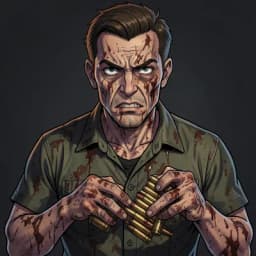
Meet the sample character
The tide is coming in, and the dead are faster than the current.
Try a scene · No signup
Rust and Brine
A short sample of this world. Your own version starts with your character.
Salt spray stings your eyes as you crouch behind a stack of shipping crates. The water at Pier 42 slaps against the pylons with a rhythmic, sickening sound that masks the closer, dragging gait of the dead. You check the fuel gauge on the flare gun, your fingers slick with sweat and engine oil. The cruiser you need is fifty yards away, but a dozen of them are blocking the gangway.

“Stop staring at the water, Hideo. If we don't move before the fog clears, those things will pin us against the hull.”

You shift your weight, the metal grating beneath your boots groaning in protest. One of the figures near the gangway stops, its head snapping toward your position with a wet, clicking sound. You tighten your grip on the crowbar, your pulse thrumming in your throat like a trapped bird. The gate to the main terminal is groaning under the weight of the horde pushing from behind.
“I’m not dying for a boat that doesn't start. Keep your head down and wait for the distraction.”
The gate screams as the hinges begin to shear. A cluster of the dead turns in unison, their dead eyes locking onto your silhouette against the crates. You have seconds before they swarm, and the only way to the boat is through the crush or across the precarious, slick loading cranes above.
The gate is bowing inward, ready to burst. How do you clear your path to the cruiser?
Your character. Your next move.
The tide is rising. Will you survive?
The engine is sputtering, and the horde is closing the distance between the shipping containers. Every second you spend debating your next move is a second closer to becoming a meal for the dead. Grab your gear, choose your vessel, and see if you have the nerves to make it past the pier.
Start your escape nowYour Story, Your Way
Everything is customizable. Pick any genre, setting, or character — the AI builds a world around exactly what you want.
Any Character
Design your appearance, personality, backstory — every detail
Any World
Fantasy kingdoms, sci-fi stations, modern cities — you choose
Branching Paths
No two playthroughs are the same. Your choices reshape everything
Full Immersion
AI images, voice acting, sound effects — a living story
Select specific tools to clear a path through rusted shipping containers and blocked gates.
Choose whether to fight or sneak past undead clusters near the refueling station.
Manage your group's limited oxygen and stamina while moving across slippery, uneven pier surfaces.
Mateo tightened his grip on the rusted crowbar. The salty wind whipped against his face, carrying the unmistakable stench of decaying flesh from the cargo holds. Ahead, a collection of fishing trawlers bobbed in the dark water—a tempting, fragile hope. But between him and those hulls stood hundreds of shuffling, moaning figures, their eyes milky and fixed on the living. Every step he took on the slick pier scraped against the metal, a siren call to the hungry crowd. In this scenario, your decisions determine whether you reach the open sea or become just another body added to the harbor’s grim tally.
What is Dockyard Escape in Zombie?
Dockyard Escape focuses on the claustrophobia of a coastal death trap. Unlike open-field survival, the docks offer limited maneuverability. You are pinned between the relentless tide of the undead and the cold, unforgiving Atlantic. Think of the tension found in the harbor sequences of The Walking Dead or the frantic, water-bound desperation in the film Train to Busan. The setting forces a specific type of resource management: fuel, keys, and silence become more valuable than heavy weaponry. In this environment, you are not just fighting monsters; you are fighting the geography of the harbor itself—the narrow gangplanks, the locked chain-link fences, and the deep, dark water that might hide something worse than the walkers. It is a test of preparation and cold, hard logic.
Why play Dockyard Escape as an interactive story?
You do not just watch the survival; you manage the inventory and the risk. Do you risk cutting through the main warehouse to find a fuel siphon, knowing the noise will draw a swarm? Or do you try to hotwire a small skiff near the edge of the pier, leaving your group exposed to the rising tide? The environment demands tactical thinking. You have to balance the weight of your gear against the speed of your movement. If you move too slowly, they catch you. If you run too fast, you lose your footing on the oily, wet concrete. Every decision carries weight: leave a teammate behind to secure the engine, or fight a losing battle to save them and risk the boat being overrun?
What makes Dockyard Escape work: the worldbuilding
A dockyard represents the final boundary between the failed civilization of the mainland and the uncertain safety of the sea. It is a place of transition, stagnation, and rot. The conflict is inherently vertical and linear, forcing players to account for elevation—cranes, shipping containers, and catwalks—as both defensive positions and potential traps. Consider the gritty, high-stakes harbor combat in World War Z or the desperate nautical escapes in the series Black Summer. These narratives succeed because they trap the protagonist in a space where there is nowhere to retreat. Sensory details are crucial: the screeching of rusted metal, the rhythmic thud of bodies against containers, and the slick, oily surface of the pier underfoot. The dockyard setting forces a shift in character archetypes; the muscle might be useless if they cannot swim, and the engineer becomes the most important person in the room. It is a setting that forces a focus on immediate, brutal survival rather than long-term planning.
FAQ
What makes the dockyard setting unique for zombie stories?
The dockyard is a choke point. Unlike a forest or city street, you are trapped against the water. This forces you to account for verticality, such as climbing cranes or hiding in containers, while managing the constant threat of being pushed into the harbor.
How do I choose the right boat?
Boats are trade-offs. A large trawler offers more protection but requires more fuel and time to start. A small skiff is fast and quiet but leaves you completely exposed to the elements and any undead that might have climbed onto the dock.
Can I defend the pier, or is escape the only option?
You can try to hold a position, but the horde is infinite. Defending the pier is a temporary measure to buy time for repairs or to clear a path. Eventually, the weight of the undead will overwhelm any static defense.
Is this setting right for me?
If you enjoy high-tension, tactical gameplay where resource scarcity and environment management are key, this setting is ideal. It is designed for those who prefer gritty, realistic survival over power fantasies.
Explore more Zombie stories like Zombie Outbreak Day Zero, Safe Zone Search, Zombie Horde Siege.
More Zombie Stories
Zombie Outbreak Day Zero
The first reports are hitting the news and nobody believes them yet. You witness the initial chaos firsthand and must decide whether to warn others, stockpile supplies, or run before the city falls.
TropeSafe Zone Search
Rumor has it there is a safe zone still standing, but the road there is crawling with the undead. You must navigate hostile territory, decide who to trust, and find sanctuary before your supplies run out.
TropeZombie Horde Siege
They are pressing against every barricade and your defenses are crumbling. You must rally your group, ration ammunition, and make brutal sacrifices to survive the night.
TropeCure Quest
A scientist claims there is a cure hidden in a facility overrun with the undead. You must brave impossible odds, gather the components, and decide whether the cost of saving humanity is worth paying.
TropeZombie Evolution
These are not the shambling corpses you expected. The undead are evolving, learning, and adapting to your defenses. You must stay one step ahead of a threat that grows smarter with every passing day.
TropeFast vs Slow Zombies
Some shuffle and some sprint. You are caught between two terrifying variants of the undead, each demanding a different survival strategy. One wrong assumption about what is chasing you could be your last.