
Witch Fiction · Interactive story
The Enchantress of Avalon: Rewrite the Arthurian Legend
Your bloodline is royalty, your craft is forbidden, and Camelot is waiting to burn.
Start as a guest. Choose your character before the story begins.
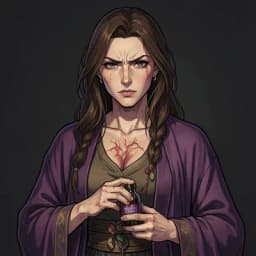
Meet the sample character
The king's crown is heavy, but his blood is colder.
Try a scene · No signup
Bitter Roots of Camelot
A short sample of this world. Your own version starts with your character.
The iron brazier sputters, casting long, frantic shadows against the limestone walls. You stand over the king, his skin pale as bleached driftwood, a jagged wound across his side refusing to knit. Outside, the tide hammers against the cliffs, a rhythmic thrum that matches the failing pulse beneath your fingertips. You reach into your satchel, fingers brushing the cool glass of a hemlock extract, wondering if the kingdom is truly worth saving.

“He has been feverish for three days, Morgana. If the healers cannot stop the rot, the crown will fall to chaos before the moon wanes.”

Gawain’s hands tremble as he grips the hilt of his sword, his loyalty a thin veneer over sheer panic. You can smell the copper of blood and the sour sweat of his fear. The king’s life is a fragile thread, and you hold the shears. One drop of your brew could either seal the vein or silence the heartbeat forever.
“Step back, Gawain. Your presence is an agitation to the humors. I will do what the court physicians cannot, provided you swear your silence regarding the ingredients.”
The knight hesitates, his gaze darting to the murky, bubbling liquid in your basin. A shadow crosses his face—suspicion, or perhaps realization. You hold the glass vial steady, the liquid within swirling like a storm, waiting for him to bow or draw his steel. The choice is no longer about his health; it is about who holds the true power in these lands.
Gawain watches your hands with narrowed eyes—will you act for the king, or for yourself?
Your character. Your next move.
The Crown Falls or Rises by Your Hand.
Seize your magic, command the knights, and decide the fate of Britain. Step into the mists of Avalon and begin your path as the true power behind the throne.
Begin Your ReignYour Story, Your Way
Everything is customizable. Pick any genre, setting, or character — the AI builds a world around exactly what you want.
Any Character
Design your appearance, personality, backstory — every detail
Any World
Fantasy kingdoms, sci-fi stations, modern cities — you choose
Branching Paths
No two playthroughs are the same. Your choices reshape everything
Full Immersion
AI images, voice acting, sound effects — a living story
Brew tinctures from wild herbs to alter the perceptions of unsuspecting knights at court.
Influence the outcome of jousting tournaments by weaving subtle charms into a champion’s armor.
Decide whether to shelter the displaced druids or leverage their ancient secrets for political gain.
Navigate complex, shifting alliances between the Round Table members and the hidden powers of Avalon.
The scent of crushed hemlock and wet stone clings to your robes as you stand on the jagged cliffs of Tintagel. Below, the tide pulls at the rocks, mirroring the turmoil rising within you. Your half-brother, Arthur, claims a throne built on steel and superstition, while you command the ancient, whispering currents of the earth. You are the architect of your own destiny, and the choices you make here ripple through the halls of the Round Table. Whether you choose to heal the king’s wounds with nightshade poultices or dismantle his legacy through subtle, biting enchantments, the power rests in your hands. This is your path to walk—every decision you weigh alters the trajectory of a kingdom teetering on the edge of oblivion.
What is Morgan le Fay in Witch Fiction?
Morgan le Fay represents the archetype of the witch as a political and magical force. Unlike the passive figures often found in medieval romance, she is a catalyst for change. In literature, she is the shadow to Merlin’s light, a practitioner of arts that are less about prophecy and more about direct intervention in the affairs of men. Think of her portrayal in Thomas Malory’s 'Le Morte d'Arthur,' where her magic is a tool for survival and retribution, or her more nuanced, complex depiction in Marion Zimmer Bradley’s 'The Mists of Avalon.' She is not merely a villain to be defeated; she is a woman navigating a world that fears her intellect and her connection to the old ways. When you step into her shoes, you are not just reciting a familiar myth—you are engaging with a character who understands that true power is found in the interplay between nature, intuition, and cold, calculated action.
Why play Morgan le Fay as an interactive story?
Stepping into the role of Morgan means balancing courtly intrigue with the visceral realities of spellwork. You face moments where the outcome is not dictated by a script, but by your own moral compass. Will you use your influence to protect the healers of the forest, or will you tighten your grip on the knights who swear allegiance to a crown that ignores the old gods? You might find yourself deciding whether to poison a rival’s wine or offer a deceptive vision that sends them into the wilderness. The tension lies in the consequences: a spell cast in haste may save a life today but cost you your standing in the court tomorrow. You manage your resources—rare herbs, hidden favors, and the shifting loyalties of the nobility—to ensure your vision for Britain comes to pass.
The literary legacy of Morgan le Fay
Morgan le Fay’s origins are as murky as the waters surrounding her mythical island. First appearing in Geoffrey of Monmouth’s 'Vita Merlini,' she was initially a healer and protector. Over centuries, her character underwent a radical transformation, morphing from a benevolent, otherworldly figure into the spiteful sorceress popularized by medieval romance writers. In modern cinema, such as the 1981 film 'Excalibur,' her dark, icy aesthetic solidified her as the quintessential witch, while television shows like 'Merlin' reimagined her as a tragic figure driven by systemic oppression. This evolution highlights our fascination with the 'othered' woman—the one who refuses to conform to the expectations of a patriarchal society. She represents the intersection of the domestic and the divine, the herbalist and the enchantress. Whether she is portrayed as a villain, an anti-hero, or a guardian of fading traditions, Morgan remains a vital figure because she embodies the tension between progress and preservation. Her story is a mirror for our own modern struggles with power, legacy, and the consequences of our choices in a world that often wants us to remain silent.
FAQ
What is the role of magic in this story?
Magic is treated as a craft rooted in the earth. You will gather ingredients, brew tinctures, and use intuition to influence the world around you, rather than relying on flashy, impossible spells.
Can I choose to support Arthur's reign?
Yes. Your choices dictate your allegiance. You may choose to be his most powerful protector or his ultimate undoing, depending on how you view the future of the kingdom.
How do my choices impact the ending?
Every action, from the alliances you build to the spells you cast, shifts the political landscape of Camelot, leading to multiple branching conclusions based on your personal agenda.
Is this story based on historical facts or mythology?
The story pulls from Arthurian mythology and medieval literature, blending folklore with interactive narrative design to create a grounded, atmospheric experience.
Explore more Witch Fiction stories like Witch Awakening, Coven Initiation, Familiar Bond.
More Witch Fiction Stories
Witch Awakening
Power surges through you unbidden — candles flare, glass shatters, and the world suddenly feels thin. Discover the magic in your blood and decide whether to embrace it or fight it before it consumes you.
TropeCoven Initiation
Thirteen witches form a circle and speak your name. The initiation rite will test your loyalty, your nerve, and your magic — and not everyone who enters the circle leaves unchanged.
TropeFamiliar Bond
A creature chooses you — a black cat, a clever raven, a silver fox — and through its eyes you see the hidden world. Your familiar is your guide, your guardian, and your deepest magical connection.
TropePotion Mastery
Every ingredient carries a secret and every brew can heal or harm. Master the art of potion-making, experiment with volatile combinations, and discover recipes that the old witches died to protect.
TropeSpell Gone Wrong
One mispronounced syllable and the spell twists into something terrible. Now you must undo the damage before the magic spirals further out of control — and before anyone discovers what you have done.
TropeWitch Trial
Accusations fly, the pyre is built, and the mob demands blood. Defend yourself in a world where real magic exists but proving your innocence might mean exposing your power — and making everything worse.