
Witch Fiction · Interactive story
The Pyre Awaits: Survive the Witch Hunt
The embers are glowing. Will you burn, or will you command the flame?
Start as a guest. Choose your character before the story begins.
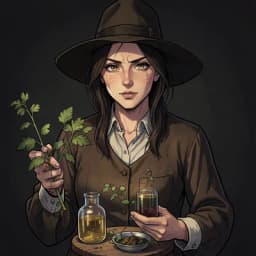
Meet the sample character
The soil remembers what the village wants to burn.
Try a scene · No signup
Drought of the Blighted Root
A short sample of this world. Your own version starts with your character.
You stand in the center of the village square, the dry earth beneath your boots cracking like parched skin. The townspeople press close, a wall of jagged breath and sour sweat. Magistrate Halloway looms on the dais, his black robes stained with the soot of previous fires, his eyes pinning you to the dirt like a moth to a board.

“The rain stopped the day you bled into the garden, Maren. Confess the pact you made with the rot.”

Your fingers ache to curl into the ground, to pull the deep subterranean water up through your own veins and let the grass burst through the cobblestones in a desperate, green explosion. To do so is to fulfill his accusation. The air smells of dry kindling and stale fear, and the wind has shifted toward the stacked wood.
“I am an herbalist, not a storm-bringer. My mother taught me the rhythm of the roots, nothing more.”
The crowd surges. A woman in the front row heaves a stone, and it strikes the base of the wood pile with a sickening thud. The magistrate raises a hand, signaling the torch-bearer. You have seconds before the flames touch the kindling, and your hidden power is the only thing that can quench the fire—or ignite it further.
The torch-bearer steps forward, flame licking the air near your skirts. How do you respond to the coming fire?
Your character. Your next move.
The Crowd is Gathering. What is Your Move?
The magistrate is reading the charges. The wood is stacked high in the square. You have one chance to shift the narrative before the final judgment is passed. Will you beg for mercy, or will you show them exactly why they should be afraid? Your defense starts now.
Face the Trial NowYour Story, Your Way
Everything is customizable. Pick any genre, setting, or character — the AI builds a world around exactly what you want.
Any Character
Design your appearance, personality, backstory — every detail
Any World
Fantasy kingdoms, sci-fi stations, modern cities — you choose
Branching Paths
No two playthroughs are the same. Your choices reshape everything
Full Immersion
AI images, voice acting, sound effects — a living story
Decide whether to hide your magical sigils or reveal them to terrify the mob.
Interrogate villagers to find out who started the rumors about your herbal remedies.
Choose to sacrifice a familiar to create a distraction during the trial proceedings.
Negotiate with the inquisitor to trade dangerous secrets for your freedom from the pyre.
The smell of wet wool and woodsmoke hangs heavy in the village square. Someone pointed a finger, and now the town council turns their gaze toward your cottage. You keep your hands tucked inside your sleeves, hiding the faint, glowing sigils etched into your palms. To admit your craft is to invite the torch; to deny it is to let them execute an innocent. You stand before the judge, the wooden platform creaking under your weight. Every word you speak in this interactive story carries the weight of a life-or-death decision. Your choices here determine if you walk away or become ashes in the wind.
What is the Witch Trial trope in fiction?
The Witch Trial trope is a staple of dark fantasy, focusing on the tension between societal fear and hidden power. It centers on the psychological torture of being hunted by those you once called neighbors. In Arthur Miller’s play The Crucible, the focus is on the hysteria that consumes a town, showing how lies can be weaponized against the innocent. In contrast, the film The Witch (2015) treats the accusation as a gateway to actual supernatural corruption, blurring the line between victim and monster. The trope works because it forces the protagonist into a corner. They must decide: do they hide their nature to appease the mob, or do they embrace their power and risk destruction? It is a battle of survival, reputation, and the morality of using magic when the world demands your silence. You are not just observing the hunt; you are living the consequences of every whispered rumor.
Why play a Witch Trial interactive story?
You are not just reading about a victim; you are the one deciding how to react to the mounting pressure. Do you feign ignorance, hoping the evidence is circumstantial? Or do you unleash a minor display of magic to intimidate the accusers, knowing it proves their point? You will face interrogation, secret meetings with allies, and the crushing weight of public opinion. Every response to the town elders changes the narrative path. Will you manipulate the jury, bribe the guards, or prepare a desperate ritual to escape when the sun sets? The tension stems from your agency; you have the power to change the outcome, but the cost of your freedom might be higher than you ever intended to pay.
Famous examples of Witch Trial in books, film, and games
The Witch Trial trope serves as an exploration of power dynamics and the fear of the unknown. In the video game Dragon Age: Inquisition, the trial of the protagonist after the explosion at the Conclave highlights the political stakes—here, magic is a controlled resource, and the trial acts as a matter of state power. Conversely, in the manga Witch Hat Atelier, the fear of magic is rooted in the preservation of tradition; when a witch's secret is compromised, the threat of erasure is immediate and absolute. These examples show that the trope is about more than just a fire; it is about the cost of being different. Whether it is historical fiction or high fantasy, the witch trial forces characters to define what their magic is worth. Is it worth your life? Is it worth the town’s safety? The trope endures because it mirrors real-world anxieties about outsiders and the misuse of authority, forcing you to confront the reality that the most dangerous weapon is often a neighbor's suspicion.
FAQ
Can I use my magic to escape during the trial?
Yes, but using magic during a trial carries risks. You might escape the shackles, but you also confirm the town's worst fears, turning the entire village against you and changing the narrative drastically.
Does the story end if I am found guilty?
A guilty verdict is a major pivot point, but it does not have to be the end. You might find ways to survive the pyre, escape imprisonment, or turn the tables on your accusers if you planned ahead.
How do my character's background choices influence the trial?
Your background, such as being a village healer or a solitary hermit, changes how the townspeople perceive you. A healer might have friends who testify, while a hermit is easier to scapegoat.
What is the primary challenge in this interactive story?
The central challenge is managing the mob's level of suspicion versus your own survival. You have to balance the need for secrecy with the desperate requirement to protect yourself and your craft.
Explore more Witch Fiction stories like Witch Awakening, Coven Initiation, Familiar Bond.
More Witch Fiction Stories
Witch Awakening
Power surges through you unbidden — candles flare, glass shatters, and the world suddenly feels thin. Discover the magic in your blood and decide whether to embrace it or fight it before it consumes you.
TropeCoven Initiation
Thirteen witches form a circle and speak your name. The initiation rite will test your loyalty, your nerve, and your magic — and not everyone who enters the circle leaves unchanged.
TropeFamiliar Bond
A creature chooses you — a black cat, a clever raven, a silver fox — and through its eyes you see the hidden world. Your familiar is your guide, your guardian, and your deepest magical connection.
TropePotion Mastery
Every ingredient carries a secret and every brew can heal or harm. Master the art of potion-making, experiment with volatile combinations, and discover recipes that the old witches died to protect.
TropeSpell Gone Wrong
One mispronounced syllable and the spell twists into something terrible. Now you must undo the damage before the magic spirals further out of control — and before anyone discovers what you have done.
TropeHereditary Magic
Your grandmother's grimoire appears on your doorstep the day she dies, and with it comes a lineage of power — and enemies — stretching back centuries. Accept the inheritance and all the danger it carries.