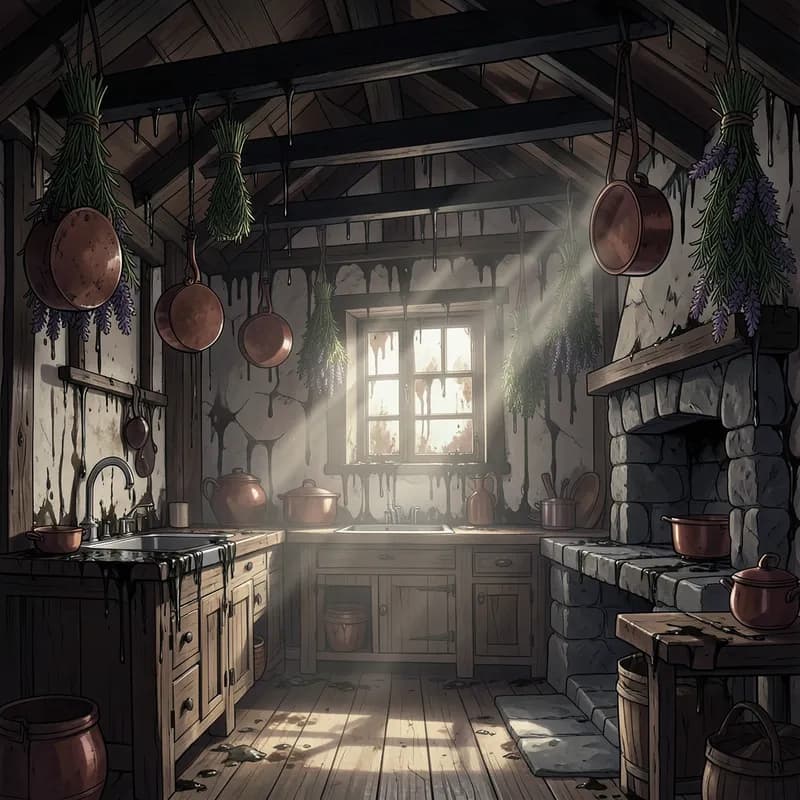
Witch Fiction · Interactive story
The Hearth of Hexes: Mastering the Enchanted Kitchen
A pinch of nightshade, a dash of intent—what will you serve the world today?
Start as a guest. Choose your character before the story begins.
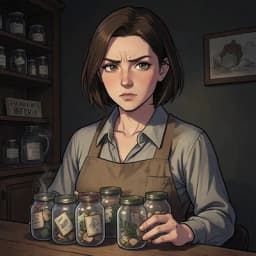
Meet the sample character
The flavor of vengeance is best served cold.
Try a scene · No signup
Saffron, Ash, and Bitter Regret
A short sample of this world. Your own version starts with your character.
The iron cauldron rattles against the grate, its heat radiating an unnatural, rhythmic pulse. You stand over the bubbling stock, your knuckles white as you grind crushed hemlock into the broth. The kitchen walls seem to lean inward, the scent of parched lavender fighting against the sharp, stinging odor of the poison you hold.

“That soup smells of funerals, Maren. Why are you cooking for the magistrate when his tax collectors burned your father's barn?”

You freeze, the wooden spoon trembling in your grip. The shadows in the corners of the room stretch toward you, hungry for the secret you keep behind your teeth. Cora’s eyes flicker to the vial of dark oil sitting atop your butcher block, her jaw tight with an unspoken accusation that threatens to unravel your carefully woven cover.
“It is a tonic for his gout, Cora. Nothing more. Do not mistake my hospitality for a lack of memory.”
The liquid in the pot turns a violent, swirling violet as if reacting to your lie. A heavy knock thunders against the cottage door—the magistrate’s guard has arrived early. You have seconds to hide the evidence of your malice before the door swings wide, exposing your work and your intentions to the men who hold your fate.
The guard’s shadow stretches across the threshold. How do you mask the scent of the hemlock?
Your character. Your next move.
Your hearth is cold. Will you light it?
The pantry is full of secrets, and the moon is rising. A desperate traveler is at your door, and the ingredients you choose will decide their fate. Will you offer healing or a lesson they won't soon forget? Step into your kitchen and begin your craft.
Start Your StoryYour Story, Your Way
Everything is customizable. Pick any genre, setting, or character — the AI builds a world around exactly what you want.
Any Character
Design your appearance, personality, backstory — every detail
Any World
Fantasy kingdoms, sci-fi stations, modern cities — you choose
Branching Paths
No two playthroughs are the same. Your choices reshape everything
Full Immersion
AI images, voice acting, sound effects — a living story
Harvest rare night-blooming herbs to determine the potency of your next restorative brew.
Choose whether to feed a starving traveler or trap them in a gluttonous feast.
Adjust the temperature of your enchanted hearth to alter the magical properties of your meals.
Decide which memories to stir into your concoctions to influence the emotions of your guests.
The copper kettle whistles, but there is no fire beneath it. Instead, it hums with a low, rhythmic vibration that matches the beating of your own heart. You stand in the center of a room where the spice rack rearranges itself based on your mood, and the flour bin never runs dry. Every movement you make, from the way you chop roots to the cadence of your stirring, alters the outcome of the meal. In this interactive story, your choices determine if the guest at your table leaves with a mended spirit or a lingering curse. The air is thick with the scent of dried sage and ozone, and the cast-iron skillet seems to wait for your command. You are not merely a cook; you are an architect of fate, using the alchemy of ingredients to bind, banish, or beckon. Before you lies a pantry stocked with bottled moonlight and crushed dragon-bone salt. How you use these supplies defines the path your magic takes.
What is Enchanted Kitchen in Witch Fiction?
The enchanted kitchen is a staple of folklore where the act of cooking is indistinguishable from the practice of high magic. It is a space where the domestic becomes the divine. Unlike traditional fantasy settings that focus on combat, this environment treats ingredients as reagents and the kitchen counter as an altar. You see this dynamic in films like Howl’s Moving Castle, where the hearth is the literal soul of the home, fueled by a fire demon that responds to the cook’s whims. Similarly, in Alice Hoffman’s Practical Magic, the kitchen serves as the emotional and mystical epicenter where spells are folded into midnight margaritas and chocolate cakes. In this setting, the stove isn't just an appliance; it is a crucible. The 'enchanted kitchen' trope relies on the idea that magic is rooted in the earth, the harvest, and the tactile nature of nourishment. It emphasizes the consequence of intent—if you stir a pot with anger, the broth will taste of ash and spite. If you stir with grace, the meal can cure a plague. It is a setting that rewards those who pay attention to detail and understand that the smallest ingredient can change the trajectory of an entire kingdom.
Why play Enchanted Kitchen as an interactive story?
Playing through an enchanted kitchen allows you to move beyond passive observation and into the role of a practitioner. You must balance the physical demands of cooking with the volatile requirements of spellcraft. When a stranger arrives at your door seeking a cure for a mysterious ailment, you aren't just selecting dialogue options; you are deciding which herbs to harvest, how to temper your heat, and what secret ingredient to fold into the dough. The tension arises from the uncertainty of your own recipes. Will the moon-blossom tea provide clarity, or will it force the drinker to speak only the truth for twenty-four hours? You face moral dilemmas where the most effective solution might be the most dangerous. Perhaps you need to curse an encroaching king, but the only way to do so is by sacrificing your own memories into the gravy. Every action has a weight, and the kitchen responds to your hesitation or your confidence. By managing your pantry and your own internal state, you influence the outcome of the narrative in ways that feel both intimate and significant.
What makes Enchanted Kitchen work: the worldbuilding
The success of this setting lies in the sensory connection between the player and the craft. To make an enchanted kitchen feel authentic, the storytelling must prioritize the tactile—the grit of salt, the sting of chopped onions, and the unnatural cold of a jar of preserved frost. This setting generates conflict through the 'Law of Equivalent Exchange.' If you want to create a meal that can resurrect a lost love, the kitchen demands a high price, perhaps your own ability to taste or your sense of direction. This creates a natural narrative arc: the acquisition of ingredients, the challenge of the recipe, and the final consumption of the magic. Works like the manga and anime Delicious in Dungeon excel by making the preparation of food a logical, yet mystical, extension of the characters' survival. They demonstrate that the kitchen is a place where nature is both respected and harvested. In your story, you should look for character types that thrive in this environment: the hedge witch who gathers from the local woods, the royal chef who hides poison in plain sight, or the wandering alchemist who cooks on an open flame under the stars. The conflict in these stories is rarely about grand wars; it is about the quiet, heavy power of changing someone’s life through a single bite. By focusing on the interplay between the mundane and the magical, you create a world where every meal is a potential turning point. The kitchen is the most honest place in the house, because there, you cannot hide your intentions. If you are malicious, the soup will curdle. If you are desperate, the bread will burn. Your character's growth is reflected in their ability to master these volatile forces.
FAQ
How does cooking actually affect the story?
Your cooking acts as a mechanic for change. A meal prepared with specific herbs might convince a guard to let you pass, or a hexed dish could weaken an enemy before a confrontation. The quality and intent of your cooking directly influence how NPCs react to you.
Can I fail at my recipes?
Yes. Magic is volatile. If your focus wavers or your ingredients are mismatched, your concoctions can backfire. A botched potion might turn your kitchen into a swamp or cause your appliances to revolt against you.
Is this setting only about peaceful domestic life?
Not at all. An enchanted kitchen is often a place of high stakes. You might be forced to cook for a dangerous fae court, where a single mistake in the seasoning could result in your imprisonment or worse.
Do I need to know about actual cooking to play?
No. The focus is on the magical properties of the ingredients and the choices you make. Whether you are a master chef or have never boiled an egg, the narrative guides you through the process of balancing your craft.
Explore more Witch Fiction stories like Witch Awakening, Coven Initiation, Familiar Bond.
More Witch Fiction Stories
Witch Awakening
Power surges through you unbidden — candles flare, glass shatters, and the world suddenly feels thin. Discover the magic in your blood and decide whether to embrace it or fight it before it consumes you.
TropeCoven Initiation
Thirteen witches form a circle and speak your name. The initiation rite will test your loyalty, your nerve, and your magic — and not everyone who enters the circle leaves unchanged.
TropeFamiliar Bond
A creature chooses you — a black cat, a clever raven, a silver fox — and through its eyes you see the hidden world. Your familiar is your guide, your guardian, and your deepest magical connection.
TropePotion Mastery
Every ingredient carries a secret and every brew can heal or harm. Master the art of potion-making, experiment with volatile combinations, and discover recipes that the old witches died to protect.
TropeSpell Gone Wrong
One mispronounced syllable and the spell twists into something terrible. Now you must undo the damage before the magic spirals further out of control — and before anyone discovers what you have done.
TropeWitch Trial
Accusations fly, the pyre is built, and the mob demands blood. Defend yourself in a world where real magic exists but proving your innocence might mean exposing your power — and making everything worse.