
Western · Interactive story
The Long Road to Redemption
The blood on your hands won't wash off, but you might still earn a clean slate.
Start as a guest. Choose your character before the story begins.
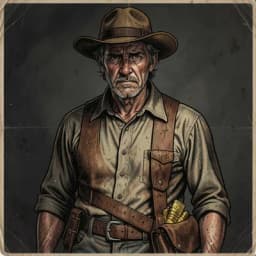
Meet the sample character
Some debts are paid in lead, others in silence.
Try a scene · No signup
Blood on the Sagebrush
A short sample of this world. Your own version starts with your character.
Dust coats your throat, dry as the gulch you have been riding through for three days. Your horse, a swaybacked mare named Bess, stumbles in the heat of the midday sun. You reach the edge of Dry Creek, a collection of rotting shacks and splintered wood. The town is silent, save for the rhythmic clanking of a broken windmill. You did not come here for trouble, but your shadow has a habit of finding it.

“I recognize that walk, Vane. It’s the same one you had when you burned the station house in Abilene.”

The weight of your Colt, tucked into your waistband, feels heavier than it did an hour ago. You keep your hands visible, palms turned toward the cracked earth. Halloway has a shotgun resting across his saddle, the barrels aimed just below your ribs. A single twitch of his finger would turn your plans for a quiet life into a shallow grave.
“That man died in Abilene, Marshal. I am just a drifter looking for a patch of dirt to work.”
Halloway spits a stream of tobacco juice into the dust, inches from your boot. He knows you are lying, and he knows the bounty on your head is enough to buy him a new life in the territory up north. Behind him, three men step out from the shade of the general store, their hands hovering near their own holsters. The tension hangs in the air like a noose.
How do you handle the Marshal before his men decide to draw?
Your character. Your next move.
Will you find peace or return to the life?
The bounty hunter is only a mile behind you, and the town ahead is your last chance for a fresh start. Every choice you make from this moment forward defines your legacy. Will you hang up your guns, or will you prove that some men can never change? Your path is waiting.
Start Your Redemption StoryYour Story, Your Way
Everything is customizable. Pick any genre, setting, or character — the AI builds a world around exactly what you want.
Any Character
Design your appearance, personality, backstory — every detail
Any World
Fantasy kingdoms, sci-fi stations, modern cities — you choose
Branching Paths
No two playthroughs are the same. Your choices reshape everything
Full Immersion
AI images, voice acting, sound effects — a living story
Choose whether to draw your weapon or de-escalate a tense standoff in a saloon.
Decide if you will protect a small town at the risk of exposing your identity.
Manage your reputation with local lawmen who remember the crimes you committed years ago.
Confront former gang members who demand you return to your old life of crime.
Dust chokes the air as your horse stumbles onto the main street of a town that doesn't want you. Your saddlebags are light, your canteen is dry, and the holster at your hip feels heavier than it did yesterday. For years, you rode with men who measured worth in stolen gold and terrified whispers. Now, you are alone, and the law is looking for a ghost you left behind. In this interactive story, the decisions you make dictate whether you find peace or a shallow grave. Every stranger you meet could be a friend or a bounty hunter looking to collect on your past. When a local sheriff asks for your help, you must decide if you are the man you were, or the man you want to become. Your iron is quick, but your conscience is slower, and the frontier is a harsh teacher for those trying to change their ways.
What is Outlaw Redemption in Westerns?
The outlaw redemption trope focuses on the transition from villain to reluctant hero. It centers on a character burdened by a violent history, attempting to find a path toward morality in an unforgiving landscape. Unlike traditional hero narratives, this trope highlights the internal tension between old habits and new desires. The protagonist is rarely a saint; they are a survivor attempting to outrun their reputation. In Clint Eastwood’s film 'Unforgiven', William Munny represents the archetype perfectly. He is a retired killer who tries to shed his past to support his family, only to find that the world refuses to let him forget who he was. The trope functions because it tests whether a person can truly change, or if their history is a cage they can never escape. The tension arises not just from external threats, but from the protagonist’s fear that their own nature will eventually resurface.
Why play Outlaw Redemption as an interactive story?
Playing as a reformed outlaw forces you to reconcile your survival instincts with your newfound morals. You are not a hero by default; you are a criminal fighting against your own conditioning. The agency you possess allows you to test the limits of forgiveness. When an old associate rides into town to pull you back into the life, do you turn them in to the law, or do you try to convince them to lay down their guns? You encounter moments where violence is the easiest solution, but choosing peace might cost you your life. You manage your reputation in towns that know your face from 'Wanted' posters. Every choice you make—whether to defend a defenseless shopkeeper or keep your head down to avoid detection—shapes the ending of your tale. The thrill lies in the constant threat of your past catching up to you, forcing you to prove that you are not the person you used to be.
Famous examples of Outlaw Redemption in books, film, and games
The theme of the repentant gunman appears across various media, each adding unique layers to the struggle for change. In the video game 'Red Dead Redemption', Arthur Morgan’s struggle is the defining example of the trope. Arthur begins as an enforcer for a gang, but as he faces his own mortality, he makes conscious efforts to help those he once exploited. His redemption is not about being a hero, but about finding a way to do right by the few people left who deserve it. It is a slow, painful process of unlearning a lifetime of cruelty. Similarly, in the film 'The Proposition', Charlie Burns is forced into an impossible choice to save his younger brother from the gallows. He must hunt down his older, more psychotic brother, showcasing the idea that redemption often requires betraying the only community the outlaw has ever known. Finally, in Louis L’Amour’s novels, characters like Hondo Lane often find themselves trying to leave behind a violent past to settle down, only to be pulled back into conflict by the needs of others. What makes the trope endure is the universal desire to believe that no matter how far someone has fallen, they can still choose a better path. It is the hope that actions, not just words, can rewrite a person’s legacy.
FAQ
Can I choose to return to my life of crime?
Yes. The path you take is entirely up to you. While the narrative encourages seeking redemption, you can revert to your old ways if you find that the outlaw life suits you better than the path of righteousness.
How does my reputation affect the game?
Non-player characters react to your history. If you have been seen committing crimes, townspeople may lock their doors or call the sheriff when you arrive. Conversely, performing acts of mercy can lead to unexpected allies.
Is this game suitable for those who prefer slow-burn stories?
Absolutely. The focus is on the psychological weight of your past and the slow, difficult process of changing your character. The pacing allows for introspection and tension-filled conversations.
Do I need to know Western history to play?
No. The story provides all the context needed to understand the era, the dangers of the frontier, and the stakes of your choices. You can jump right in and start shaping your story.
Explore more Western stories like Sheriff Showdown, Gold Rush Fever, Train Robbery.
More Western Stories
Sheriff Showdown
The badge on your chest makes you the only thing standing between a lawless town and chaos. When the outlaws ride in, you must rally the townsfolk or face the gang alone in a showdown on Main Street.
TropeGold Rush Fever
Gold has been found in the hills, and the world has gone mad. You join the stampede of dreamers, swindlers, and desperados chasing fortune in a lawless camp where a nugget of gold can buy you everything or cost you your life.
TropeTrain Robbery
The iron horse carries a fortune in gold, and your gang has a plan to take it. Thunder down the tracks on horseback, board the moving train, and pull off the heist before the Pinkertons close in.
TropeFrontier Justice
Out here, the nearest judge is three days' ride away, and justice cannot wait. You take the law into your own hands, but every verdict you pass blurs the line between righteousness and tyranny.
TropeCattle Drive
A thousand head of cattle, a hundred miles of hostile territory, and a crew of cowboys who may not all make it. You lead the drive through storms, rustlers, and river crossings where one wrong move means disaster.
TropeBounty Hunter Chase
Dead or alive, the poster says, and you intend to collect. You track your quarry across sun-scorched deserts and through hostile towns, but the closer you get, the more you question whether justice is really what you are serving.