
Sword & Sorcery · Interactive story
Steel, Dust, and No Master
Your blade is sharp, your coin is low, and the horizon is hungry.
Start as a guest. Choose your character before the story begins.
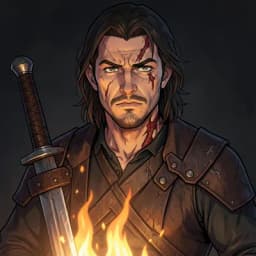
Meet the sample character
Rain, steel, and a debt you cannot pay.
Try a scene · No signup
The Last Copper at The Rusty Hilt
A short sample of this world. Your own version starts with your character.
You push the door to The Rusty Hilt, the storm howling at your back. Rain clings to your cloak, smelling of wet wool and rot. Inside, the air is thick with the scent of sour ale and unwashed bodies. A man with a jagged scar slicing through his left eyebrow watches you, his fingers dancing nervously near the pommel of his shortsword.

“You aren't from around here, stranger. And people who show up in this weather usually have something to hide or nothing left to lose.”

You feel the weight of your steel against your hip, a comforting, familiar drag. You haven't had a warm meal in three days, and your coin purse is lighter than a ghost's breath. The tavern goes silent, the patrons waiting to see if you are a traveler looking for a bed or a killer looking for a payday.
“I am just a man looking for a stool, not a fight. Though if the ale is as bad as your hospitality, I might be convinced to find somewhere else to bleed.”
The scarred man stands, his chair scraping against the stone floor like a dying animal. He reaches for his weapon, and three other men at the back table start to rise, their hands resting on heavy, iron-bound cudgels. The tavern door swings shut behind you, locking with a metallic click that echoes through the room. You are trapped.
The room is closing in; the men are moving toward you. How do you handle the bottleneck?
Your character. Your next move.
Steel, Blood, and Your Own Terms
The road is calling. A village waits for a savior, or a bandit king waits for a challenger. Will you become a local legend or just another corpse in the ditch? Grab your hilt and step into the fray to see where your path leads.
Begin Your JourneyYour Story, Your Way
Everything is customizable. Pick any genre, setting, or character — the AI builds a world around exactly what you want.
Any Character
Design your appearance, personality, backstory — every detail
Any World
Fantasy kingdoms, sci-fi stations, modern cities — you choose
Branching Paths
No two playthroughs are the same. Your choices reshape everything
Full Immersion
AI images, voice acting, sound effects — a living story
Decide whether to protect a village or accept a bribe to look away.
Manage the condition of your blade and armor during long, arduous travels.
Navigate complex social interactions where a wrong word leads to a duel.
Choose your combat style, from precise dueling techniques to brutal, efficient brawling.
Rain slicks the mud of a nameless village. You stand at the tavern door, hand resting on the pommel of a battered steel longsword. A group of local toughs is shaking down a merchant, their blades drawn, their intentions clear. Nobody else in this room moves, but you have no home to return to and no lord to answer to. Do you intervene and risk a fight for a stranger, or do you finish your ale and move on? In this interactive story, your choices determine if you become a local hero, a feared mercenary, or a ghost who leaves only whispers behind. Every step you take on the road changes your reputation and the state of your gear, making your survival entirely dependent on your judgment.
What is The Wandering Swordsman in Sword & Sorcery?
The wandering swordsman is a fixture of folklore. Whether called a ronin, a sellsword, or a drifter, this character lives outside the rigid hierarchies of feudal systems or city-states. They are defined by their mobility and their autonomy. Unlike a king or a knight bound by oaths, the drifter is answerable only to their own code—or the lack thereof. Think of Miyamoto Musashi in Eiji Yoshikawa’s classic novel, the nameless master of Akira Kurosawa’s Yojimbo, or Geralt of Rivia in The Witcher books. These figures function as catalysts in the stories they occupy. They arrive in a static environment, disturb the status quo with a blade, and then vanish before the dust settles. This archetype thrives on the tension between isolation and the sudden, violent necessity of contact with others. It is a story of the individual against the system, where the only thing keeping you alive is the speed of your draw and the sharpness of your steel.
Why play The Wandering Swordsman as an interactive story?
Playing as a wandering swordsman places the weight of every decision on your shoulders. You are not just reading about a hero; you are managing the resources of a life lived on the road. You must decide when to draw your blade and when to sheath it. Is it worth fighting a corrupt magistrate for a pittance, or does that lead to a bounty on your head? You might encounter a village under siege by bandits, or a lonely ruin holding a cursed artifact. Each choice ripples outward, affecting your reputation, your gear, and your path forward. Will you seek redemption for a past mistake, or lean into the cold brutality of the road? The tension comes from knowing that in a world without laws, your moral compass is the only thing protecting you from becoming the very villain you despise.
The psychology of The Wandering Swordsman: why readers fall for this character
The appeal of the wandering swordsman lies in the fantasy of absolute independence. In a world where most people are tied to land, family, or lords, the drifter represents the ultimate form of agency. They own nothing but their skill. This archetype reflects the human desire to escape the constraints of societal obligation. We see this in the contrast between characters like Clint Eastwood’s Man with No Name, whose silence is a weapon, and the more professional, weary sellswords found in tabletop games. The wandering swordsman acts as a mirror to the environments they visit. In a corrupt city, they might be the only honest force, even if they are a criminal themselves. In a peaceful land, they are a harbinger of violence. This duality—the sword as a tool of protection and a tool of destruction—is why the archetype remains a staple. It forces you to confront the reality that freedom is often just another word for being alone. You aren't just a fighter; you are a witness to the decay of the world, choosing which fires to extinguish and which to feed.
FAQ
What defines the wandering swordsman archetype?
It is a character who lacks a master, home, or permanent allegiance. They are defined by their mobility, their mastery of combat, and their isolation from societal structures.
Can I choose my own combat style?
Yes. Your decisions regarding training, equipment choices, and past experience will dictate how you handle conflicts, whether through stealth, speed, or raw strength.
Are there consequences for my actions?
Every interaction, from refusing a drink in a tavern to killing an enemy in a dispute, changes how townsfolk react to you and whether you find allies or enemies later.
Is this story strictly combat-focused?
While combat is a major component, you will also need to manage resources, negotiate with local leaders, and decide when it is safer to avoid conflict entirely.
Explore more Sword & Sorcery stories like Barbarian Quest, Ancient Tomb Raid, Sorcerer Duel.
More Sword & Sorcery Stories
Barbarian Quest
You come from the wild lands with nothing but a blade and iron will. Carve your path through civilized treachery, ancient ruins, and sorcerous enemies who underestimate the fury of the uncivilized.
TropeAncient Tomb Raid
A forgotten king's tomb lies unsealed, its corridors lined with traps, curses, and treasures that haven't seen daylight in millennia. Plunder the dead — if you can survive what guards them.
TropeSorcerer Duel
Two wielders of dark power face off in a contest of will, cunning, and raw magical force. Challenge a rival sorcerer to a duel where the loser pays with far more than their life.
TropeMercenary Contract
Gold is gold, and you don't ask questions — until the job turns out to be far darker than the contract described. Navigate double-crosses, moral dilemmas, and enemies on every side.
TropeGladiator Arena
The crowd roars and the gate rises. Fight beasts, warriors, and sorcerers on the blood-soaked sand, winning your freedom one kill at a time — or die entertaining the masses.
TropeCursed Blade
The sword whispers to you, promising victory at a terrible cost. Wield a weapon of legendary power that feeds on your soul, and discover whether you master the blade or it masters you.