
Sword & Sorcery · Interactive story
Hammer of the Gods: The Battle Priest
Prayers are whispered in the temple, but steel speaks the final word.
Start as a guest. Choose your character before the story begins.
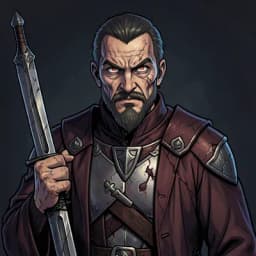
Meet the sample character
Faith is a weapon, provided you have the arm to wield it.
Try a scene · No signup
Iron and Incense
A short sample of this world. Your own version starts with your character.
You press your back against the weeping stone of the catacombs. The smell of grave dirt and ozone hangs thick, choking the air. Your warhammer, heavy with dried blood, hums with fading divine light. Before you, the shattered remains of the skeleton knight begin to knit themselves back together with a sickening, rhythmic grinding sound.

“Joran, my leg... I cannot feel my feet anymore. Please, do not let them reach me.”

You shift your weight, the heavy iron plates of your armor clanking against the wet floor. Every instinct demands you finish the knight before it fully rises, but Milla’s arterial spray is pooling dangerously close to the altar. If you move toward her, you leave your back exposed to the knight's rusted blade.
“Silence, girl. Keep your grip on the rosary. I will not let the dark take you while I draw breath.”
The knight stands, its ribs snapping into place like clockwork. It raises a jagged longsword, its hollow eye sockets fixed squarely on the bleeding initiate. You have one swing of the hammer left in you before your channeled light vanishes entirely. The creature lunges, and you must decide whether to save the life at your feet or shatter the source of the rot.
The knight is closing the distance; will you prioritize the kill or the initiate?
Your character. Your next move.
Will you be a shield or a hammer?
Your temple has fallen, and the shadows are closing in. The god you serve demands action, but the choice of how to respond belongs to you. Will you save the survivors of the raid, or track the monsters to their lair and finish the job? Step into the vestments of the war cleric and write your own legend.
Begin your holy crusadeYour Story, Your Way
Everything is customizable. Pick any genre, setting, or character — the AI builds a world around exactly what you want.
Any Character
Design your appearance, personality, backstory — every detail
Any World
Fantasy kingdoms, sci-fi stations, modern cities — you choose
Branching Paths
No two playthroughs are the same. Your choices reshape everything
Full Immersion
AI images, voice acting, sound effects — a living story
Choose between healing the wounded or channeling divine wrath to execute the unholy.
Manage your limited faith reserves during intense combat scenarios against monstrous threats.
Determine the public reputation of your order through your actions on the road.
Face moral dilemmas where the 'right' choice leads to dire tactical consequences.
Blood stains the white linen of your vestments, a stark contrast to the golden sigil of your order. You stand over the fallen, the heavy iron head of your mace vibrating with the residue of a smiting blow. A village child cowers behind a rotted oak barrel, eyes wide with terror as the shadow of a corrupted demon looms in the doorway. Your faith dictates mercy, yet the stench of sulfur and the sight of torn flesh demand immediate, brutal retribution. You reach for your prayer beads, but your grip tightens on your weapon instead. Every decision you make determines whether you remain a shepherd of the light or become a butcher in the name of a silent deity. The path you walk is carved in stone and stained with the grime of the battlefield, and your next action will decide who lives to see the dawn.
What is The Battle Priest in Sword & Sorcery?
The Battle Priest is a classic archetype that occupies the uncomfortable space between the sanctuary and the slaughterhouse. Unlike a traditional mage who relies on distance or a knight who fights for secular glory, this character serves a higher power that often demands contradictory actions. They are the frontline executors of divine will, equipped with heavy armor, blunt weaponry, and incantations that can either mend a severed limb or burn an enemy to ash. This archetype is famously exemplified by the Clerics of the Dungeons & Dragons universe, who must balance the preservation of life with the necessity of destroying abominations. In other settings, such as the Templars in Dragon Age, the character often struggles with the political and moral weight of their religious institution. Their power is not earned through study or birthright, but granted through devotion, making their internal struggle with that faith the primary engine of their character development. They represent the conviction that sometimes, the only way to protect the innocent is to become a weapon against the wicked.
Why play The Battle Priest as an interactive story?
Playing as a warrior of the cloth forces you to confront the grim reality of morality in a broken land. You are not a passive observer; you are the instrument of your god. When a plague-ridden town begs for help, do you exhaust your mana to heal the dying, leaving yourself defenseless against the inevitable bandit raid? Or do you prioritize the destruction of the source of evil, knowing that those you leave behind will perish? These moments of tension define your character. You will manage the resource of your faith, choosing when to call upon the divine and when to rely on the cold, hard steel in your hands. The consequences of your choices ripple through the narrative, changing how NPCs perceive you and how the world reacts to your presence. Every encounter is a test of your resolve.
The psychology of The Battle Priest: why readers fall for this character
The appeal of the Battle Priest lies in the inherent friction of their existence. Humans are drawn to the conflict of duality: the desire to be a healer pitted against the requirement to be a killer. This archetype allows readers to explore the limits of conviction. When you play a character like the Crusader in the Diablo series, you are not just fighting demons; you are fulfilling a lifelong penance for the sins of your predecessors. This provides a clear, driving motivation that makes every swing of the hammer significant. Similarly, characters like the Inquisitors in various dark fantasy settings showcase the danger of certainty. What happens when the divine commands something that defies human morality? The Battle Priest archetype activates our fascination with authority and the potential for corruption. We wonder if we would remain righteous if our god spoke directly to us, or if we would lose our humanity in the process. It is a power fantasy tempered by the crushing weight of responsibility. Unlike the rogue who lives for themselves or the warrior who seeks fame, the Battle Priest is bound by an oath. The drama arises from the moments when that oath is put to the test, forcing the character to decide if they serve the deity, the people, or their own interpretation of justice. This tension provides a narrative engine that keeps the story moving, ensuring that every battle has stakes beyond just survival.
FAQ
What is the primary difference between a Battle Priest and a standard Paladin?
While both use divine power, the Battle Priest typically focuses on the intersection of religious study and combat, often acting as a bridge between the clergy and the military. Paladins are usually defined by a strict, personal code of honor, whereas a Battle Priest is defined by their relationship with a church or deity's specific dogma, which can be more complex or even morally gray.
How does the faith mechanic work in these stories?
Faith often acts as a limited resource, similar to mana or stamina. You may need to spend it to perform miracles, such as healing wounds or shielding allies, but using too much can leave you vulnerable in physical combat. Decisions you make during the story can increase or decrease your standing with your deity, affecting the strength of your abilities.
Can I play a Battle Priest who questions their own god?
Yes. The conflict between your character's personal morality and the demands of their faith is a core theme. You can choose to interpret holy texts in ways that defy the status quo, which will lead to different narrative branches and potential conflicts with your own order.
Is this archetype suitable for dark fantasy settings?
Absolutely. The Battle Priest is particularly effective in dark fantasy, where the line between good and evil is blurred. The archetype thrives when the world is hostile and the 'holy' path is difficult, dangerous, and often misunderstood by the common folk.
Explore more Sword & Sorcery stories like Barbarian Quest, Ancient Tomb Raid, Sorcerer Duel.
More Sword & Sorcery Stories
Barbarian Quest
You come from the wild lands with nothing but a blade and iron will. Carve your path through civilized treachery, ancient ruins, and sorcerous enemies who underestimate the fury of the uncivilized.
TropeAncient Tomb Raid
A forgotten king's tomb lies unsealed, its corridors lined with traps, curses, and treasures that haven't seen daylight in millennia. Plunder the dead — if you can survive what guards them.
TropeSorcerer Duel
Two wielders of dark power face off in a contest of will, cunning, and raw magical force. Challenge a rival sorcerer to a duel where the loser pays with far more than their life.
TropeMercenary Contract
Gold is gold, and you don't ask questions — until the job turns out to be far darker than the contract described. Navigate double-crosses, moral dilemmas, and enemies on every side.
TropeGladiator Arena
The crowd roars and the gate rises. Fight beasts, warriors, and sorcerers on the blood-soaked sand, winning your freedom one kill at a time — or die entertaining the masses.
TropeCursed Blade
The sword whispers to you, promising victory at a terrible cost. Wield a weapon of legendary power that feeds on your soul, and discover whether you master the blade or it masters you.