
Regression Fiction · Interactive story
The Catalyst Character: Rewrite the Moment Everything Changed
They don't know they are the reason the world burns. Will you stop them?
Start as a guest. Choose your character before the story begins.
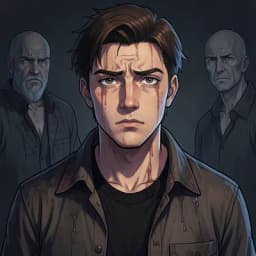
Meet the sample character
The lighter in his pocket is still cold.
Try a scene · No signup
Smoke on the Platform
A short sample of this world. Your own version starts with your character.
The fluorescent lights flicker, casting long, sickly shadows across the subway platform. You watch him—Kenji—adjusting his glasses with a trembling hand. In your memories, this man is a monster, the accidental arsonist whose clumsy stumble leads to a horrific explosion. Here, he is just a nervous student, clutching a briefcase that currently holds nothing but textbooks and a cheap, plastic lighter.

“Excuse me, do you have the time? I’m terrified I’m going to miss my final exam.”

Your stomach turns. The politeness in his voice is a jagged blade. You know that in seventy-two hours, his bag will catch the sparking wire on the train, and the panic that follows will turn this station into a crematorium. His life hangs on a precipice, and your hand twitches, itching to either shove him away from his destiny or extinguish his future entirely.
“You have plenty of time, Kenji. But maybe you should skip this train. It’s not worth the risk.”
Kenji blinks, his brow furrowing in confusion at the sound of his own name from a stranger’s lips. He reaches into his pocket, his fingers brushing against the lighter. The train whistle screams in the distance, growing louder, signaling the arrival of the vehicle that will end everything. You have seconds to act, and the choice you make will either save this city or seal your own hollow fate.
How do you handle the man destined to become the catalyst for a catastrophe?
Your character. Your next move.
Rewrite the history that ruined your life.
The clock is ticking toward the moment the world falls apart. You have the knowledge to change the outcome, but the Catalyst is standing right there, waiting for your move. Will you be the savior who guides them, or the shadow that stops them permanently? Your choices determine if the future stays broken or begins anew.
Claim Your Second ChanceYour Story, Your Way
Everything is customizable. Pick any genre, setting, or character — the AI builds a world around exactly what you want.
Any Character
Design your appearance, personality, backstory — every detail
Any World
Fantasy kingdoms, sci-fi stations, modern cities — you choose
Branching Paths
No two playthroughs are the same. Your choices reshape everything
Full Immersion
AI images, voice acting, sound effects — a living story
Interrogate the Catalyst to discover the specific hidden motive behind their future betrayal.
Manipulate social circles to isolate the Catalyst before they gain the power to act.
Attempt to mentor the Catalyst, guiding them toward a path that avoids historical catastrophe.
Decide if some individuals are beyond redemption and must be removed from the timeline.
The ink on the parchment is fresh, and the wine in your glass has not yet soured. Across the banquet hall, Hwan-su laughs, entirely oblivious to the fact that his careless remark tonight triggers the border war that claims your family in three years. You remember the smell of smoke and the weight of a sword that failed to protect anyone. Here, your choices dictate whether that future ever comes to pass. Do you poison his drink, befriend him to change his perspective, or expose his secret before he even speaks it? The past is a fragile, shifting landscape, and you have the map to its most dangerous turning point. In this interactive story, the weight of history rests entirely on how you handle the one person who sparks the end.
What is The Catalyst Character in Regression Fiction?
The Catalyst Character is the fulcrum upon which an entire narrative pivots. They are rarely the villain in the classic sense; often, they are simply a person in the wrong place at the wrong time, or someone whose singular, shortsighted ambition ignites a powder keg. In the film The Butterfly Effect, the protagonist realizes that his own childhood choices are the catalysts for his present-day misery. In regression fiction, you encounter this person before the damage is done. They are the naive noble whose treaty proposal sparks a genocide, or the loyal knight whose hidden insecurity leads to a coup. By focusing on the Catalyst, you are not just fighting a war—you are auditing the very architecture of tragedy. You see them eating, breathing, and dreaming, unaware that their next breath could be the spark for a global catastrophe. It is a unique tension: you know the gravity of their future actions, but they remain a person with agency, feelings, and motivations that you must navigate if you hope to alter the course of history. This archetype turns the narrative into a tactical puzzle where you must balance your cold, hard knowledge of the future against the messy, human reality of the present.
Why play The Catalyst Character as an interactive story?
In this interactive story, you are not just a player; you are a surgeon operating on the timeline. The tension lies in the distance between your knowledge and their innocence. If you treat them as a monster, you might alienate them and inadvertently cause the very betrayal you seek to prevent. If you treat them as a friend, you risk becoming complicit in their eventual downfall. You will face moments where you must decide whether to manipulate their relationships, steer them toward a different career path, or simply remove them from the board entirely. Every conversation is a gamble. Do you challenge their ideology at a public hearing, or do you quietly sabotage their influence behind the scenes? The agency you possess transforms the narrative from a fixed tragedy into a tactical puzzle where morality is often the first casualty. You are the only one who knows the cost of their next decision, and the pressure of that secret defines every interaction.
The psychology of The Catalyst Character: why readers fall for this character
This archetype embodies the ultimate fantasy of regret: the desire to reach back and stop a disaster at the source. It resonates because it shifts the focus from the grand scale of war to the intimacy of the individual. In Steins;Gate, the protagonist constantly grapples with the people whose minor, seemingly inconsequential choices lead to world-ending consequences, highlighting the terrifying fragility of cause and effect. Similarly, in the Re:Zero light novels, the protagonist must reconcile with the various catalysts who turn his life into a cycle of suffering, often finding that the 'villains' are just people reacting to their own broken circumstances. This archetype forces you to confront the 'Great Man' theory of history—do wars happen because of systems, or because one person made a bad choice? By placing the player in the room with the Catalyst, the game removes the safety of hindsight. You are forced to empathize with the person you hate. You see their fears, their unrequited loves, and their pettiness. The fantasy is not just about changing the world; it is about the power of judging another person’s soul before they have even committed their crime. It forces a difficult question: if you punish someone for a crime they have not committed yet, are you the hero, or have you become the new catalyst for the tragedy? This moral ambiguity is what keeps readers and players returning to the genre, constantly searching for that one perfect timeline where the tragedy is averted without losing one's own humanity.
FAQ
What makes the Catalyst Character different from a standard villain?
A villain is an active antagonist working against you. A Catalyst is often a bystander or a well-meaning person whose single, specific action creates a domino effect. They don't want to destroy the world; they just want to solve their own minor problem, unaware of the carnage that follows.
Can I change the timeline without killing the character?
Yes. Many paths allow you to steer the Catalyst toward different life choices, changing their trajectory so they never reach the point where they trigger the original tragedy.
Does my future knowledge always lead to a better outcome?
Not necessarily. Sometimes, forcing a change creates an even worse 'butterfly effect' where a new, more dangerous Catalyst emerges in the vacuum you created.
Is this game strictly about combat or political maneuvering?
It is both. You will engage in dialogue, social engineering, and strategic planning. The conflict is often against the character's own personality flaws rather than their physical strength.
Explore more Regression Fiction stories like Death and Return, Future Knowledge Advantage, Changed Timeline.
More Regression Fiction Stories
Death and Return
You die — violently, suddenly, unfairly — and then you open your eyes in the past, alive and whole with every memory of what killed you. The second chance is real, the pain was real, and you have no intention of dying the same way twice.
TropeFuture Knowledge Advantage
You know the stock that will skyrocket, the disaster that will strike, and the betrayal that has not happened yet. Your knowledge of the future is the ultimate cheat code, but using it without revealing how you know is a constant, exhausting balancing act.
TropeChanged Timeline
You change one thing and the ripples rewrite everything you thought you knew. The future you came from is dissolving, replaced by a new timeline where your knowledge is increasingly unreliable and the people you loved may become strangers.
TropeButterfly Effect Regression
You fix one problem and create three more, each small change cascading into consequences you never predicted. The butterfly effect turns your careful plans into chaos, and you begin to understand that the past is not a machine you can simply adjust.
TropeRegression Romance
You are reunited with someone you lost, but they do not know you yet, and the love you shared exists only in your memory. You must fall in love again from the beginning while carrying the weight of a future they will never remember, and the relationship is both familiar and heartbreakingly new.
TropePreventing the Catastrophe
You came back for one reason — to stop the event that destroyed everything. You have the knowledge, the motivation, and the desperate urgency of someone who has already lived through the worst, but the catastrophe has roots deeper than you realized and preventing it may require sacrifices you are not prepared to make.