
Regression Fiction · Interactive story
The Bitter Cost of a Second Chance
The date on your phone is years before the tragedy. Do you try again?
Start as a guest. Choose your character before the story begins.

Meet the sample character
Rewriting the bullet that claimed your best friend.
Try a scene · No signup
The Rainfall Calculation
A short sample of this world. Your own version starts with your character.
The rain hasn't changed. It hits the metal with the same rhythmic drumming that echoed in your ears for ten years of nightmares. You stand on the fire escape, hands buried deep in your coat, watching Kenji check his pistol for the third time. Every movement he makes is a ghost you haven't seen in a decade, vibrant and alive, oblivious to the fact that his pulse is scheduled to stop in precisely eighty-two minutes.
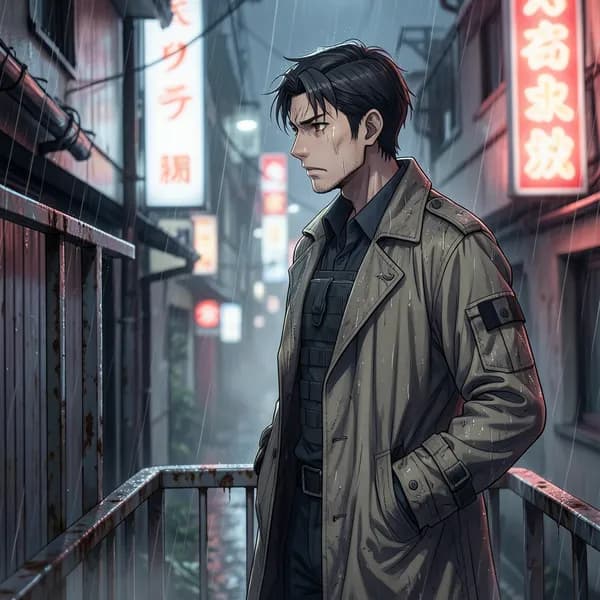
“Stop staring at me like I’m already dead, Hideo. We do the job, we get the credits, and we’re out of the city by dawn. Relax.”

Your heart hammers against your ribs, a frantic rhythm that betrays your composure. You know the exact trajectory of the sniper’s round that will tear through his chest during the breach. If you move now, you shatter the timeline, but if you stay silent, the cycle of grief begins again. The weight of his life sits entirely in the palm of your hand, heavy and trembling.
“We aren't going in tonight. I saw the layout, Kenji—it’s a trap, and if we step through that door, we don't come back out.”
Kenji freezes, his thumb hovering over the safety. He looks at you with a mix of confusion and mounting irritation, the kind of look that precedes a permanent fracture in your partnership. The clock on the nearby tower chimes, marking the beginning of the end. You have seconds to commit to your lie or watch him walk straight into the kill zone.
How do you stop him from walking into his own grave?
Your character. Your next move.
Rewrite the tragedy before it happens.
The funeral is still months away, but you know who will be in the casket. You have the knowledge to change the outcome, but the timeline is fighting back. Will you risk everything to save them, or will you let history repeat itself? Step into the past and make your move.
Start Your RegressionYour Story, Your Way
Everything is customizable. Pick any genre, setting, or character — the AI builds a world around exactly what you want.
Any Character
Design your appearance, personality, backstory — every detail
Any World
Fantasy kingdoms, sci-fi stations, modern cities — you choose
Branching Paths
No two playthroughs are the same. Your choices reshape everything
Full Immersion
AI images, voice acting, sound effects — a living story
Choose to reveal your future knowledge to allies, risking your reputation and their trust.
Manage the stability of the timeline to prevent unpredictable, dangerous consequences of your interference.
Prioritize which friends to save when multiple tragedies occur simultaneously across the map.
Navigate complex social dynamics where your 'future' behavior confuses those who don't know you.
The rain slicked the pavement outside the cathedral, just as it had three years ago. You still wore the black mourning band, the fabric rough against your skin, but the date on your phone read years before the tragedy. You remember the exact moment the light left their eyes. You know exactly how the betrayal unfolded and which alleyway became the final resting place for your closest ally. Now, every interaction is a gamble. Your choices dictate whether the people you love survive or succumb to the same fate you remember from your previous life. You are the only one who knows the truth, and the timeline is a tightening noose. Every word you speak to them is a potential catalyst for disaster. You have the foresight to prevent their end, but the future is stubborn, and the path to safety is littered with the consequences of your interference. You must act with precision, because one wrong step ensures the cycle of grief begins all over again.
What is Saving the Lost Ones in Regression Fiction?
Saving the Lost Ones is a narrative trope common in regression fiction where a protagonist returns to the past armed with the memory of future tragedies. The goal is simple: prevent the deaths of friends, family, or mentors who fell during the original timeline. Unlike standard time travel, this trope focuses on the psychological burden of being the only person who knows what is coming. In the anime Steins;Gate, the protagonist Okabe Rintarou cycles through countless timelines, witnessing the brutal death of his friend Mayuri over and over. Each attempt to save her reveals that the universe has a way of course-correcting, forcing him to choose between his sanity and the lives of those he holds dear. Similarly, in the light novel series Re:Zero, the hero Subaru Natsuki experiences the agony of 'Return by Death,' where he must endure horrific personal loss to gather the information needed to keep his companions breathing. This trope functions as a high-stakes puzzle. It forces the reader to confront the reality that saving one life often requires sacrificing another, or that the timeline itself is a sentient force resisting your efforts. It is a genre that thrives on the tension between the desire to fix the past and the terrifying possibility that some fates are fixed no matter how much knowledge you possess.
Why play Saving the Lost Ones as an interactive story?
Playing a regression story turns the act of observation into a tactical conflict. You are not a passive reader; you are an architect of a new timeline. When you enter a conversation with a character marked for death, you hold the weight of their future in your dialogue choices. If you act too suspiciously, you might alienate them, causing them to leave your side and walk straight into the trap you are trying to prevent. If you act too casually, you miss the window of opportunity to intervene. You will face moments where you must decide whether to reveal your secret identity, risking everything to save a comrade, or stay silent to keep your advantage. The game tracks your relationship levels and the timeline's stability. If you change too much, you might trigger a 'butterfly effect' where a new, unknown danger arises to replace the one you stopped. This creates a constant state of alertness. You are forced to weigh the value of a single life against the integrity of the timeline, knowing that the people you save will be fundamentally changed by the events you put in motion. Every scene is a test of your strategy and your resolve.
Famous examples of Saving the Lost Ones in books, film, and games
The appeal of this trope lies in the tension between human desire and inevitable fate. In the manga and film ERASED, the protagonist Satoru Fujinuma finds himself transported back to his childhood to prevent a string of murders. He must navigate the social landscape of his own past, befriending the victims and identifying the killer before the original timeline repeats. His struggle highlights the vulnerability of the protagonist; even with adult knowledge, he is trapped in a child’s body, limited by physical strength and the skepticism of adults. This creates a unique form of suspense where the threat is not just the killer, but the inability to be taken seriously. Another example is the video game series Life is Strange, where Max Caulfield uses her ability to rewind time to save her friend Chloe Price. The narrative forces players to confront the idea that every time they save Chloe, they create a new, potentially worse disaster. The game poses a brutal question: is the life of one person worth the destruction of a town? These stories endure because they mirror our own regrets. We all have moments where we wish we could go back and say the right thing, or prevent a tragedy. By putting the player in the shoes of someone who actually has that power, the genre transforms wish fulfillment into a harrowing exercise in responsibility. It captures the essence of the 'what if' scenario, proving that the most compelling stories are the ones where the hero is forced to fight against the inevitable.
FAQ
Can I prevent every single death in my playthrough?
The timeline is designed to be resilient. While you have the power to change outcomes, the game introduces counter-measures and unforeseen variables. Saving everyone often requires perfect execution and complex trade-offs, making it a difficult, though not impossible, challenge.
How does the game handle my future knowledge?
Your character remembers the events of the previous timeline. You can choose when to use this information in dialogue. Be careful, as acting on information that shouldn't be available to you can alert enemies or cause your allies to become suspicious of your motives.
What happens if I change the timeline too much?
Significant alterations to history may result in 'Timeline Instability.' If this meter gets too high, the game introduces new, unforeseen threats that replace the ones you prevented, forcing you to adapt to a version of reality you are no longer prepared for.
Is this genre right for me?
If you enjoy high-stakes decision-making, strategic planning, and emotional narratives where your choices have tangible, long-term consequences, this genre will appeal to you. It is ideal for players who want to test their ability to manipulate events to achieve a better outcome.
Explore more Regression Fiction stories like Death and Return, Future Knowledge Advantage, Changed Timeline.
More Regression Fiction Stories
Death and Return
You die — violently, suddenly, unfairly — and then you open your eyes in the past, alive and whole with every memory of what killed you. The second chance is real, the pain was real, and you have no intention of dying the same way twice.
TropeFuture Knowledge Advantage
You know the stock that will skyrocket, the disaster that will strike, and the betrayal that has not happened yet. Your knowledge of the future is the ultimate cheat code, but using it without revealing how you know is a constant, exhausting balancing act.
TropeChanged Timeline
You change one thing and the ripples rewrite everything you thought you knew. The future you came from is dissolving, replaced by a new timeline where your knowledge is increasingly unreliable and the people you loved may become strangers.
TropeButterfly Effect Regression
You fix one problem and create three more, each small change cascading into consequences you never predicted. The butterfly effect turns your careful plans into chaos, and you begin to understand that the past is not a machine you can simply adjust.
TropeRegression Romance
You are reunited with someone you lost, but they do not know you yet, and the love you shared exists only in your memory. You must fall in love again from the beginning while carrying the weight of a future they will never remember, and the relationship is both familiar and heartbreakingly new.
TropePreventing the Catastrophe
You came back for one reason — to stop the event that destroyed everything. You have the knowledge, the motivation, and the desperate urgency of someone who has already lived through the worst, but the catastrophe has roots deeper than you realized and preventing it may require sacrifices you are not prepared to make.