
Regression Fiction · Interactive story
The Final Loop: Escaping Your Own Regression
How many times can you die before the timeline stops demanding your blood?
Start as a guest. Choose your character before the story begins.

Meet the sample character
The champagne is poisoned, and you’ve watched it happen ninety-nine times.
Try a scene · No signup
The Hundredth Toast
A short sample of this world. Your own version starts with your character.
The flute of champagne vibrates against your palm, a tactile warning you have felt precisely ninety-nine times before. Around the Obsidian Hall, the court nobles laugh with a rehearsed cadence that grates against your sanity. You know exactly when the glass will shatter, when the lights will die, and when the blade will find the Empress’s throat. The familiarity is a physical weight, pressing the air from your lungs as you watch the clock tick toward the inevitable execution.

“My dear strategist, you look as though you’ve seen a ghost—or perhaps you simply find my company dull tonight?”
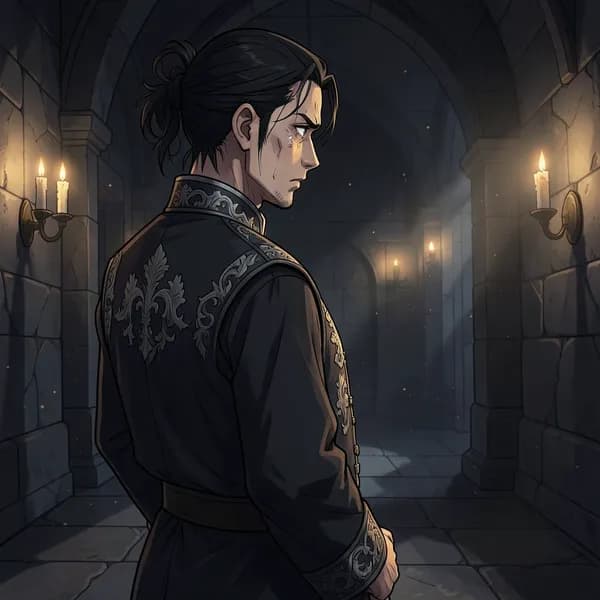
Her smile is pristine, devoid of the blood that will stain it in three minutes. You could answer her with a lie, a truth, or a scream. Every nerve in your body begs for this cycle to snap, for the pattern to deviate just enough to grant you an exit. If you act now, you risk drawing the assassin’s ire early, or worse, triggering a fate even more catastrophic than the one you are trying to rewrite.
“Your Majesty, I merely find the wine lacking. Perhaps it is time we poured a different vintage before the night turns sour.”
The Empress tilts her head, her curiosity piqued by your sudden defiance. Across the room, the assassin’s hand twitches toward a concealed dagger, sensing the disruption in the timeline. The script is fraying, the threads of the loop are beginning to snap, and you are standing at the epicenter of a collapse that will either liberate your soul or seal your doom forever.
The room holds its breath. How will you fracture this timeline?
Your character. Your next move.
Stop the clock and reclaim your future.
You have seen this day a thousand times before. You know exactly when the betrayal happens and who holds the knife. This time, you have the chance to change the outcome. Will you continue to suffer the cycle, or will you finally break the loop? Start your regression now and find the exit.
Begin the final loopYour Story, Your Way
Everything is customizable. Pick any genre, setting, or character — the AI builds a world around exactly what you want.
Any Character
Design your appearance, personality, backstory — every detail
Any World
Fantasy kingdoms, sci-fi stations, modern cities — you choose
Branching Paths
No two playthroughs are the same. Your choices reshape everything
Full Immersion
AI images, voice acting, sound effects — a living story
Track your sanity levels as you endure the psychological weight of repeating the same days.
Experiment with divergent timelines to see how small changes ripple into massive, unforeseen consequences.
Use your retained knowledge from previous cycles to outmaneuver enemies who think they have the upper hand.
Solve complex environmental puzzles that require specific items gathered across multiple failed iterations.
The clock strikes midnight, the smell of ozone fills the room, and you are back at the start. Again. You remember the faces of everyone you failed, the betrayals you did not see coming, and the weight of a thousand identical days. This time, however, the script feels brittle. In this interactive experience, your decisions determine whether you finally shatter the mechanism governing your existence or remain trapped in a recursive hell of your own making. Every detail you change adds a hairline fracture to the loop. You have the advantage of total recall, but the world is learning to adapt to your interference. The challenge is no longer just about surviving the day—it is about finding the specific point of divergence that allows you to step off the treadmill and into a future that is finally your own.
What is Loop Escape in Regression Fiction?
Loop Escape is a subgenre of regression fiction where the protagonist is not merely reliving their life to fix mistakes, but is actively trying to end the repetition itself. Unlike standard regression stories where the goal is often wealth, power, or revenge, the Loop Escape trope focuses on the psychological toll of immortality. The protagonist is usually aware of their state, having experienced hundreds of iterations, and the narrative centers on solving the cosmic puzzle that keeps resetting the clock. Think of the light novel series Re:Zero—Starting Life in Another World, where Subaru Natsuki is forced to reset his life upon death. While he initially tries to achieve a 'perfect' ending, his true struggle becomes the trauma of the loop and the desperate search for an exit condition. This trope turns the timeline into a puzzle box. The reader or player must identify which specific action, person, or object is the anchor holding the loop in place. When you realize that death is just a reset button, the stakes shift from physical danger to the erosion of your own humanity. The fiction thrives on the contrast between the protagonist's exhaustion and the world's ignorance of the cycle.
Why play Loop Escape as an interactive story?
Playing a Loop Escape narrative adds a layer of genuine tension because you are the one responsible for the timeline's stability. In a static book, you watch the character struggle; here, you calculate the risks of every departure from the established script. You might decide to save a character you previously ignored, only to find that their survival triggers a catastrophic event that wipes out your progress. You will face moments where you must intentionally fail a task to learn a secret, or endure a painful social interaction just to gather information for the next iteration. Agency matters because the game tracks your 'Loop Count.' As you make choices, you will see the world react to your presence—NPCs might start to feel a sense of déjà vu, or the environment itself might become hostile as the timeline attempts to self-correct. The thrill comes from the moment of discovery: realizing that the key to breaking the cycle was not in the big, heroic action, but in the small, seemingly insignificant choice you made three chapters ago.
Famous examples of Loop Escape in books, film, and games
The Loop Escape trope resonates because it reflects the human desire to fix the unfixable. In the film Edge of Tomorrow, Major William Cage is trapped in a combat loop against an alien force. He uses his death as a training mechanic, learning the exact movements of his enemies to progress further each time. This highlights the 'game-like' nature of the trope, where progress is earned through failure. Similarly, in the visual novel Steins;Gate, Rintaro Okabe travels through timelines to prevent a future tragedy. His struggle is defined by the emotional cost of his interference; every fix creates a new, often more painful, set of problems. This is the hallmark of a great Loop Escape story—it is never just about winning, but about the price of the exit. In the video game Outer Wilds, the protagonist is trapped in a 22-minute loop before a supernova destroys the solar system. The game forces you to map the entire system and understand its ancient history to find the exit. You do not gain levels or items; you gain information. This is what makes the trope endure: it treats knowledge as the ultimate currency. Whether it is a gritty sci-fi setting or a high-fantasy palace intrigue, the core remains the same. You are the only person who knows the world is broken, and you are the only one capable of fixing it, provided you do not lose yourself in the process.
FAQ
What is the primary goal in a Loop Escape story?
The goal is to identify the anchor of the cycle—the person, object, or event that forces the timeline to reset—and manipulate the narrative to break that anchor permanently.
How does my future knowledge affect the gameplay?
You can use information gathered in previous loops to skip dialogue, bypass traps, or preemptively strike enemies, allowing you to reach new areas of the narrative faster.
Can I permanently change the timeline?
Yes. Each choice you make creates a unique branch. By carefully managing your actions, you can steer the story toward an exit condition that stops the loop for good.
Does the game get harder as I loop more?
The world often responds to your interference. As you change history, the timeline may introduce new obstacles or 'corrections' to stop your progress, increasing the difficulty.
Explore more Regression Fiction stories like Death and Return, Future Knowledge Advantage, Changed Timeline.
More Regression Fiction Stories
Death and Return
You die — violently, suddenly, unfairly — and then you open your eyes in the past, alive and whole with every memory of what killed you. The second chance is real, the pain was real, and you have no intention of dying the same way twice.
TropeFuture Knowledge Advantage
You know the stock that will skyrocket, the disaster that will strike, and the betrayal that has not happened yet. Your knowledge of the future is the ultimate cheat code, but using it without revealing how you know is a constant, exhausting balancing act.
TropeChanged Timeline
You change one thing and the ripples rewrite everything you thought you knew. The future you came from is dissolving, replaced by a new timeline where your knowledge is increasingly unreliable and the people you loved may become strangers.
TropeButterfly Effect Regression
You fix one problem and create three more, each small change cascading into consequences you never predicted. The butterfly effect turns your careful plans into chaos, and you begin to understand that the past is not a machine you can simply adjust.
TropeRegression Romance
You are reunited with someone you lost, but they do not know you yet, and the love you shared exists only in your memory. You must fall in love again from the beginning while carrying the weight of a future they will never remember, and the relationship is both familiar and heartbreakingly new.
TropePreventing the Catastrophe
You came back for one reason — to stop the event that destroyed everything. You have the knowledge, the motivation, and the desperate urgency of someone who has already lived through the worst, but the catastrophe has roots deeper than you realized and preventing it may require sacrifices you are not prepared to make.