
Regression Fiction · Interactive story
The City You Remember No Longer Exists
You know where the bodies are buried, but the ghosts have all gone home.
Start as a guest. Choose your character before the story begins.
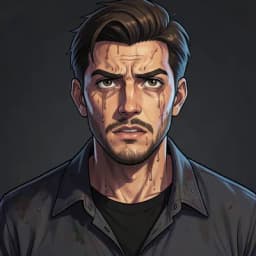
Meet the sample character
The ghosts of your memory are living, breathing men.
Try a scene · No signup
Echoes of the Spire
A short sample of this world. Your own version starts with your character.
Your boots click against the pristine pavement of the plaza. Every storefront is intact, glowing with warm, inviting light. You remember this place reduced to smoldering craters, the screams of the dying echoing against the broken steel. The normalcy of the evening hits you like a physical blow, grounding you in a reality that feels painfully fragile.

“You look like you've seen a ghost, Hideo. Are you coming to the café, or do you plan on staring at that clock tower until the gears rust?”

Kenji’s voice is a jagged blade to your composure. He died in the initial tremor three years from now, yet here he stands, alive and oblivious. The laughter in his eyes is a cruel reminder of everything you lost. You know the exact structural weakness in the tower’s foundation that will cost him his life in exactly seventy-two hours.
“I just… I have a bad feeling about the structural integrity of this place, Kenji. Maybe we should go somewhere else.”
Kenji laughs, dismissing your warning with a wave of his hand. He begins to walk toward the shadow of the clock tower, unaware that he is walking into his own grave. Your pulse quickens, the weight of the future pressing against your chest. Do you drag him away by force, or do you let the clock run out to avoid a larger catastrophe?
How will you intervene in the path of a man who should already be dead?
Your character. Your next move.
Will you save the city or break it?
The clock is ticking, and the tram is arriving at the station you know is doomed. You have the knowledge to change the outcome, but the cost of that change is yours to bear. Step into the familiar streets and start writing your new history today.
Rewrite Your TimelineYour Story, Your Way
Everything is customizable. Pick any genre, setting, or character — the AI builds a world around exactly what you want.
Any Character
Design your appearance, personality, backstory — every detail
Any World
Fantasy kingdoms, sci-fi stations, modern cities — you choose
Branching Paths
No two playthroughs are the same. Your choices reshape everything
Full Immersion
AI images, voice acting, sound effects — a living story
Warn a childhood friend of a pending accident, changing their entire life trajectory.
Invest in real estate you know will become a luxury district next year.
Avoid specific city districts to escape encounters with people who died in your timeline.
The smell of roasting chestnuts from the corner stall hits you first—a scent that should have vanished five years ago when the market burned down. You stand on the corner of 5th and Main, watching a tram rattle past that was supposed to be decommissioned in the riots. The buildings are whole, the glass is unbroken, and the people walking past you have no idea they are living in a borrowed future. You carry the weight of a decade of ash and ruin in your pockets, a secret burden that makes every familiar brick and cobblestone feel like a trap. In this interactive story, you are the only one who remembers the collapse. Every choice you make to save a friend or prevent a tragedy ripples outward, potentially erasing the normalcy you are desperate to protect. The city is a puzzle, and you hold the only map to its hidden dangers.
What is Changed Familiar City in Regression Fiction?
This setting focuses on the psychological dissonance of returning to a place that feels like home but operates on a different set of rules. In regression narratives, the protagonist gains a second chance, but the environment rarely remains static. The 'Changed Familiar City' trope thrives on the uncanny: the protagonist knows the layout, the shortcuts, and the inevitable catastrophes, yet they must find their way through a version of reality that defies their memory. Popular examples include the kdrama 'Reborn Rich,' where the protagonist uses future knowledge to navigate a shifting corporate and urban landscape, or the manga 'Tokyo Revengers,' where the protagonist constantly returns to a past city to prevent the deaths of friends. The tension stems from the gap between what the character expects and what actually happens. It is not about simply fixing mistakes; it is about managing the ripple effects of your presence. When you save a shopkeeper who was destined to die, you change the commute of a stranger, which in turn alters the political climate of the district. The city is a living character, reacting to your interference with every step you take.
Why play Changed Familiar City as an interactive story?
Playing through this setting transforms your knowledge into a tactical resource. You are not just reading about a character’s struggle; you are deciding which parts of the future to sacrifice for the sake of the present. You might choose to warn a neighbor about a fire that hasn't happened yet, only to realize that their survival leads to a more dangerous outcome later. The agency lies in your ability to balance your desire for a better life against the risk of creating a worse one. You will face moments where you must decide whether to act on your foreknowledge, risking exposure as an outsider in your own life, or remain silent while the people you love head toward their original fates. The city provides the feedback: a closed shop, a new face in the crowd, or a sudden change in public opinion. Your choices define whether you become the savior of this city or the catalyst for its next collapse.
What makes Changed Familiar City work: the worldbuilding
The effectiveness of this setting relies on sensory contrast. The writer must emphasize the 'wrongness' of the correct environment—the way a pristine skyline feels oppressive compared to the memory of rubble. Successful works like 'All You Need Is Kill' by Hiroshi Sakurazaka masterfully use the repetition of a specific location to highlight how much the protagonist grows while the world remains deceptively stagnant. When building this setting, the focus should be on the mundane details that anchor the character to their past: the specific graffiti in an alleyway, the brand of coffee served at the local cafe, or the rhythmic chime of a clock tower that was supposed to fall. These details create a sense of belonging that is immediately undermined by the protagonist's knowledge of upcoming tragedies. Conflicts arise naturally from the protagonist's isolation; they cannot explain their actions to others without sounding insane, which forces them to act in shadows. The city becomes a character that pushes back against the protagonist's attempts to rewrite history. If you change a major event, the city changes its own layout or social dynamics in response, forcing you to constantly adapt. This creates a loop of tension where the protagonist is always one step behind their own influence. By focusing on the intersection of personal memory and objective reality, the story gains a layer of tragedy that makes every victory feel fragile and earned.
FAQ
What makes this different from standard time travel stories?
Standard time travel often focuses on the 'how' of the jump. Regression fiction focuses on the 'aftermath' of the arrival. You are not trying to get back to the future; you are trying to live in a past that you have fundamentally altered.
Can I prevent every tragedy I remember?
You can try, but the butterfly effect is a core mechanic. Saving one person might inadvertently cause a different, unforeseen problem elsewhere in the city, forcing you to choose between lesser evils.
Does my knowledge of the city layout provide an advantage?
Yes, but it is a double-edged sword. Knowing where a shortcut is can help you avoid danger, but if you change the timeline enough, the city might stop matching your memory, leaving you lost in a place you once called home.
Is this setting right for me?
If you enjoy high-stakes decision-making and the bittersweet tension of trying to fix the past without breaking the future, this setting offers a unique challenge that rewards careful planning.
Explore more Regression Fiction stories like Death and Return, Future Knowledge Advantage, Changed Timeline.
More Regression Fiction Stories
Death and Return
You die — violently, suddenly, unfairly — and then you open your eyes in the past, alive and whole with every memory of what killed you. The second chance is real, the pain was real, and you have no intention of dying the same way twice.
TropeFuture Knowledge Advantage
You know the stock that will skyrocket, the disaster that will strike, and the betrayal that has not happened yet. Your knowledge of the future is the ultimate cheat code, but using it without revealing how you know is a constant, exhausting balancing act.
TropeChanged Timeline
You change one thing and the ripples rewrite everything you thought you knew. The future you came from is dissolving, replaced by a new timeline where your knowledge is increasingly unreliable and the people you loved may become strangers.
TropeButterfly Effect Regression
You fix one problem and create three more, each small change cascading into consequences you never predicted. The butterfly effect turns your careful plans into chaos, and you begin to understand that the past is not a machine you can simply adjust.
TropeRegression Romance
You are reunited with someone you lost, but they do not know you yet, and the love you shared exists only in your memory. You must fall in love again from the beginning while carrying the weight of a future they will never remember, and the relationship is both familiar and heartbreakingly new.
TropePreventing the Catastrophe
You came back for one reason — to stop the event that destroyed everything. You have the knowledge, the motivation, and the desperate urgency of someone who has already lived through the worst, but the catastrophe has roots deeper than you realized and preventing it may require sacrifices you are not prepared to make.