
Noir · Interactive story
The City’s Seedy Underbelly: A Noir Interactive Story
The penthouse lights are a lie. The truth is found in the gutter.
Start as a guest. Choose your character before the story begins.
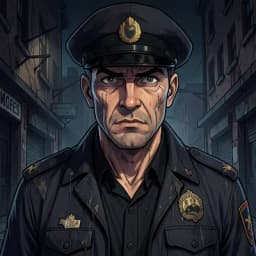
Meet the sample character
Truth is the only thing that doesn't wash off in the gutter.
Try a scene · No signup
Rust and Rain
A short sample of this world. Your own version starts with your character.
Rain beats against your trench coat like a persistent debt collector. You stand in the shadow of the Sump, the air thick with the smell of rotted fish and industrial runoff. Across the street, the flickering neon sign of the Last Call bar buzzes, a dying insect trapped in glass. You aren't here for a drink. You are here because Mina Rossi said she had the ledger that could bury the Commissioner.

“You’re late, Vane. In this part of town, time isn't just money—it's a burial plot.”

The click of a hammer cocking back echoes off the wet brick. You don't turn around. You know the weight of a snub-nose barrel pressing into your spine. It isn't Mina. She smells of gin, but this shadow carries the sharp, metallic tang of machine oil. You’ve crossed the tracks to find the truth, but the tracks have finally crossed you back.
“If you were going to pull the trigger, you would have done it before the rain soaked through my shirt. What do you want?”
The pressure against your shoulder blade remains steady. The man behind you doesn't speak, but his heavy breathing matches the rhythm of the downpour. You recognize the silhouette—a man you were supposed to protect back when your badge still meant something. He’s the reason you’re waiting in the dark, and now you have to decide if you want to survive the night or finally settle the score.
The barrel digs deeper into your spine. How do you handle the man from your past?
Your character. Your next move.
The city is waiting. Which side are you on?
The rain will not stop, and the clock is ticking. A body just turned up in the wharf district, and the trail leads straight to the mayor’s office. You are the only one with the grit to follow it. Do you take the bribe and walk away, or do you keep digging until you find the dirt that buries them all? Every decision determines if you survive the night.
Start your investigation nowYour Story, Your Way
Everything is customizable. Pick any genre, setting, or character — the AI builds a world around exactly what you want.
Any Character
Design your appearance, personality, backstory — every detail
Any World
Fantasy kingdoms, sci-fi stations, modern cities — you choose
Branching Paths
No two playthroughs are the same. Your choices reshape everything
Full Immersion
AI images, voice acting, sound effects — a living story
Choose to intimidate a corrupt landlord or bribe them for critical evidence.
Navigate a high-stakes gala while hiding a weapon beneath your coat.
Decide whether to protect a witness or leave them to the mob.
Manage limited funds to buy information in the city's forgotten districts.
Rain drums against the brim of my hat. It is the kind of night that washes the grime from the sidewalks but leaves the sins intact. You are standing at the edge of the district where the streetlamps stop working and the shadows grow teeth. Up on the hill, the lights of the elite flicker like diamonds. Down here, it is just neon signs reflecting in oil slicks and the smell of cheap gin and bad decisions. You have a lead that takes you into the heart of the district, where the law is a suggestion and survival is a full-time job. This is an interactive story where every choice you make pulls you deeper into the muck or forces you to claw your way toward a different kind of justice. You decide how much of your soul you are willing to spend to close the case.
What is Wrong Side of the Tracks in Noir?
The Wrong Side of the Tracks trope is more than a metaphor for poverty. In classic noir, it is a physical boundary. It is the line between the people who own the city and the people who keep it running. When you step across that line, the rules change. In the film Chinatown (1974), J.J. Gittes discovers that the corruption is not just happening in the back alleys—it is built into the infrastructure of the city itself. The contrast between the sun-drenched, expensive water projects and the dusty, desperate lives of the farmers is the engine of the plot. It is about the friction between those who have the power to write the laws and those who only have the power to break them. You learn that the real villains do not live in the flophouses. They live in mansions, protected by high walls and paid-off cops. The trope is effective because it forces the protagonist to witness the human cost of greed. It is not just about solving a case; it is about choosing whether to play by the rules of the elites or burn the whole system down.
Why play Wrong Side of the Tracks as an interactive story?
You are not just watching a detective stumble through a crime scene. You are the one deciding which door to kick in. When you are hunting a killer through the tenement blocks, you face choices that define your character. Do you shake down a terrified informant for a quick answer, or do you offer them protection, knowing it paints a target on your own back? The tension comes from the lack of resources. In the high-society scenes, you might be bluffing your way through a gala, sweating under a tuxedo. In the low-life districts, you are counting your remaining bullets and hoping your car starts. The agency lies in how you navigate these two worlds. Will you be the detective who stays clean, or will you let the grit of the streets settle into your skin? Every conversation, every bribe, and every desperate chase is a gamble. You might find the truth, but you will have to decide what part of your history you are willing to trade for it.
Famous examples of Wrong Side of the Tracks in books, film, and games
The Wrong Side of the Tracks trope is the backbone of the genre. Think of L.A. Confidential by James Ellroy. The story exposes the rot beneath the polished surface of 1950s Los Angeles. The detectives are caught between the glamorous, corrupt Hollywood scene and the brutal reality of the LAPD’s backroom dealings. It is a masterclass in how class divides create victims and monsters. Another example is the game Disco Elysium. You start in a crumbling, forgotten corner of the city, and your journey takes you through the wreckage of a failed revolution. The class divide is not just about money; it is about history, trauma, and the way the city remembers its past. The trope endures because it is inherently unfair. We are drawn to stories where the underdog fights against a system designed to crush them. Whether it is a film noir classic like The Big Sleep or a modern gritty game, the appeal is the same: seeing if someone can hold onto their integrity when the entire world is pushing them into the mud.
FAQ
What defines a 'Wrong Side of the Tracks' story?
It is defined by the stark contrast between the elite world and the impoverished underbelly. The protagonist must bridge this gap, often realizing that the two worlds are inextricably linked by corruption.
Does my character's background matter?
Yes. Your background and the choices you make influence how the city treats you. A detective from the streets knows how to talk to snitches, while one from the force might find it easier to bluff their way into a mansion.
Are these stories always sad?
Noir is not about sadness; it is about cynicism and the hard cost of truth. You might not get a happy ending, but you will get a meaningful one based on the risks you took.
Can I play as a villain?
You can make morally grey decisions. In the city, survival often requires doing things that are not exactly good. You decide where your moral compass points.
Explore more Noir stories like Dame Walks In, Double Cross, Blackmail Scheme.
More Noir Stories
Dame Walks In
She steps through your office door with trouble written all over her and a story that doesn't add up. You know better than to take the case, but the rent is due and her eyes are persuasive.
TropeDouble Cross
Everyone in this city is playing an angle, and the person you trusted just revealed theirs. You've been set up, sold out, and left holding the bag—now it's time to return the favor.
TropeBlackmail Scheme
Someone has the photographs, the letters, or the recordings that could ruin everything. You're hired to make the problem disappear, but the deeper you dig, the dirtier your own hands get.
TropeThe Fall Guy
You've been framed so perfectly that even you almost believe it. The real criminals have covered their tracks and left you holding the murder weapon—your only option is to prove the impossible.
TropeDouble Indemnity
An insurance policy worth a fortune and a spouse worth more dead than alive—the scheme is perfect until you realize you're not the only one with a plan. Greed and desire collide in a deadly spiral.
TropeCorrupt City
The mayor, the police chief, and the crime boss all drink at the same bar. You're trying to find justice in a city where it's been bought and sold, and every honest move paints a bigger target on your back.