Noir · Interactive story
The Wrong Man: A Noir Frame-Up
They painted you into a corner. Now, paint your way out in blood and ink.
Start as a guest. Choose your character before the story begins.

Meet the sample character
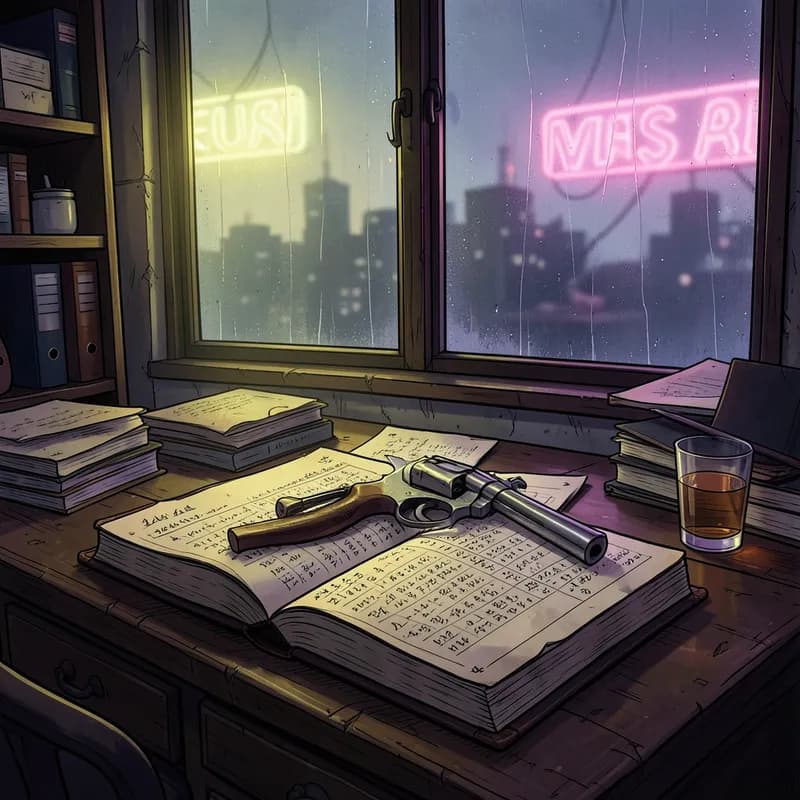
The gun in your hand is the only evidence they need.
Try a scene · No signup
Lead Weight Blues
A short sample of this world. Your own version starts with your character.
The smell of cordite stings your nostrils, cutting through the metallic tang of blood pooling on the linoleum. You stare at the cold steel of the .38 in your palm, wondering how the weight of it feels so natural. The heavy lock on the office door groans under the pressure of a shoulder slamming against the other side. You have seconds before the law breaks through.

“Drop the iron, Vance. You're making this real easy on my report.”

The wood splinters, and a flashlight beam cuts through the gloom, dancing over the body of the boss sprawled on the rug. You look at the open window behind the desk, then back at the door. The siren wails, getting louder, drowning out the steady rhythm of the rain. Your pulse hammers against your temples, a frantic warning that your time is running out.
“I didn't pull the trigger, Halloway. You know who the real rat is.”
Halloway doesn't blink; he just levels his weapon, his finger tightening on the trigger as the door hinges begin to give way. The flash of red and blue lights washes over the room, turning the scene into a strobe-lit nightmare. You are trapped between a murder charge and a bullet in the gut. You have to move, but your boots feel like they are cast in lead.
The door is giving way, and Halloway is losing his patience. How do you survive the next ten seconds?
Your character. Your next move.
Clear your name before the city burns.
The sirens are getting louder, and the evidence is already being filed against you. You have one chance to find the shadow who framed you before the handcuffs click shut. Will you play it smart, or will you go down fighting?
Start your noir storyYour Story, Your Way
Everything is customizable. Pick any genre, setting, or character — the AI builds a world around exactly what you want.
Any Character
Design your appearance, personality, backstory — every detail
Any World
Fantasy kingdoms, sci-fi stations, modern cities — you choose
Branching Paths
No two playthroughs are the same. Your choices reshape everything
Full Immersion
AI images, voice acting, sound effects — a living story
Choose to burn your ID and vanish or stay to hunt the real killer.
Decide which witnesses to manipulate and which to silence before the police arrive.
Manage your 'Suspicion Meter' by carefully selecting your dialogue during interrogations.
Risk everything by returning to the crime scene to plant counter-evidence.
Rain hits the window like gravel. The sirens are getting closer, their blue lights bleeding through the Venetian blinds. You look down at the .38 in your hand, but you don't remember picking it up. The man on the floor—a city councilman with a penchant for secrets—didn't need to die, but someone needed him gone. And they needed a face to pin it on. Yours. You have exactly three hours before the precinct logs your prints and locks the cage. Your choices determine whether you vanish into the city's underbelly or end up behind bars for a crime you didn't commit. This is a path where every witness is a liar and every alleyway is a potential trap. You are not a hero; you are a target.
What is The Fall Guy in Noir?
The 'Fall Guy' is a staple of hardboiled fiction. It represents the ultimate powerlessness of the individual against a rigged system. You are the patsy, the unlucky sap chosen to take the fall so the real sharks can keep swimming in shark-infested waters. Unlike a standard mystery where you play the detective, this trope forces you to play the suspect. You aren't just solving a crime; you are fighting the narrative that has already been written about you. Consider the classic tension in Alfred Hitchcock’s 'The Wrong Man' or the desperate scrambles found in 'L.A. Confidential.' In these stories, the protagonist is burdened by the weight of public perception, police incompetence, and a web of corruption that feels impossible to untangle. The trope thrives on the gap between the truth and the evidence. The audience knows you are innocent, but the world inside the story is convinced of your guilt. You must use the same tools the criminals used to frame you—deception, leverage, and grit—to turn the tables before the system grinds you to dust.
Why play The Fall Guy as an interactive story?
Playing a patsy adds a layer of desperation that a passive novel cannot replicate. When you are the one holding the smoking gun, every conversation is a high-stakes negotiation. You aren't gathering clues to solve a puzzle; you are gathering leverage to save your own skin. Do you bribe the beat cop at the door? Do you run into the rain, knowing you’ll be an instant fugitive? Or do you attempt to confront the person you know set you up, risking a bullet in the dark? The tension lies in the fact that your agency is limited by your reputation. If you act too aggressive, you look like a killer. If you act too timid, you look like a coward. You have to thread the needle of a false reality. Every choice you make echoes through the investigation, changing who trusts you and who is ready to testify against you. You will face moments where you must decide whether to betray an ally to save yourself or take the heat to protect a secret that might be the only key to your freedom.
Famous examples of The Fall Guy in books, film, and games
The Fall Guy trope has defined noir for decades because it strikes a chord with our fear of institutional injustice. In the film 'The Fugitive,' Richard Kimble is the ultimate patsy, forced to outrun the law while hunting a phantom. Unlike a detective story, the focus here is on the sheer physical and mental exhaustion of being hunted. Then there is the complex web of James Ellroy’s 'L.A. Confidential,' where characters are constantly being set up by their own departments, showing that the most dangerous enemies are often the ones wearing badges. In video games like 'L.A. Noire,' the player often encounters scenarios where the evidence is stacked against them, forcing a frantic search for the truth. What makes this trope endure is the raw, human desire to prove one's worth when the world has already decided you are guilty. It turns the 'whodunit' into a 'how-do-I-survive.' The fall guy doesn't just want justice; they want their life back, and that drive is what keeps readers and players glued to the page and screen.
FAQ
How does the 'Fall Guy' trope change the way I play?
Instead of playing a detective looking for clues, you play a suspect looking for an exit. You have to manage your public image, avoid police scrutiny, and outsmart the people who set you up. Every interaction carries the risk of incriminating yourself further.
Can I prove my innocence, or am I destined to be caught?
Your ending is not pre-written. Through your choices, you can uncover the conspiracy, expose the real culprits, and clear your name, or you can fail and face the consequences of a system that refuses to listen to the truth.
Is this trope right for me if I prefer action over investigation?
Absolutely. Being the fall guy involves high-speed chases, narrow escapes, and tense confrontations. You will have to make split-second decisions that involve physical risks, not just dialogue-heavy investigation.
What happens if I make a 'wrong' choice?
There are no wrong choices, only consequences. Making a mistake might lead to a dead end, an arrest, or a new, more dangerous set of problems. You have to adapt to the reality you created.
Explore more Noir stories like Dame Walks In, Double Cross, Blackmail Scheme.
More Noir Stories
Dame Walks In
She steps through your office door with trouble written all over her and a story that doesn't add up. You know better than to take the case, but the rent is due and her eyes are persuasive.
TropeDouble Cross
Everyone in this city is playing an angle, and the person you trusted just revealed theirs. You've been set up, sold out, and left holding the bag—now it's time to return the favor.
TropeBlackmail Scheme
Someone has the photographs, the letters, or the recordings that could ruin everything. You're hired to make the problem disappear, but the deeper you dig, the dirtier your own hands get.
TropeDouble Indemnity
An insurance policy worth a fortune and a spouse worth more dead than alive—the scheme is perfect until you realize you're not the only one with a plan. Greed and desire collide in a deadly spiral.
TropeCorrupt City
The mayor, the police chief, and the crime boss all drink at the same bar. You're trying to find justice in a city where it's been bought and sold, and every honest move paints a bigger target on your back.
TropeMidnight Chase
Rain hammers the pavement as you sprint through darkened streets with someone deadly on your trail. You know this city's shadows better than anyone, but tonight they might not be enough to save you.