
Noir · Interactive story
The Glass is Half Empty
Pour another drink and decide if the truth is worth the hangover.
Start as a guest. Choose your character before the story begins.
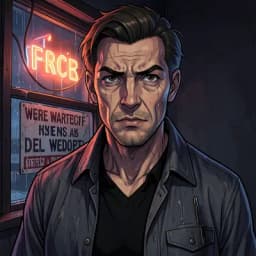
Meet the sample character
The bottom of the glass is where the bodies are buried.
Try a scene · No signup
Three Fingers of Yesterday
A short sample of this world. Your own version starts with your character.
You stare at the photograph on your desk, the edges curled by heat and time. The neon sign outside flickers, casting a rhythmic, sickly pulse over the case file. You have read the same line three times, but the words refuse to stick. Your hand trembles as you reach for the glass, the liquid inside amber and biting.

“You are going to drink yourself into a shallow grave, Arthur, and I am not bringing flowers to the funeral.”

You ignore her, watching the rain streak the window like tears on a dirty face. She stands by the door, her coat damp, clutching a manila envelope. It’s the kind of parcel that usually contains enough money to make a man disappear or enough evidence to bury him for good. She doesn't belong here, and she knows it.
“Flowers are a waste of money, Evelyn. Just tell me why you're really here.”
She places the envelope on the desk, right over the smeared ink of your report. It is heavy, damp, and smells faintly of the river. She doesn't pull her hand back. Her eyes lock onto yours, cold and expectant, waiting for you to decide whether to look inside or throw it—and her—out into the storm.
Do you open the envelope, or do you keep the past buried?
Your character. Your next move.
The bottle is waiting. Will you drink?
The suspect is at the bar. You have a loaded gun and a glass of scotch in front of you. Every choice you make from here on out changes the ending. Don't let the past finish you off.
Start Your InvestigationYour Story, Your Way
Everything is customizable. Pick any genre, setting, or character — the AI builds a world around exactly what you want.
Any Character
Design your appearance, personality, backstory — every detail
Any World
Fantasy kingdoms, sci-fi stations, modern cities — you choose
Branching Paths
No two playthroughs are the same. Your choices reshape everything
Full Immersion
AI images, voice acting, sound effects — a living story
Decide whether to trade classified evidence for a bottle of top-shelf bourbon.
Choose to confront a former partner, knowing the truth will destroy your reputation.
Navigate a high-stakes interrogation while struggling to keep your head clear of alcohol.
Determine if a suspect’s plea for help warrants breaking your own personal code.
Rain taps against the window like a persistent creditor. You are staring at the case file—the one that kept you awake for three nights straight. Outside, the city is a sprawl of neon smears and shadows. Inside, it is just the smell of stale tobacco and the amber burn of cheap rye. You have a choice. You can close the file, finish the glass, and walk away from the mess you made. Or you can pick up the pen, take a breath, and see how deep the rot goes. This is an interactive story where every decision ripples through the city’s underbelly. Your choices turn the screws on people who do not want to be found, and the consequences of your past are never more than a heartbeat away. Whether you find redemption or just another reason to pour a double is entirely up to you.
What is Whiskey and Regret in Noir?
The whiskey and regret trope is the heartbeat of classic noir. It is not just about a character drinking; it is about the paralysis of past mistakes. The protagonist is usually a detective or an unlucky soul who has lost their edge, their partner, or their moral compass. They use the bottle to quiet the static in their head. Think of Philip Marlowe in Raymond Chandler’s 'The Long Goodbye'. He is not just solving a crime; he is trying to survive the crushing weight of his own disillusionment. In these stories, the alcohol is a punctuation mark at the end of a long, bad day. It is the physical manifestation of guilt. When you encounter this in fiction, you are looking at a character who has realized that justice is a luxury item they cannot afford. The trope relies on the tension between wanting to do the right thing and knowing that doing so will likely cost you everything. It is the classic standoff between a conscience that will not quit and a world that will not give a damn. The bottle acts as a shield against the harsh neon reality of a city that never forgives.
Why play Whiskey and Regret as an interactive story?
You do not just watch the detective drown their sorrows; you decide when they stop drinking and start acting. The tension lies in the friction between your character’s weary cynicism and the immediate pressure of the investigation. You choose whether to lean into the bottle to get a confession out of a desperate witness, or to stay sharp and risk losing the only lead you have. Every drink you take clouds your judgment, and every moment you hesitate gives the antagonist another edge. You will face moments where the truth is more dangerous than the lie. Will you confront the ghost from your past, or will you let them stay buried under a mountain of paperwork? Your choices define whether you are a hero fighting for redemption or just another ghost in the rain.
Famous examples of Whiskey and Regret in books, film, and games
The archetype of the regretful drinker is everywhere in noir. Consider the game 'Max Payne'. The story starts with Max drowning his grief in a bottle after his family is murdered, and that sense of inescapable loss drives every bullet he fires. He is not just a cop; he is a man who has already lost the game and is now just trying to make the house pay for it. Then there is 'Blade Runner'—specifically Rick Deckard. He is a man who has done things he cannot forget, and he uses his isolation and his glass to buffer the reality of his job. Unlike the traditional detective, he is hunting his own kind, which makes the regret feel heavier and more immediate. Finally, look at 'The Big Sleep'. While Marlowe is sharper than most, the way he navigates the corruption of the Sternwood family shows he knows exactly how much he is sacrificing. He is a man who has seen too much and knows that the only reward for being an honest man in a corrupt city is a headache. These stories endure because we all know what it is like to look back and wish we had done things differently. The whiskey is just the catalyst for the honesty we cannot handle while sober.
FAQ
What is the Whiskey and Regret trope?
It is a narrative device where the protagonist uses alcohol to cope with past trauma, failure, or moral decay, highlighting their internal struggle against a corrupt environment.
Does my choice of drink affect the story?
In many scenarios, your level of sobriety impacts your perception and how you interact with NPCs, changing the outcome of your investigation and the dialogue options available.
Is this genre only about detectives?
No, it often features private investigators, disgraced journalists, or ordinary people caught in webs of conspiracy who use substances to cope with their circumstances.
Can I choose a path without drinking?
Yes, you can play a character who stays sober, though that often means facing the raw, unbuffered reality of the case head-on without the emotional buffer.
Explore more Noir stories like Dame Walks In, Double Cross, Blackmail Scheme.
More Noir Stories
Dame Walks In
She steps through your office door with trouble written all over her and a story that doesn't add up. You know better than to take the case, but the rent is due and her eyes are persuasive.
TropeDouble Cross
Everyone in this city is playing an angle, and the person you trusted just revealed theirs. You've been set up, sold out, and left holding the bag—now it's time to return the favor.
TropeBlackmail Scheme
Someone has the photographs, the letters, or the recordings that could ruin everything. You're hired to make the problem disappear, but the deeper you dig, the dirtier your own hands get.
TropeThe Fall Guy
You've been framed so perfectly that even you almost believe it. The real criminals have covered their tracks and left you holding the murder weapon—your only option is to prove the impossible.
TropeDouble Indemnity
An insurance policy worth a fortune and a spouse worth more dead than alive—the scheme is perfect until you realize you're not the only one with a plan. Greed and desire collide in a deadly spiral.
TropeCorrupt City
The mayor, the police chief, and the crime boss all drink at the same bar. You're trying to find justice in a city where it's been bought and sold, and every honest move paints a bigger target on your back.