
Mythology · Interactive story
Awakening the World Serpent
The ocean churns. The scales shift. Beneath the waves, the end of everything stirs.
Start as a guest. Choose your character before the story begins.
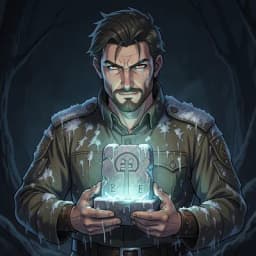
Meet the sample character
The coils shift, and the foundations of the world groan.
Try a scene · No signup
Beneath the Frozen Tide
A short sample of this world. Your own version starts with your character.
Salt spray stings your eyes as the shoreline recedes with terrifying speed. You stand on the jagged edge of the world, watching the ocean boil. The horizon is not made of waves, but of a shifting, obsidian ridge that rises miles into the sky. The earth beneath your feet vibrates—a rhythmic, subterranean heartbeat that threatens to shatter the very permafrost you rely on for survival.

“Stop staring at the depths, boy. If you wake the belly of the world, you’ll be the first to be crushed by the coming tide.”

The old seer’s warning is drowned out by a sound like grinding mountains. A colossal scale, slick with ancient frost, breaches the surface near your feet. It is not an animal; it is a tectonic shift made flesh. You feel the runestone hidden against your chest burning hot, pulsing in violent harmony with the creature’s immense, restless movement.
“It isn't waking, Hrafn. It is waiting for someone to acknowledge it. If I don't touch the mark now, the entire coast will be dragged into the dark.”
The serpent’s eye, a golden sphere the size of a village, fixes on your position. The pressure in the air becomes suffocating, collapsing your lungs. You have seconds before the creature plunges back down, taking the land with it, or rises to finish the cycle of the world. Your hand hovers over the ice, the runestone screaming for release.
The world trembles under your feet; how will you confront the ancient coil?
Your character. Your next move.
The tides are turning. Will you hold the world together?
The horizon is buckling. A massive, scaled shadow has breached the surface, and the gods are silent. Your decisions in the coming hours will determine if the world holds its shape or breaks under the weight of the ancient beast. Step into the myth and make your choice before the sea swallows everything.
Begin the awakeningYour Story, Your Way
Everything is customizable. Pick any genre, setting, or character — the AI builds a world around exactly what you want.
Any Character
Design your appearance, personality, backstory — every detail
Any World
Fantasy kingdoms, sci-fi stations, modern cities — you choose
Branching Paths
No two playthroughs are the same. Your choices reshape everything
Full Immersion
AI images, voice acting, sound effects — a living story
Debate the gods on whether to sacrifice treasures to calm the serpent's restless coils.
Decipher ancient scripts to discover the true, hidden purpose of the beast's eternal cycle.
Scout the coastlines for signs of the serpent's rise before the panic spreads further.
Influence local political factions to prepare for the inevitable flooding of the lowlands.
The salt spray stings your eyes as the horizon line begins to shudder. You are not looking at a storm; you are looking at the colossal, moss-slicked scales of a creature that encircles the entire map of human existence. Its tail is locked firmly in its own jaws, a grim seal holding the continents in place. As you stand on the precipice of the shoreline, you feel the vibration in your marrow. The beast is waking. In this interactive story, your decisions dictate whether the coil tightens, crushing the foundations of reality, or if you can find a way to soothe the ancient hunger that threatens to unravel the stars. Every word you speak to the gods, every offering you cast into the black water, alters the trajectory of the coming cataclysm. Will you be the savior who keeps the world bound, or the catalyst for its final, watery grave?
What is The World Serpent in Mythology?
The World Serpent, most famously known as Jormungandr in Norse myth, represents the ultimate boundary of the known universe. Unlike monsters that hide in caves or forests, this entity is so vast that it acts as the literal floor of the ocean and the perimeter of the physical world. It is a creature of paradox: a guardian of cosmic order through its stillness, and a harbinger of total destruction should it move. In the Poetic Edda, the serpent is destined to clash with Thor during the final battle of Ragnarok, signaling the end of the age of gods. Similar archetypes appear in various cultures, such as the Egyptian serpent Apophis, who constantly attempts to swallow the sun, or the Ouroboros, the ancient symbol of cyclic time and eternal return. You might recognize this scale of threat in modern media, such as the massive leviathans in God of War or the world-spanning titans in Pacific Rim. The World Serpent is not merely a beast to be slain; it is an elemental force that defines the limits of human perspective and the fragile nature of stability.
Why play The World Serpent as an interactive story?
Playing through the perspective of this archetype forces you to confront the weight of absolute power. You are not a hero with a sword, but an individual standing before a god-level threat that ignores your existence. The agency here comes from how you interact with the inevitable. Do you attempt to negotiate with the Aesir to prevent the serpent's awakening? Do you seek ancient, forbidden runes to bind the beast tighter? Or do you embrace the coming chaos, acting as a prophet for the end-times? You will face moments where the ground beneath your feet literalizes the serpent's tension—every dialogue choice with a frantic king or a stoic priest changes how the world perceives the approaching doom. Agency is about managing the ripple effects of your survival strategies. The tension is constant because the creature is always there, waiting just beneath the surface of every scene.
The psychology of The World Serpent: why readers fall for this character
The World Serpent taps into a primal human anxiety: the fear that the stability of our world is an illusion held together by a thin, fragile thread. We are drawn to this archetype because it embodies the 'inevitable end.' It is a character that cannot be reasoned with, only managed or endured. In the lore of the Eddas, Jormungandr represents the shadow of Thor—the chaos that mirrors the order. When we engage with this type of figure, we are playing out our own fears regarding climate change, societal collapse, and the ticking clock of mortality. Consider the difference between a dragon, which guards gold, and the World Serpent, which guards nothing but its own existence. The serpent is a mirror. If you see it as a destroyer, you are projecting your fear of loss. If you see it as a pillar, you are acknowledging the necessity of destruction to allow for rebirth. Modern interpretations often lean into this duality. Whether it is the cosmic horror of Lovecraftian entities or the mythological weight of Jormungandr, these stories allow us to interact with the scale of the universe in a way that feels personal. You aren't just reading about a monster; you are deciding how to face the end of the world with dignity or defiance. This choice is what keeps the narrative resonant long after the screen goes dark.
FAQ
What is the primary difference between a dragon and the World Serpent?
A dragon is typically a territorial creature that guards a specific hoard or location. The World Serpent, however, is a foundational element of the universe. Its body is the boundary of the world itself; it does not hoard gold, but holds the physical globe together through its presence.
Can I choose to side with the serpent in this story?
Yes. Your choices are entirely open to interpretation. You can play as a character trying to prevent the apocalypse, one who seeks to accelerate it, or one who simply tries to survive the chaos that the serpent's movement creates.
How does the AI handle the scale of such a massive creature?
The AI uses descriptive, sensory-focused prose to build the scale of the serpent. Instead of focusing on simple combat stats, the narrative emphasizes the environmental changes, the shifting of tides, and the psychological dread that a creature of that magnitude would inspire in the people living near the coast.
Is this story suitable for fans of Norse mythology?
Absolutely. The narrative draws heavily on the atmosphere and lore of the Prose and Poetic Eddas, providing a grounded experience for those who appreciate the weight and tone of original mythic texts while allowing for modern, interactive agency.
Explore more Mythology stories like Godly Intervention, Mortal Champion, Underworld Journey.
More Mythology Stories
Godly Intervention
The gods take a personal interest in your fate, meddling with your life for their own amusement or agenda. Navigate divine politics where a single prayer can bring salvation or catastrophe depending on which god is listening.
TropeMortal Champion
A god chooses you as their champion in a conflict they cannot fight directly. Wield divine blessings and carry the weight of a god's expectations as you battle on behalf of forces far greater than yourself.
TropeUnderworld Journey
Descend into the realm of the dead to rescue a lost soul, seek forbidden knowledge, or bargain with death itself. The underworld tests your resolve with shades of the past and guardians who do not easily release the living.
TropeDivine Punishment
You dared to defy the gods, and now their wrath reshapes your existence. Endure a punishment designed to last eternity and search for the loophole, the redemption, or the defiance that could set you free.
TropeProphecy Fulfillment
An oracle speaks your fate, and every attempt to avoid the prophecy brings you closer to fulfilling it. Choose your path carefully in a story where destiny is a trap and free will may be the greatest illusion of all.
TropeGodly Love Affair
A deity descends from the heavens to pursue a mortal lover, bringing gifts, transformations, and the jealousy of divine spouses. Love a god and face the consequences that come when immortal desire collides with mortal fragility.