
Mythology · Interactive story
Command the Skies: The Thunder God’s Reckoning
Lightning crackles in your palm. Do you bring salvation to the fields or ruin?
Start as a guest. Choose your character before the story begins.
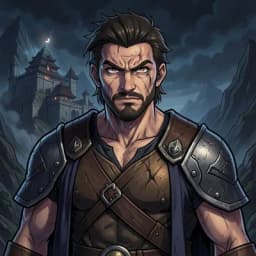
Meet the sample character
The storm waits for no god.
Try a scene · No signup
Hammer of the Iron Peak
A short sample of this world. Your own version starts with your character.
Static dances across your knuckles, raising the fine hairs on your arms. The air tastes like scorched metal and wet granite. Below the cliff edge, the frost-bound army has breached the outer gate, their iron axes biting into the wooden barricades of the sanctuary where the last mountain refugees huddle.

“If you do not call the lightning now, Hjalmar, there will be nothing left of our people but frozen statues to decorate their king's hall.”

The hammer strapped to your back feels like a collapsing star. Its gravity drags at your spine, reminding you of the last time you summoned the storm. You remember the sound of collapsing roofs and the silence that followed. The power is a wild dog straining at a frayed leash, waiting for you to provide the command.
“If I pull the clouds down to this height, the blast will shatter the temple foundations as surely as it kills the invaders.”
A massive battering ram impacts the inner door, shaking the very peak of the Crag. Dust cascades from the ceiling, burying the altar in white grit. You look at the hammer, then at the terrified faces of the refugees, and realize the mountain is beginning to groan under the sheer pressure of the coming strike. You have seconds before the roof collapses entirely.
The temple shudders again; how will you direct the storm's fury without killing those you swore to protect?
Your character. Your next move.
Summon the Storm and Rule the Heavens
The clouds are gathering, and the mortals are looking to the sky for a sign. Will you be their savior or their reckoning? The choice is yours to make. Step into the pantheon today and see how the world changes under your command.
Wield the LightningYour Story, Your Way
Everything is customizable. Pick any genre, setting, or character — the AI builds a world around exactly what you want.
Any Character
Design your appearance, personality, backstory — every detail
Any World
Fantasy kingdoms, sci-fi stations, modern cities — you choose
Branching Paths
No two playthroughs are the same. Your choices reshape everything
Full Immersion
AI images, voice acting, sound effects — a living story
Select which villages to protect from the coming frost giant invasion.
Choose to negotiate with rival gods or settle disputes with a crack of thunder.
Manage your divine energy reserves to prevent catastrophic collateral damage in mortal lands.
Decide the fate of legendary artifacts that could tip the scales of cosmic balance.
The sky turns a bruised, sickly violet. Static prickles against your skin, and the scent of ozone—sharp, metallic, and cold—fills the air. Below, the village fires are flickering out, their inhabitants cowering in the mud as the horizon begins to bleed light. The wind howls, carrying the pleas of the dying and the arrogant prayers of kings. You stand at the precipice of a mountain that has known no footprints for centuries, watching the clouds churn like a black sea. The hammer hums against your palm, a living, vibrating weight that yearns for impact. You are not a spectator to this impending cataclysm; you are its source. Whether you choose to act as a shield for the weak or a scourge upon the wicked, the consequences will echo through the halls of your pantheon. Every decision you make, from the specific target of your fury to the alliances you forge with the frost giants, dictates the survival of the realms. History is written by the victors, but here, the lightning is yours to command.
What is The Thunder God in Mythology?
The thunder god is an archetype found in almost every culture, representing the raw, untamable force of nature. From Thor in Norse mythology, with his iconic Mjölnir, to the Greek Zeus, who hurled lightning bolts from Mount Olympus, and the Japanese Raijin, who beats his drums to create thunder, this figure is rarely subtle. They are defined by their duality: they are both the protectors who guard humanity from primordial chaos and the volatile destroyers whose temper can raze an entire civilization. In media, this archetype remains a titan of storytelling. Consider the way Thor is portrayed in the Marvel Cinematic Universe—a prince struggling with the weight of responsibility and the allure of brute force—or the way the protagonist of the God of War series interacts with the pantheon, highlighting the fragility of divine order. These figures are never static. They are defined by their strength, their loud presence, and their tendency to act before they think. They embody the belief that power, when left unchecked, creates a landscape of both brilliant creation and devastating destruction.
Why play The Thunder God as an interactive story?
Playing as the thunder god forces you to grapple with the consequences of absolute power. In this narrative, your choices are not merely dialogue options; they are cosmic events. When you face a drought-stricken kingdom, do you summon the rains and risk flooding the lowlands, or do you demand a sacrifice from the local priesthood to prove their loyalty? You will feel the tension of managing the expectations of mortals who worship you and the political maneuvering of other deities who fear you. Every decision tests your moral compass. You might choose to spare an enemy to gain a strategic ally, only to have that decision backfire when they steal a relic from your hall. The game captures the sheer weight of your presence—the way the ground trembles when you walk and the way the air grows heavy with electricity when you are angry. You are not playing a hero; you are playing a force of nature that is just beginning to understand the limits of its own authority.
The psychology of The Thunder God: why readers fall for this character
The thunder god archetype satisfies a deep-seated human desire to possess power that can change the world in an instant. We are drawn to these characters because they represent the intersection of order and chaos. Unlike the steady, wise mentor or the cunning rogue, the thunder god is defined by their emotional volatility. This makes them inherently relatable, despite their divine status. They are prone to jealousy, arrogance, and protectiveness—human flaws amplified to a planetary scale. Take Zeus in 'Clash of the Titans,' whose detachment from human suffering highlights the danger of unchecked authority, or the portrayal of Raiden in various fighting games, where he serves as a burdened guardian trying to fix the mistakes of mortals. These characters resonate because they occupy a space where their actions carry permanent weight. We fear the storm, yet we admire its majesty. When we inhabit the thunder god, we are exploring our own capacity for impact. We ask: if I had the power to change everything with a single strike, would I have the wisdom to know when to hold back? The fascination lies in the struggle against our own nature. The thunder god is rarely the villain, but they are seldom purely good. They are a mirror held up to our own impulses—the urge to be loud, to be noticed, and to reshape the world in our own image. By putting the player in this position, the story transforms the archetype from a mythic figure into a personal challenge of character and control.
FAQ
How does the power level of the thunder god affect the story?
Your power is a central mechanic. Using massive bolts of lightning can resolve immediate threats, but it often carries high costs, such as destabilizing the local environment or drawing the unwanted attention of other gods. You must balance brute force with tactical diplomacy.
Can I choose to be a benevolent protector or a vengeful tyrant?
Yes. Your choices reflect your personality as a god. You can prioritize the safety of your mortal followers, demanding worship in exchange for protection, or you can act as a distant, vengeful deity who only intervenes when your own interests are threatened.
Is this story suitable for those who prefer political drama over action?
Absolutely. While the archetype is defined by power, the narrative includes deep political intrigue. You will negotiate with other deities, handle the politics of your own pantheon, and manage the complex relationships between competing mortal kingdoms.
Does the story follow a specific mythology?
The narrative draws from various mythic traditions, blending elements of Norse, Greek, and other global storm-deity legends to create a unique, cohesive world where your choices dictate the history of the gods.
Explore more Mythology stories like Godly Intervention, Mortal Champion, Underworld Journey.
More Mythology Stories
Godly Intervention
The gods take a personal interest in your fate, meddling with your life for their own amusement or agenda. Navigate divine politics where a single prayer can bring salvation or catastrophe depending on which god is listening.
TropeMortal Champion
A god chooses you as their champion in a conflict they cannot fight directly. Wield divine blessings and carry the weight of a god's expectations as you battle on behalf of forces far greater than yourself.
TropeUnderworld Journey
Descend into the realm of the dead to rescue a lost soul, seek forbidden knowledge, or bargain with death itself. The underworld tests your resolve with shades of the past and guardians who do not easily release the living.
TropeDivine Punishment
You dared to defy the gods, and now their wrath reshapes your existence. Endure a punishment designed to last eternity and search for the loophole, the redemption, or the defiance that could set you free.
TropeProphecy Fulfillment
An oracle speaks your fate, and every attempt to avoid the prophecy brings you closer to fulfilling it. Choose your path carefully in a story where destiny is a trap and free will may be the greatest illusion of all.
TropeGodly Love Affair
A deity descends from the heavens to pursue a mortal lover, bringing gifts, transformations, and the jealousy of divine spouses. Love a god and face the consequences that come when immortal desire collides with mortal fragility.