
Mythology · Interactive story
Where the Torii Gate Meets the Infinite
Do you bow to the fox spirit, or do you demand passage through the veil?
Start as a guest. Choose your character before the story begins.
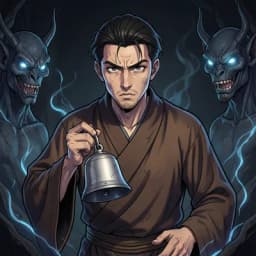
Meet the sample character
A bargain signed in shadow.
Try a scene · No signup
The Toll of the Foxfire Grove
A short sample of this world. Your own version starts with your character.
The path beneath your feet has vanished, replaced by moss that pulses like a slow, sleeping lung. A violet mist clings to your robes, turning your hempen fabric a bruised shade of indigo. Before you, the trees twist into jagged spirals, their leaves glowing with a cold, flickering azure light. You shouldn't have stepped off the mountain trail, but now the woods breathe with an ancient, predatory patience.

“A human footstep in my grove? The weight of your heartbeat is deafening, little priest. It thrums against the silence like a frantic drum.”

You grip the prayer beads at your wrist, the wooden spheres slick with your cold sweat. Shadows lengthen, stretching toward your ankles like grasping fingers. You recognize the sigils carved into the bark of the trees; you have wandered into the space between life and the eternal dusk. If you remain here, you will become part of the scenery, another memory fading into the moss.
“I seek the way back to the mortal gate. I carry no ill intent, only a prayer for my return.”
The fox-woman tilts her head, her eyes burning like twin lanterns in the dark. She holds up a porcelain mask. Behind her, the path splits into three distinct, impossible directions. One leads to a mirror-realm, one to the precipice of a waterfall that flows upward, and one simply vanishes into nothingness. She waits for your decision, her razor-sharp claws tracing the air near your throat.
The Kitsune waits for your move; which path do you commit your soul to?
Your character. Your next move.
The Torii Gate Awaits Your Choice
The spirits are gathering at the river’s edge, waiting to see if you possess the courage to walk their path. Will you be remembered as a hero who restored balance, or a traveler who faded into the mist? The gate is open, and your first decision will echo across the centuries.
Enter the Spirit RealmYour Story, Your Way
Everything is customizable. Pick any genre, setting, or character — the AI builds a world around exactly what you want.
Any Character
Design your appearance, personality, backstory — every detail
Any World
Fantasy kingdoms, sci-fi stations, modern cities — you choose
Branching Paths
No two playthroughs are the same. Your choices reshape everything
Full Immersion
AI images, voice acting, sound effects — a living story
Negotiate safe passage across the bridge by solving riddles posed by a vengeful tengu.
Decide whether to protect a sacred grove from encroaching industrial spirits at great personal cost.
Choose which ancestral memories to sacrifice to appease the hungry ghosts of a forgotten war.
Earn the favor of a powerful kami through acts of ritual purification and silent prayer.
The air in the valley tastes of ozone and crushed pine needles. Ahead, a weathered vermilion gate stands alone in the middle of a stream, separating the mundane earth from the shifting tides of the kami realm. You adjust the heavy silk of your traveling robes, feeling the weight of a promise made to a forgotten ancestor. Beyond the archway, the forest breathes—not with the wind, but with the rhythmic pulse of unseen giants. Every step you take across the moss-covered stones forces a decision: will you offer tribute to the river spirits, or will you force your way through their domain? In this interactive story, your respect for the unseen determines the path ahead. The spirits are watching, and they do not forgive intruders who lack humility.
What is Japanese Spirit World in Mythology?
The Japanese spirit world, or yūkai realm, exists in the margins of human perception. It is a place where the barrier between life and the beyond is thin, populated by kami—divine beings that manifest in thunder, trees, and stone—and yokai, the strange, often mischievous entities of folklore. Unlike the rigid pantheons of Western mythology, the Japanese spirit world operates on a system of balance, reciprocity, and purity. If you offend a river deity by polluting their waters, you do not just face a monster; you face the wrath of the ecosystem itself. Think of the atmosphere in Hayao Miyazaki’s Spirited Away or the eerie, beautiful encounters in Natsume’s Book of Friends. These stories capture the essential truth of the setting: the spirit world is not inherently good or evil, but it is deeply, dangerously alive. It demands that you recognize the divinity in the mundane.
Why play Japanese Spirit World as an interactive story?
Playing in this setting requires more than a sharp sword; it requires a keen ear for whispers and a willingness to negotiate with forces that do not view time as a straight line. You might find yourself trapped in an endless banquet hosted by a Kitsune, where eating the wrong fruit binds you to the realm forever. Do you bargain with your own memories to win your freedom, or do you look for a loophole in the spirit’s own riddle? Every interaction is a test of character. A simple gesture of kindness toward a hungry kappa might grant you safe passage through a treacherous marsh, while a display of arrogance could cost you your name. The tension lies in the constant negotiation between your mortal desires and the ancient, unchanging laws of the spirits.
What makes Japanese Spirit World work: the worldbuilding
The Japanese spirit world thrives on the concept of ma—the space between things. It is defined by sensory overload: the smell of incense, the sound of wooden sandals on stone, and the sight of lanterns glowing against a moonless sky. This setting generates conflict naturally because it pits the modern, rigid human perspective against the fluid, capricious nature of the divine. To write or play within this space, you must embrace ambiguity. Works like the game Okami masterfully utilize this by turning the act of creation—painting symbols—into a weapon against corruption. Similarly, the folklore in Kwaidan by Lafcadio Hearn highlights how the spirit world often mirrors the unresolved emotions of the human world. A location is not just a place; it is an emotional manifestation. Forests are thick with the memories of those who died there; rivers carry the tears of forgotten deities. When building a character here, avoid the hero archetype. Instead, look for a pilgrim or a mediator—someone caught between two worlds, forced to reconcile the needs of the living with the demands of the dead. This setting is best experienced when you stop trying to conquer the environment and start trying to understand its intricate, unspoken rules.
FAQ
What is the difference between a kami and a yokai?
Kami are divine, sacred spirits of nature or ancestors, while yokai are supernatural monsters or spirits that often possess complex, sometimes mischievous personalities.
How do my choices affect the spirit realm?
Your actions dictate your standing with the spirits; acts of disrespect can lead to curses, while honoring ancient rites grants you hidden knowledge.
Is this setting based on actual Japanese folklore?
Yes, it draws heavily from Shinto beliefs and traditional Japanese ghost stories, reimagined for an interactive narrative experience.
What happens if I make a mistake?
The spirit world is unforgiving. A single wrong word or slight can alter your path, leading to tragedy or unforeseen magical consequences.
Explore more Mythology stories like Godly Intervention, Mortal Champion, Underworld Journey.
More Mythology Stories
Godly Intervention
The gods take a personal interest in your fate, meddling with your life for their own amusement or agenda. Navigate divine politics where a single prayer can bring salvation or catastrophe depending on which god is listening.
TropeMortal Champion
A god chooses you as their champion in a conflict they cannot fight directly. Wield divine blessings and carry the weight of a god's expectations as you battle on behalf of forces far greater than yourself.
TropeUnderworld Journey
Descend into the realm of the dead to rescue a lost soul, seek forbidden knowledge, or bargain with death itself. The underworld tests your resolve with shades of the past and guardians who do not easily release the living.
TropeDivine Punishment
You dared to defy the gods, and now their wrath reshapes your existence. Endure a punishment designed to last eternity and search for the loophole, the redemption, or the defiance that could set you free.
TropeProphecy Fulfillment
An oracle speaks your fate, and every attempt to avoid the prophecy brings you closer to fulfilling it. Choose your path carefully in a story where destiny is a trap and free will may be the greatest illusion of all.
TropeGodly Love Affair
A deity descends from the heavens to pursue a mortal lover, bringing gifts, transformations, and the jealousy of divine spouses. Love a god and face the consequences that come when immortal desire collides with mortal fragility.