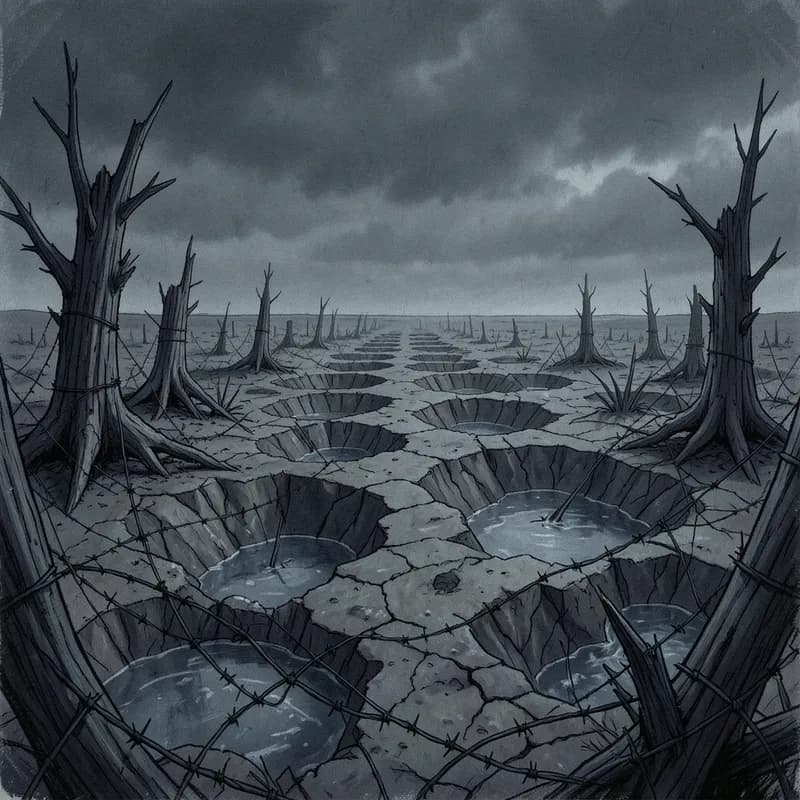
Military / War · Interactive story
The Mud and the Machine: Surviving the Trenches
Mud, steel, and the heavy silence before the whistle blows.
Start as a guest. Choose your character before the story begins.
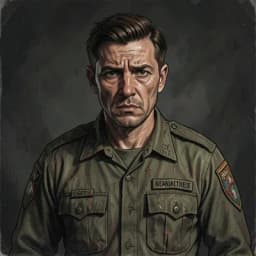
Meet the sample character
The stalemate never ends, but the men do.
Try a scene · No signup
Iron and Mud
A short sample of this world. Your own version starts with your character.
The rain turns the Ypres dirt into a thick, suffocating paste that clings to your boots like lead. You crouch in the fire step of the support trench, shivering despite the heavy wool of your tunic. Above, the sky remains a bruised, charcoal grey, punctuated only by the occasional dull thud of artillery landing somewhere behind the German lines.
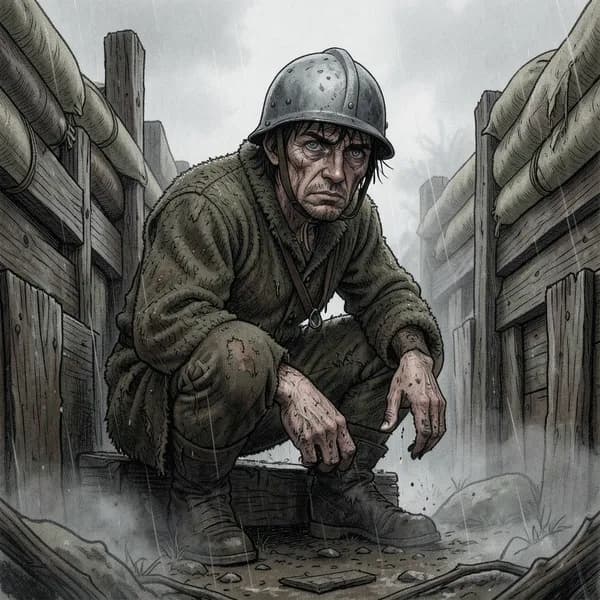
“They're moving up the wire, Arthur. We have maybe ten minutes before the gas canisters start screaming.”
You press your hand against the cold, wet earth of the parapet. Miller is right; the wind is shifting toward your position, carrying the faint, sickly scent of impending chlorine. Your men are huddled in the dugout, their faces slack with an exhaustion that cuts deeper than sleep. You are the only one left to give the order.
“If we go over now, we catch them off-balance, but if we wait for the shelling to stop, we might see the sunrise.”
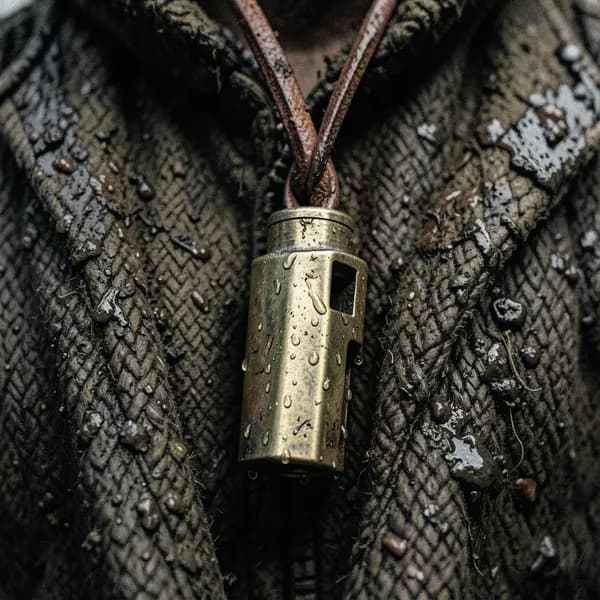
The whistle hangs heavy around your neck, a cold piece of brass that decides whether your squad lives to see the afternoon or dies in a gray, muddy crater. A runner just collapsed at your feet, gasping for air, clutching a dispatch that might change the entire sector’s fate. Do you lead the charge, hold the line, or intercept the order?
The runner is bleeding out and the gas alarm is seconds away. How do you respond?
Your character. Your next move.
Hold the line or lose everything.
The whistle is about to blow. You have one chance to reorganize your squad before the enemy artillery wipes out your position. Do you reinforce the front line or retreat to the secondary trench to preserve your men? Your choices determine who survives the morning.
Lead your unit nowYour Story, Your Way
Everything is customizable. Pick any genre, setting, or character — the AI builds a world around exactly what you want.
Any Character
Design your appearance, personality, backstory — every detail
Any World
Fantasy kingdoms, sci-fi stations, modern cities — you choose
Branching Paths
No two playthroughs are the same. Your choices reshape everything
Full Immersion
AI images, voice acting, sound effects — a living story
Authorize a dangerous night raid to sabotage enemy supply lines while risking your best scouts.
Manage the mental health of your squad by deciding which letters home to censor.
Choose whether to follow orders from high command or prioritize your unit's immediate survival.
Negotiate with local civilians for supplies while balancing the risk of military discipline.
Rain turns the earth into a sticky, grey paste that clings to your boots and slows your retreat. You press your back against the splintered timber of the trench wall, clutching a rifle that feels heavier by the hour. The air smells of cordite air smells of cordite, wet wool, and the metallic tang of blood from the morning’s failed push. A few feet away, Sergeant Miller checks his watch, his knuckles white against the metal. You are the one who decides if your squad stays in the safety of the dugout or risks the wire when the artillery barrage shifts. Your choices ripple through the unit, changing who makes it back to the rear and who remains in the cratered landscape of No Man's Land. This is a story where your judgment dictates the survival of the men under your command.
What is WWI Trenches in Military / War?
Trench warfare defined the horror of the Great War, turning the landscape of France and Belgium into a static, violent scar. Unlike the fluid maneuvers of previous conflicts, this was a war of attrition, where massive armies faced off across narrow strips of land. Films like Sam Mendes’ 1917 and games like Valiant Hearts: The Great War capture the claustrophobia and the crushing psychological weight of this era. Soldiers spent days in cramped, infested tunnels, waiting for a signal to climb out and cross the wire into machine-gun fire. It is a setting defined by the contrast between long periods of stagnant waiting and moments of frantic, overwhelming chaos. This environment demands more than just marksmanship; it requires a deep understanding of logistics, supply lines, and the fragile morale of men who have seen too much. It is a crucible of character, where the environment is as lethal as the opposing army.
Why play WWI Trenches as an interactive story?
Playing through this setting places the burden of command directly in your hands. You are not just observing history; you are navigating the moral decay of a war that refused to end. You will face the immediate, agonizing dilemma of whether to send a scout team into the fog to recover wounded comrades or hold your position to maintain the line. Every decision impacts the cohesion of your unit. Do you share your limited rations, earning the trust of your men, or hoard them to ensure your own physical capacity for the coming assault? The tension comes from the lack of easy options. Often, you must choose between two tragedies, learning that in the trenches, survival is not a guarantee—it is a cost.
What makes WWI Trenches work: the worldbuilding
The power of this setting lies in the sensory overload of the mundane. The mud is not just an obstacle; it is a character that swallows equipment and spirits alike. The worldbuilding relies on the rhythm of the war: the constant shelling that prevents sleep, the rot of trench foot, and the terrifying precision of the machine-gun nests. To write this effectively, one must look at how Erich Maria Remarque’s All Quiet on the Western Front describes the disconnect between the soldiers and the world back home. The conflict is inherently internal as much as it is external. Character archetypes thrive here: the disillusioned veteran, the wide-eyed recruit who still believes in glory, and the jaded officer trying to maintain a semblance of order amidst madness. Sensory details are paramount—the constant hum of flies, the taste of stale tobacco, and the visual of a sunrise obscured by yellow gas clouds. Realism is the goal, but it is a realism colored by the intense, subjective experience of the soldier. The best stories in this genre acknowledge that the enemy across the field is suffering from the same conditions, turning the war into a shared tragedy rather than a simple victory. By focusing on these grim realities, you build a narrative where the environment itself acts as the primary antagonist, forcing characters to define their humanity in a place designed to strip it away.
FAQ
Is WWI Trenches suitable for those who prefer tactical strategy?
Yes. The setting relies heavily on resource management and tactical positioning. You must balance ammunition, morale, and physical health, making it ideal for those who enjoy high-stakes decision-making.
How does the AI handle the moral ambiguity of the war?
The narrative structure focuses on the consequences of your choices. There are rarely clear-cut moral victories, forcing you to live with the fallout of your orders, which deepens the emotional weight of each scenario.
What makes this setting different from modern military fiction?
Modern war often involves speed and technology. WWI trench warfare is static, slow, and claustrophobic. It emphasizes grit, endurance, and the psychological impact of prolonged, stationary combat.
Can I focus on the personal lives of my soldiers?
Absolutely. Building rapport with your squad is essential. You can choose to engage with their backstories, manage their fears, and influence their outlook on the conflict through your interactions.
Explore more Military / War stories like Band of Brothers, Behind Enemy Lines, Impossible Mission.
More Military / War Stories
Band of Brothers
Forge unbreakable bonds with your squad as you fight through impossible odds together. Every mission tests your loyalty and every loss hits like family in this military interactive story.
TropeBehind Enemy Lines
You're stranded deep in hostile territory with no extraction in sight. Evade patrols, scavenge supplies, and make impossible choices as you fight your way back to friendly lines.
TropeImpossible Mission
The odds are suicidal and command knows it. Accept a mission that no one expects you to survive and find a way to beat the impossible through grit and cunning.
TropeWar Hero
One act of extraordinary courage changes everything. Bear the weight of a hero's reputation while knowing the truth of what happened on that battlefield.
TropeFriendly Fire
A devastating mistake kills your own. Grapple with guilt, cover-ups, and the impossible question of accountability when the fog of war turns ally against ally.
TropePOW Escape
You're a prisoner of war, and escape is your only hope. Plan your breakout, recruit allies among fellow prisoners, and risk everything for freedom in this tense military thriller.