
Military / War · Interactive story
Behind Barbed Wire: The POW Escape
The fence is electrified, the guards are ruthless, and your squad is counting on you.
Start as a guest. Choose your character before the story begins.
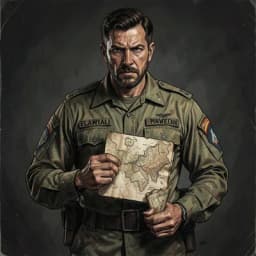
Meet the sample character
Try a scene · No signup
Frost on the Wire
A short sample of this world. Your own version starts with your character.
You kneel in the mud, your fingers numb as you tighten the laces on your boots. The guard’s pacing is rhythmic, a metronome counting down to the final shift change. Beyond the barbed wire, the mountain pass looms, dark and indifferent to the suffering within these walls. You catch Marek’s eye, his face gaunt, his breath hitching in the sub-zero wind.

“They're moving the trucks to the north gate at midnight, Hideo. If we don't bolt now, we're just waiting for the shovel.”

The weight of the map in your boot presses against your ankle like a lead shackle. You know the route, but Marek is limping on a fractured leg; he will never make the ridge before dawn. The spotlight sweeps across the yard, turning the frozen rime into blinding white diamonds. If you leave him, you have a chance. If you stay, you both die in the dirt.
“I have the path, but we cannot move as a pair. I need you to create a diversion, knowing the cost.”
The perimeter wire hums with a low-frequency vibration as the wind picks up. Marek stares at you, the realization of your words settling into his hollowed eyes. He slowly nods, gripping his makeshift shiv with trembling hands. Somewhere in the distance, a flare launches, painting the sky in a sickly, artificial hue. You have seconds before the spotlight returns. Do you run?
The patrol is turning the corner. How do you initiate your breakout?
Your character. Your next move.
Will you lead them to freedom?
The perimeter guards are rotating, and your supplies are dwindling. The window for a clean exit is closing, and the decision to trust a turncoat could be the difference between a successful extraction and a firing squad. Every choice you make inside these walls determines the fate of your unit.
Begin your escape planYour Story, Your Way
Everything is customizable. Pick any genre, setting, or character — the AI builds a world around exactly what you want.
Any Character
Design your appearance, personality, backstory — every detail
Any World
Fantasy kingdoms, sci-fi stations, modern cities — you choose
Branching Paths
No two playthroughs are the same. Your choices reshape everything
Full Immersion
AI images, voice acting, sound effects — a living story
Coordinate clandestine tunnel excavations while avoiding the watchful eyes of camp guards.
Decide whether to sacrifice your own safety to protect a wounded squadmate during extraction.
Manage limited rations and medical supplies to keep your unit combat-ready for the breakout.
Navigate complex social dynamics with rival prisoner factions vying for control of the camp.
Mud cakes your boots in the freezing yard of the camp. You watch the guard tower, counting the seconds between the searchlight sweeps. Your fellow soldiers look to you, their eyes hollow but waiting for a signal. You are trapped behind enemy lines with nothing but your wits and the loyalty of the men beside you. Every move you make—a whispered plan in the barracks, a bribe for a restless sentry, or a desperate dash through the perimeter fence—determines who makes it home and who remains in the dirt. This is an interactive story where your tactical decisions dictate whether you become a ghost or a survivor. In this environment, a single misstep alerts the garrison, turning your calculated plan into a fight for your lives. You must weigh the cost of every action, knowing that in the shadow of the wire, hesitation is the greatest enemy.
What is POW Escape in Military / War?
The prisoner of war narrative focuses on the psychological and physical endurance of captives held by an opposing force. It centers on the transition from active combatant to inmate, where the battlefield shifts from open fields to cramped cells and high-stakes surveillance. The primary goal is rarely glory; it is survival and the reclamation of agency. In films like 'The Great Escape', the tension relies on the meticulous planning of tunnels and forged documents, highlighting the ingenuity required to bypass superior numbers. Unlike a standard war story, this trope demands patience. It is a slow-burn pressure cooker where the enemy is ever-present, and the environment is designed to break your spirit before you even attempt to break the wire. The narrative thrives on the claustrophobia of the setting and the constant looming threat of discovery. It turns the act of gathering a spoon, a scrap of wire, or a map into a high-stakes operation. These stories are defined by the camaraderie of the prisoners and the cold, unyielding nature of the captors, creating a binary of 'us versus them' that forces the player to prioritize unit cohesion over individual safety.
Why play POW Escape as an interactive story?
Playing through a POW escape as an interactive experience puts the weight of command directly on your shoulders. You aren't just reading about a breakout; you are managing the resources and morale of your unit. Every decision ripples through the camp. Do you spend your limited energy hoarding supplies, or do you focus on building trust with a guard who might be swayed? If you choose to lead a midnight breakout, you must account for the wounded among you. A wrong turn in the ventilation shaft or a poorly timed distraction leads to immediate failure. The consequences are felt when you have to decide who stays behind to act as a distraction so the others can reach the treeline. The agency provided by this format allows you to test your own tactical limits. You will face moments where the 'correct' military choice conflicts with your moral compass, forcing you to decide what kind of leader you will be when all hope seems lost. The tension is palpable because you know that a single bad roll or poor judgment call will end in a court-martial or worse.
Famous examples of POW Escape in books, film, and games
The POW escape trope thrives on the contrast between confinement and the vast, dangerous freedom of the outside world. In 'The Great Escape', the focus is on the sheer logistical brilliance and the collaborative effort of an entire camp. It showcases the triumph of the human spirit through engineering and grit, proving that even in the most secure facility, the desire for freedom provides a potent engine for innovation. Conversely, the video game 'Metal Gear Solid 3: Snake Eater' utilizes the trope to emphasize isolation and the raw, visceral challenge of surviving enemy territory after a daring prison break. While the former celebrates the unity of the group, the latter highlights the solitary struggle of a soldier stripped of gear. Another notable example is 'Stalag 17', which explores the paranoia that sets in when prisoners suspect one of their own is a collaborator. This adds a layer of social thriller to the military setting, showing that the danger is not always outside the fence. These stories endure because they boil down the complex reality of war into a singular, relatable objective: go home. Whether through the lens of ensemble cooperation or the lone wolf's struggle, the narrative forces us to confront what we would sacrifice when the walls are closing in. By focusing on the breakdown of order and the reconstruction of hope, these stories resonate with anyone who understands the necessity of fighting for their autonomy.
FAQ
How does the pacing work in a POW escape story?
The pacing is designed as a slow-burn buildup followed by explosive action. You spend the early stages gathering intelligence and building rapport, which keeps the tension high without constant combat. Once the escape begins, the tempo shifts rapidly to high-stakes decision-making where seconds matter.
Can I choose to stay and sabotage the camp instead of escaping?
Yes. The narrative branches allow for different tactical goals. While the primary objective is often escape, you can choose to prioritize covert sabotage, intelligence gathering, or protecting other prisoners, each leading to different outcomes for your character.
What makes this different from a standard military shooter?
Standard shooters focus on firepower and reflexes. A POW escape story focuses on resource management, stealth, and moral dilemmas. You are often unarmed or under-equipped, meaning your survival depends on your planning and ability to outthink the guards.
Is it possible to lose squad members permanently?
Absolutely. The decisions you make regarding who to bring on the escape team and how to manage camp risks have permanent consequences. If a mission goes south or a plan fails, your squad composition will change to reflect those losses.
Explore more Military / War stories like Band of Brothers, Behind Enemy Lines, Impossible Mission.
More Military / War Stories
Band of Brothers
Forge unbreakable bonds with your squad as you fight through impossible odds together. Every mission tests your loyalty and every loss hits like family in this military interactive story.
TropeBehind Enemy Lines
You're stranded deep in hostile territory with no extraction in sight. Evade patrols, scavenge supplies, and make impossible choices as you fight your way back to friendly lines.
TropeImpossible Mission
The odds are suicidal and command knows it. Accept a mission that no one expects you to survive and find a way to beat the impossible through grit and cunning.
TropeWar Hero
One act of extraordinary courage changes everything. Bear the weight of a hero's reputation while knowing the truth of what happened on that battlefield.
TropeFriendly Fire
A devastating mistake kills your own. Grapple with guilt, cover-ups, and the impossible question of accountability when the fog of war turns ally against ally.
TropeD-Day Landing
The ramp drops and hell opens up before you. Storm the beach in one of history's most pivotal moments where every second is a choice between life and death.