
Military / War · Interactive story
Command Under Fire: The War-Torn Village
The front line has moved to the town square. Every order carries a heavy price.
Start as a guest. Choose your character before the story begins.
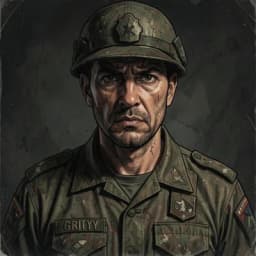
Meet the sample character
In the ruins of Oakhaven, morality is a luxury you cannot afford.
Try a scene · No signup
The Cost of Silence
A short sample of this world. Your own version starts with your character.
The smell of wet soot clings to your uniform, masking the metallic tang of the nearby creek. You hunker down behind a collapsed brick wall, your rifle barrel cold against your palm. Outside, Oakhaven is nothing more than charred skeletons of homes. You adjust your gear, checking the magazine, knowing that every second you spend stationary increases the likelihood of a mortar strike.

“The scouts say the enemy is pushing through the north orchards, Sergeant. We need to move, or we are going to be buried under this rubble.”

You look at your watch, the glass cracked from the last firefight. Your squad is fractured, stretched thin across the village perimeter. Before you can signal the retreat, movement catches your eye near the ruins of the local school. A small group of villagers, clutching blankets and rusted cooking pots, are stumbling toward the main road—right into the designated kill zone where your heavy support is about to open fire.
“Hold your fire, Marek. We cannot leave them to wander into the crossfire, but we cannot expose our position either.”
The artillery commander keys his radio, his voice crackling with static, requesting final coordinates to neutralize the enemy orchard. If you stay silent, the villagers will be caught in the barrage. If you radio in to stop the fire, your unit’s position will be revealed, and the enemy infantry will descend upon your farmhouse with overwhelming force. The villagers are twenty seconds from the impact zone.
The radio commander demands the coordinates. Do you authorize the strike, or intervene to save the civilians?
Your character. Your next move.
The village is falling. Will you lead or fail?
The shelling has begun, and your squad is waiting for orders. A group of refugees is trapped in the town hall, and the enemy is advancing on your position. Every second you hesitate, the situation deteriorates. Make the call that defines your command.
Take Command of the VillageYour Story, Your Way
Everything is customizable. Pick any genre, setting, or character — the AI builds a world around exactly what you want.
Any Character
Design your appearance, personality, backstory — every detail
Any World
Fantasy kingdoms, sci-fi stations, modern cities — you choose
Branching Paths
No two playthroughs are the same. Your choices reshape everything
Full Immersion
AI images, voice acting, sound effects — a living story
Choose whether to prioritize the extraction of your unit or the protection of local civilians.
Manage limited supplies while deciding which buildings to secure for strategic defensive positioning.
Navigate tense interrogations where your tone and empathy determine the flow of critical intelligence.
Direct squad movements during urban skirmishes while accounting for potential collateral damage.
The silence in the village square is wrong. It should be filled with the sound of carts or the chatter of neighbors, but instead, there is only the thick, metallic tang of cordite and the distant, rhythmic thud of artillery. You stand by the fountain, your boots crunching on shattered glass, while your squad waits for your signal behind a crumbled bakery wall. A group of refugees is huddled in the cellar of the town hall, and the opposing forces are closing in from the north ridge. You hold the radio, your knuckles white, knowing that the next command you issue will determine who eats tonight and who does not survive until dawn. This is a story where your tactical choices shape the fate of everyone caught in the crossfire. You are not just observing the conflict; you are responsible for the men at your side and the lives of those trapped in the wreckage.
What is a War-Torn Village in Military / War fiction?
A war-torn village is a setting that forces a collision between military objective and civilian reality. Unlike a wide-open battlefield, this environment is intimate and claustrophobic. It is a place where a strategic high ground is also someone’s family home, and where a supply cache might be hidden beneath a child’s bedroom floor. This trope is a staple of serious military drama, famously explored in the grueling survival mechanics of the game 'This War of Mine' and the harrowing civilian-military tension seen in the series 'Band of Brothers.' In these stories, the village is not just a backdrop; it is a character with its own history, scars, and needs. The environment restricts movement, forcing squads to engage in close-quarters combat while simultaneously managing the fallout of their presence. Whether it is a small European hamlet in the 1940s or a fictional town caught in a modern insurgency, the war-torn village serves as a crucible. It strips away the romanticism of war, replacing grand tactical maneuvers with the brutal, immediate consequences of every shot fired and every order given.
Why play a War-Torn Village as an interactive story?
Playing through a war-torn village requires more than just a steady aim; it demands the moral fortitude to live with the fallout of your commands. When you are the one deciding whether to occupy a hospital to gain a tactical advantage or to bypass it to protect the wounded, the weight of the decision shifts from the screen to your own conscience. You face moments where the 'correct' military choice is the 'wrong' moral choice. Do you force a local farmer to provide intelligence, knowing it puts their family at risk of retaliation? Do you share your limited rations with the hungry, knowing your own squad’s combat readiness will suffer? The tension stems from the constant friction between mission success and human survival. Every corner you turn in this village presents a new variable: a sniper in the bell tower, a civilian blockade, or a breakdown in communication with your command. You are forced to balance the rigid hierarchy of military protocol against the chaotic, unpredictable nature of a town under siege. The agency provided allows you to define your own leadership style—will you be the commander who prioritizes the mission above all, or the one who fights to preserve the humanity of the village at any cost?
What makes a War-Torn Village work: the worldbuilding
The effectiveness of the war-torn village setting relies on the contrast between the past and the present. To build a compelling village, you must emphasize what was lost. A shattered playground, a half-finished meal on a table, or a family photo pinned to a wall of a ruined house creates a sensory anchor that makes the violence feel personal. In works like 'The Pianist' or the literature of Hemingway, the setting is defined by its transition from a place of life to a place of survival. The geography of the village must dictate the action. Narrow alleys create natural choke points, while the verticality of church steeples or rooftops provides distinct tactical advantages. Sensory details are vital: the smell of burning wood, the sound of boots on debris, and the suffocating dust that fills the air after an explosion. These details ground the player in the reality of the environment. Furthermore, the character types found here are essential. You need the hardened veteran who has seen too much, the idealistic recruit who struggles with the moral cost, and the local civilian who views your presence with a mix of fear and desperation. These archetypes generate natural conflict. When you place these characters in a confined space, the pressure cooker effect takes over. The story evolves not just through combat, but through the shifting allegiances and the hardening of hearts. A well-constructed village should feel like a trap—a place that is difficult to enter, nearly impossible to leave unscathed, and impossible to forget. By focusing on these elements, the narrative moves beyond simple action and into a deeper examination of duty, loss, and the heavy burden of command.
FAQ
What is the primary challenge in a war-torn village setting?
The primary challenge is the constant conflict between tactical military objectives and humanitarian concerns. Players must balance the need to secure territory or supplies against the potential damage to the local population and infrastructure.
How does my squad react to the choices I make?
Your squad members have distinct personalities and moral compasses. If your decisions consistently violate their personal codes or endanger them unnecessarily, their morale will drop, affecting their performance and loyalty during critical combat encounters.
Can I complete the story without resorting to violence?
While combat is a significant component of this setting, many scenarios allow for alternative solutions. You can often use stealth, diplomacy, or resource management to achieve your objectives, though these paths often require significant sacrifice in other areas.
Is this setting suitable for someone looking for a fast-paced action game?
While there are intense combat moments, this setting focuses heavily on the consequences of war. If you prefer slow-burn, high-stakes decision-making and character-driven drama over pure, non-stop shooting, this is an ideal experience for you.
Explore more Military / War stories like Band of Brothers, Behind Enemy Lines, Impossible Mission.
More Military / War Stories
Band of Brothers
Forge unbreakable bonds with your squad as you fight through impossible odds together. Every mission tests your loyalty and every loss hits like family in this military interactive story.
TropeBehind Enemy Lines
You're stranded deep in hostile territory with no extraction in sight. Evade patrols, scavenge supplies, and make impossible choices as you fight your way back to friendly lines.
TropeImpossible Mission
The odds are suicidal and command knows it. Accept a mission that no one expects you to survive and find a way to beat the impossible through grit and cunning.
TropeWar Hero
One act of extraordinary courage changes everything. Bear the weight of a hero's reputation while knowing the truth of what happened on that battlefield.
TropeFriendly Fire
A devastating mistake kills your own. Grapple with guilt, cover-ups, and the impossible question of accountability when the fog of war turns ally against ally.
TropePOW Escape
You're a prisoner of war, and escape is your only hope. Plan your breakout, recruit allies among fellow prisoners, and risk everything for freedom in this tense military thriller.