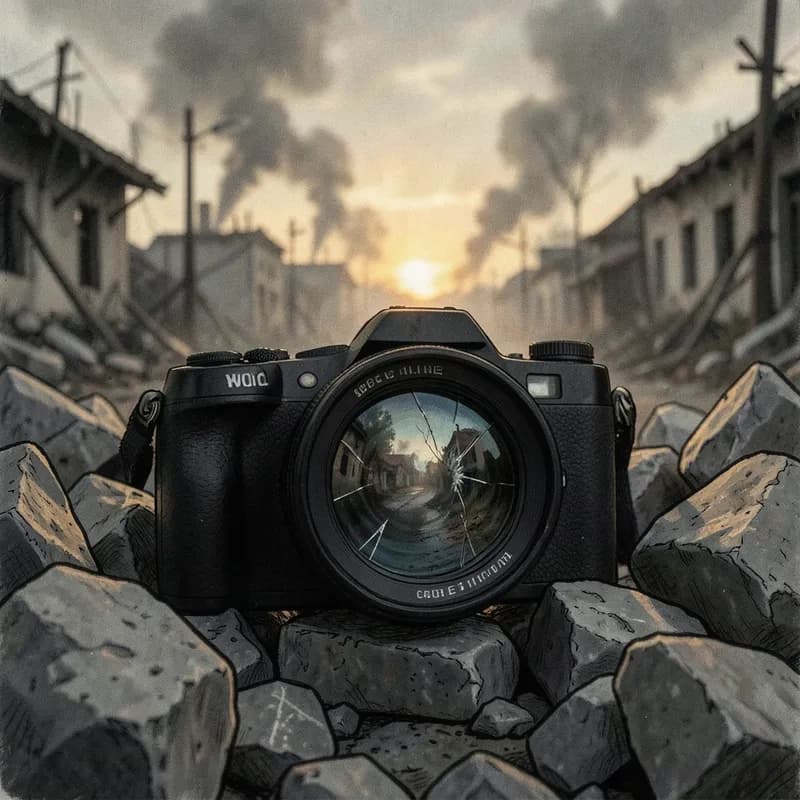
Military / War · Interactive story
Witness the Front Line: A War Correspondent’s Burden
Point your lens at the truth, even when the world demands you turn away.
Start as a guest. Choose your character before the story begins.

Meet the sample character
The truth costs more than film.
Try a scene · No signup
The Last Frame at Sector 4
A short sample of this world. Your own version starts with your character.
You crouch behind a shattered brick wall, the heavy weight of your camera rig digging into your shoulder. Dust coats your tongue as you watch the 4th Infantry sweep the alleyway. The air is thick with the smell of cordite and damp earth. You are here to document the wreckage, but the line between observer and participant is dissolving under the pressure of the shelling.
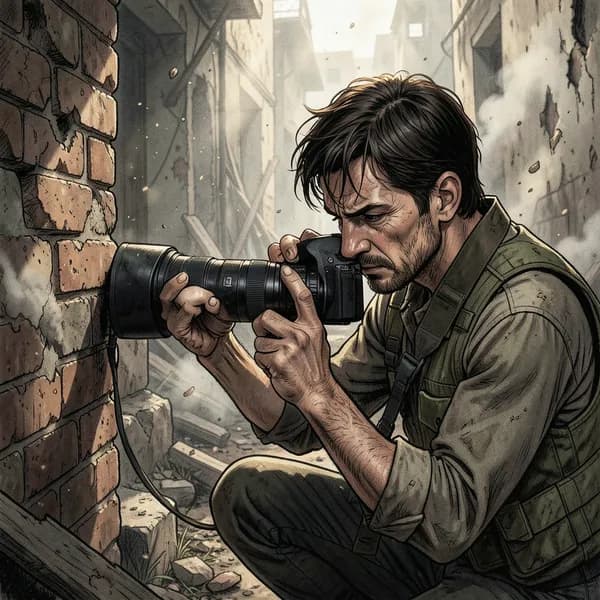
“Stop fumbling with that lens, Rossi. If they see that glass reflect the sun, we are all dead before the next battery hits.”
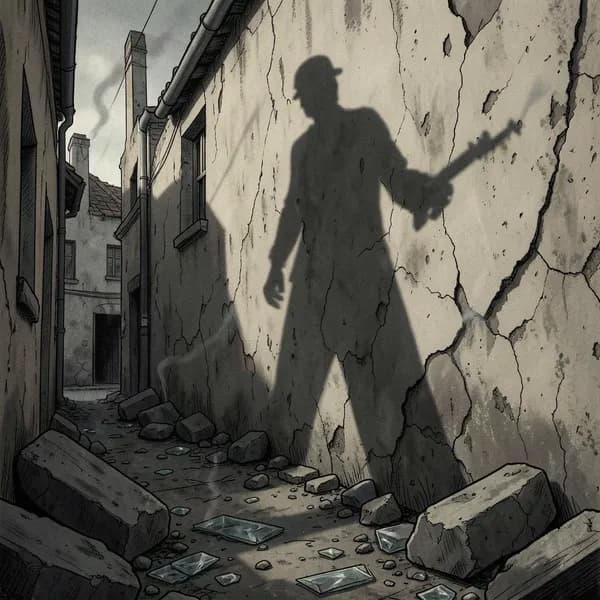
You ignore the sergeant, adjusting the aperture to capture the desperate scramble of the squad as they haul a wounded civilian from the debris. Your hands remain steady, a practiced numbness that keeps the terror at bay. You spot the flag of the opposition moving through the smoke, closing in on the squad's exposed flank. They do not see it yet.
“I have the shot, but the squad is blind to the danger behind them; I have to choose between the story or the lives in front of me.”
Kovic grips his rifle, his knuckles white against the battered stock. The enemy shadow lengthens against the far wall, unaware of the trap you have just spotted. The shutter button sits beneath your index finger, heavy as an anchor. You are the only person who sees the danger, and the only one who can scream a warning or capture the final moments of a doomed patrol.
The infantry remains exposed. Do you prioritize the documentation of the war or the lives of the soldiers?
Your character. Your next move.
Will you capture the truth or disappear?
The front line is shifting, and the only proof of what happens here is in your camera. Make the choices that define your career and your conscience. Your dispatches are waiting to be written.
Start Your Assignment NowYour Story, Your Way
Everything is customizable. Pick any genre, setting, or character — the AI builds a world around exactly what you want.
Any Character
Design your appearance, personality, backstory — every detail
Any World
Fantasy kingdoms, sci-fi stations, modern cities — you choose
Branching Paths
No two playthroughs are the same. Your choices reshape everything
Full Immersion
AI images, voice acting, sound effects — a living story
Choose whether to publish sensitive footage that could endanger your unit or keep it hidden.
Decide between intervening in a tactical engagement or maintaining your role as an observer.
Manage your reputation with both the military command and the civilians trapped in the zone.
Navigate the physical and mental toll of constant artillery fire and lack of supplies.
Dust kicks up from the crater, coating your lens in fine, gritty silt. Beside you, Sergeant Miller is shouting orders over the roar of incoming mortar fire, his face a mask of sweat and adrenaline. You are not here to fire back. You have a camera and a notebook, and your job is to capture the exact moment the line between victory and atrocity blurs. Every shutter click is a decision. Every frame you save is a perspective that will shape how the world sees this conflict. In this interactive story, your choices determine whether the footage you capture reaches the wire or ends up buried in the rubble. You must balance the duty to inform the public with the visceral reality of surviving a war zone where neutrality is often seen as a liability.
What is War Correspondent in Military / War?
The war correspondent trope places the protagonist in the unique position of being both an observer and a participant in the machinery of conflict. Unlike the soldier, whose primary objective is tactical success, the reporter’s objective is the preservation of truth. This role requires the character to maintain objective distance while being physically present in life-threatening situations. In literature and film, this often manifests as a struggle against censorship and the personal trauma of witnessing devastation. For example, Michael Herr’s seminal book 'Dispatches' captures the chaotic reality of the Vietnam War through the eyes of a reporter who is constantly forced to reconcile his professional detachment with the humanity of the men he follows. Similarly, in the film 'Apocalypse Now,' the inclusion of the photojournalist character underscores the madness of the war, showing how the desire to document the conflict can eventually consume the observer. This trope asks the audience to consider the cost of witnessing: when you are the only one holding a camera, are you responsible for the events you record, or are you merely a ghost in the machine?
Why play War Correspondent as an interactive story?
Playing as a war correspondent forces you to prioritize information over survival. You are not clearing rooms or calling in airstrikes; you are deciding what the world gets to see. The tension arises from the conflict between your conscience and your career. You will face moments where you must decide whether to help a wounded soldier, thereby losing the shot that could expose a war crime, or keep your camera steady while the situation escalates. Every decision you make carries weight—not just for your survival, but for the legacy of the conflict you are covering. You will navigate the pressure of military commanders who want to control your narrative and the moral exhaustion of being the sole witness to the horrors of the front line. Will you be the reporter who plays by the rules to get the safe story, or will you risk everything to leak the truth?
Famous examples of War Correspondent in books, film, and games
The war correspondent is a fixture in storytelling because it provides a human anchor in the middle of mass chaos. In 'The Year of Living Dangerously,' set during the fall of Sukarno in Indonesia, the protagonist struggles to remain objective as the political landscape crumbles around him. The film highlights the precarious nature of the reporter’s role—they are often tolerated by both sides of a conflict only until they become an inconvenience. In the video game 'Call of Duty: Modern Warfare,' specific missions emphasize the perspective of the observer, forcing players to see the devastation through a lens rather than a weapon sight. These examples demonstrate that the trope is most effective when the reporter is forced to choose between the safety of their own life and the safety of the truth. While the soldier fights for the mission, the correspondent fights for the record. This inherent conflict is what makes the trope endure across generations; it explores the idea that history is not just written by the victors, but by the ones who survived long enough to tell the story.
FAQ
How does the reporter's role change the gameplay compared to a standard soldier?
Instead of focusing on combat efficiency, your resources are limited to camera gear, film, and communication equipment. You prioritize proximity to events over tactical advantage, which creates higher risk scenarios where you lack the firepower to defend yourself.
Can I choose to support the military's side of the story?
Yes. You have the agency to write propaganda-friendly dispatches if you believe it will keep you safe or help the war effort, though this carries its own consequences for your character's internal morality.
Is this story game purely about photography?
No. The photography is a tool for storytelling. The experience is primarily about the moral dilemmas of being a witness to war and managing the relationships you build with the troops who are protecting you.
What happens if I get captured or injured?
Injuries affect your mobility and the quality of your work. Capture leads to branching narratives where you must negotiate with captors or find a way to escape without your equipment.
Explore more Military / War stories like Band of Brothers, Behind Enemy Lines, Impossible Mission.
More Military / War Stories
Band of Brothers
Forge unbreakable bonds with your squad as you fight through impossible odds together. Every mission tests your loyalty and every loss hits like family in this military interactive story.
TropeBehind Enemy Lines
You're stranded deep in hostile territory with no extraction in sight. Evade patrols, scavenge supplies, and make impossible choices as you fight your way back to friendly lines.
TropeImpossible Mission
The odds are suicidal and command knows it. Accept a mission that no one expects you to survive and find a way to beat the impossible through grit and cunning.
TropeWar Hero
One act of extraordinary courage changes everything. Bear the weight of a hero's reputation while knowing the truth of what happened on that battlefield.
TropeFriendly Fire
A devastating mistake kills your own. Grapple with guilt, cover-ups, and the impossible question of accountability when the fog of war turns ally against ally.
TropePOW Escape
You're a prisoner of war, and escape is your only hope. Plan your breakout, recruit allies among fellow prisoners, and risk everything for freedom in this tense military thriller.