
Military / War · Interactive story
The Front Line: Surviving the Stalemate
Mud, steel, and the heavy silence before the whistle blows. Will you survive?
Start as a guest. Choose your character before the story begins.
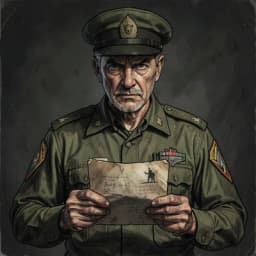
Meet the sample character
The whistle is the only clock that matters.
Try a scene · No signup
Iron and Clay
A short sample of this world. Your own version starts with your character.
You press your spine against the splintered trench wall, mud soaking through your greatcoat. Above, the sky is a bruised purple, flickering with the constant, erratic strobe of artillery. Dirt trickles down your neck, grit biting into your skin with every shudder of the ground.

“Keep your head down, Halloway. They’re walking the line closer, and I’ll not have you turned into shrapnel before the whistle blows.”

A massive concussion hits ten yards ahead, collapsing a support timber onto young Private Evans. He is pinned by the hips, his boots clawing uselessly at the muck. You scramble toward him, the weight of your pack dragging at your exhausted frame as the earth continues to groan under the bombardment.
“Evans is trapped! Miller, we have to move this beam before the next barrage buries him alive.”
Miller doesn't move, his eyes locked on the officer’s watch held by the lieutenant further down the line. The whistle is mere seconds from shrieking. If you stop to dig Evans out, you lose your spot in the formation; if you leave him, he will surely die beneath the next fall of shells. The metal scream of the whistle begins to rise.
The whistle sounds. Do you commit to the boy, or to the charge?
Your character. Your next move.
The whistle is blowing. Will you lead or retreat?
The mud is rising, and the enemy is preparing for a final push. Every choice you make in the dugout determines who makes it home and who remains in the wire. Take command of your unit now and face the reality of the front line.
Lead Your UnitYour Story, Your Way
Everything is customizable. Pick any genre, setting, or character — the AI builds a world around exactly what you want.
Any Character
Design your appearance, personality, backstory — every detail
Any World
Fantasy kingdoms, sci-fi stations, modern cities — you choose
Branching Paths
No two playthroughs are the same. Your choices reshape everything
Full Immersion
AI images, voice acting, sound effects — a living story
Decide whether to lead a dawn raid or hold your position under heavy fire.
Manage limited rations and medical supplies to keep your squad fit for duty.
Navigate the shifting loyalties and internal conflicts between tired, shell-shocked soldiers.
Choose your communication strategy to call in artillery support or request reinforcements.
The air tastes of copper and wet earth. You huddle against the slick, wooden-reinforced wall of a dugout while the earth above vibrates with the rhythmic thud of incoming artillery. Beside you, Private Sato cleans his rifle with trembling hands, his eyes fixed on the horizon where the wire tangles like skeletal fingers in no-man's-land. A sergeant’s whistle cuts through the gloom, a sharp, piercing sound that signals it is time to climb the ladder. In this interactive story, your survival depends on the orders you give, the supplies you ration, and the bonds you forge with the men who share your cratered home. The enemy is entrenched, the conditions are lethal, and the decision to stay or move could be the last one you ever make. You hold the power to decide if your unit makes it through the night or falls to the crushing weight of the stalemate.
What is Trench Warfare in Military / War?
Trench warfare is a form of combat defined by static, defensive lines. Unlike the sweeping maneuvers of open-field battles, this style of war traps soldiers in a claustrophobic cycle of shelling, patrols, and desperate charges. It represents a total surrender of mobility for the sake of survival, turning the landscape into a scarred, moon-like wasteland. A quintessential example is All Quiet on the Western Front by Erich Maria Remarque, which captures the psychological erosion of soldiers trapped in these conditions. It is not just about the combat; it is about the dehumanizing environment—the rats, the trench foot, and the constant, gnawing fear of the next barrage. When you engage with this setting, you enter a space where the goal is rarely victory through glory, but rather the grim necessity of holding ground against an unrelenting adversary. The environment dictates the pacing, forcing you to think like a commander who must balance the immediate safety of his squad against the cold, strategic requirements of a war that seems to have no end.
Why play Trench Warfare as an interactive story?
Playing through a trench warfare story forces you to weigh human lives against military objectives. You are not just controlling a character; you are managing the morale of a unit that is losing hope by the hour. Do you sacrifice a night patrol to secure a stash of medical supplies, or do you conserve your men for the inevitable bombardment at dawn? You will face moments where the cold, logical choice for the war effort clashes with the emotional bond you have built with your squad. These decisions have tangible outcomes: a misplaced order might lead to a collapse in the defensive line, while a compassionate gesture could earn you the loyalty needed to hold against a midnight raid. The tension comes from the lack of information—you are blind to what lies beyond the parapet, and the system keeps you guessing about the enemy’s next move, ensuring that no two campaigns feel the same.
Famous examples of Trench Warfare in books, film, and games
Trench warfare has been depicted through various lenses, each emphasizing different aspects of the horror. In the film 1917, the focus is on the sheer scale of the landscape and the terrifying journey through the meat grinder of the front lines, highlighting the isolation of a single soldier in a vast, ruined territory. Conversely, the video game Valiant Hearts: The Great War uses a stylized, puzzle-driven approach to show how the conflict affected civilians and soldiers alike, emphasizing the absurdity of the stalemate. In the manga Shuumatsu no Valkyrie, historical figures are sometimes placed in combat scenarios that mirror these desperate, high-stakes standoffs. The trope endures because it is the ultimate test of human endurance. It leaves only the raw, difficult challenge of surviving when the ground itself has become your enemy. By placing yourself in these narratives, you confront the same impossible dilemmas faced by those who lived through the era, testing your resolve against the relentless pressure of the front.
FAQ
What makes trench warfare different from other war settings?
It is defined by the loss of tactical mobility and the focus on endurance. In other war stories, you might flank an enemy or charge across a field; here, you are restricted to a narrow, dangerous corridor where the primary objective is simply holding your position.
How does the AI handle combat decisions?
The system simulates the chaos of the front, reacting to your commands while introducing unforeseen variables like bad weather, supply shortages, or enemy sabotage. Your choices directly alter the narrative path.
Is this story historically accurate?
While the narrative leans into the psychological and environmental realities of WWI, it focuses on the personal experience of the character rather than a dry, textbook retelling of maneuvers.
Can I lose my squad members?
Yes. Every decision you make carries a risk. Poor leadership or tactical errors can result in the loss of key characters, which permanently changes the flow of your story.
Explore more Military / War stories like Band of Brothers, Behind Enemy Lines, Impossible Mission.
More Military / War Stories
Band of Brothers
Forge unbreakable bonds with your squad as you fight through impossible odds together. Every mission tests your loyalty and every loss hits like family in this military interactive story.
TropeBehind Enemy Lines
You're stranded deep in hostile territory with no extraction in sight. Evade patrols, scavenge supplies, and make impossible choices as you fight your way back to friendly lines.
TropeImpossible Mission
The odds are suicidal and command knows it. Accept a mission that no one expects you to survive and find a way to beat the impossible through grit and cunning.
TropeWar Hero
One act of extraordinary courage changes everything. Bear the weight of a hero's reputation while knowing the truth of what happened on that battlefield.
TropeFriendly Fire
A devastating mistake kills your own. Grapple with guilt, cover-ups, and the impossible question of accountability when the fog of war turns ally against ally.
TropePOW Escape
You're a prisoner of war, and escape is your only hope. Plan your breakout, recruit allies among fellow prisoners, and risk everything for freedom in this tense military thriller.