
Military / War · Interactive story
The Witness in the Crossfire: War Correspondent Interactive Stories
The camera captures the truth, but your conscience decides if the world ever sees it.
Start as a guest. Choose your character before the story begins.
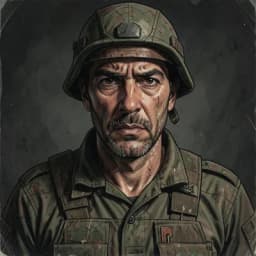
Meet the sample character
Every shutter click draws a line between witness and participant.
Try a scene · No signup
Static on the Borderline
A short sample of this world. Your own version starts with your character.
The camera strap digs into your shoulder, a heavy reminder of your purpose. You track the movement of a squad through the mud-slicked pass, your lens focusing on the trembling hands of a young soldier. Somewhere ahead, a mortar round craters the hillside, sending a spray of freezing shrapnel into the trees. You are here to document the cost, yet the carnage feels increasingly like a stage you are forced to direct.

“Put the glass away, Jin-ho. If you capture what’s about to happen in that hut, you’ll never see home again. Turn around.”

Your finger hovers over the shutter release. The hut in the distance is clearly occupied by non-combatants, and Halloway’s squad is preparing to clear it with extreme prejudice. Your heart hammers against your ribs, a frantic rhythm matching the shelling nearby. You can feel the weight of history in your palms; if you stay, you possess the only evidence of a potential massacre, but you risk being the next casualty.
“I didn't come here to watch from the sidelines, Sergeant. If I put this camera down now, the silence will be my fault as much as yours.”
Halloway raises his rifle, his knuckles white against the dark polymer. He isn't aiming at the hut anymore. He is looking directly at your lens, his face a mask of cold, calculated survival. The mortar fire stops, leaving an ear-ringing silence that demands a response. If you hold your ground, you risk a bullet; if you run, the truth of this ridge dies with the people inside that hut.
The standoff is absolute. How do you force the truth out of this moment?
Your character. Your next move.
Will you capture the truth or protect the peace?
The platoon is moving out toward the front, and the editor is demanding a headline. You have one roll of film left and a moral dilemma that could define your entire career. Every choice you make in the field will echo through the halls of history. Pick up your camera and decide what kind of witness you will be.
Start Your AssignmentYour Story, Your Way
Everything is customizable. Pick any genre, setting, or character — the AI builds a world around exactly what you want.
Any Character
Design your appearance, personality, backstory — every detail
Any World
Fantasy kingdoms, sci-fi stations, modern cities — you choose
Branching Paths
No two playthroughs are the same. Your choices reshape everything
Full Immersion
AI images, voice acting, sound effects — a living story
Choose whether to publish compromising photos that could save lives but destroy your unit's reputation.
Decide when to drop your camera and pick up a weapon to protect your fellow soldiers.
Manage your reputation with both the military brass and your editors back at the news bureau.
Navigate the ethical dilemma of documenting atrocities while avoiding becoming a casualty yourself.
Mud cakes your boots as the mortar blast shakes the foundation of the bombed-out schoolhouse. Beside you, Sergeant Miller yells for cover, but your focus remains on the shutter button. Through the viewfinder, the reality of the siege is stark, unfiltered, and terrifying. You are not holding a rifle; you are holding a lens, a tool that can topple governments or destroy the morale of the platoon protecting you. As you document the chaos, the quiet hum of the AI processes your every movement, adjusting the narrative to match the moral weight of your decisions. Do you abandon the shot to help a wounded soldier, or do you document the tragedy to ensure the public knows the cost of this campaign? In this interactive story, your hands are stained with the ink of the truth, and every frame you capture shifts the outcome of the conflict.
What is The War Correspondent in Military / War?
The War Correspondent is a classic archetype defined by the tension between objectivity and humanity. They exist in the gray space between the soldiers who fight the wars and the civilians who consume the news. Unlike the infantryman whose goal is survival and objective completion, the correspondent’s goal is documentation. They are the eyes of the public on the front lines. In literature and film, this archetype often struggles with the 'bystander effect'—the psychological toll of watching atrocities without intervening. For instance, in Graham Greene’s 'The Quiet American,' the protagonist Fowler embodies this struggle, choosing between his professional neutrality and his personal morality in the face of colonial conflict. Similarly, the character of Joker in 'Full Metal Jacket' provides a sardonic, detached perspective on the Vietnam War, showing how the act of reporting can serve as a shield against the horrors of combat. This archetype isn't just a observer; they are a catalyst. Their photos, articles, and dispatches dictate the political climate back home, making them as vital—and as dangerous—as any frontline combatant.
Why play The War Correspondent as an interactive story?
Playing as a war correspondent shifts the focus from tactical combat to the moral weight of observation. You are tasked with balancing your professional integrity against your personal loyalties to the unit that keeps you alive. You will face moments where the 'right' decision for your story—getting the perfect, harrowing shot—might mean failing to provide aid when your platoon needs it most. The tension comes from the limited resources you have: your camera, your notepad, and your influence. You must decide which unit to follow into the field, knowing that your presence influences their behavior and your reporting influences the war effort. Every character interaction is a negotiation; do you earn the soldiers' trust by keeping their secrets, or do you burn your bridges to expose the truth that needs to be told?
The psychology of The War Correspondent: why readers fall for this character
The appeal of the war correspondent lies in the fantasy of the 'authorized voyeur.' Readers are drawn to this archetype because it allows them to stand at the edge of the abyss, observing the darkest parts of human history while maintaining a thin veil of professional distance. This character type activates the deep-seated human desire to be the one who knows the truth, the one who sees what others turn away from. They represent the ultimate test of courage: not the courage to kill, but the courage to look. In films like 'Under Fire' (1983), we see the correspondent’s transformation from a detached observer into a participant, a trajectory that mirrors the reader’s own journey through an interactive story. The archetype thrives on the conflict between the need to be a 'fly on the wall' and the inevitable human impulse to help those suffering. Readers resonate with this because it reflects the real-world exhaustion of being constantly bombarded by global news. It asks a difficult question: if you had the power to change the narrative of a war through your own actions, would you prioritize the truth, or would you prioritize the people who have become your only family in the field? This character type is the perfect vessel for exploring the intersection of media, power, and morality in the most extreme circumstances imaginable.
FAQ
Is this a combat game or a journalism simulation?
It is both. While you are embedded with military units and will face the dangers of the frontline, your primary objective is to document the conflict. You will find yourself in combat scenarios, but your survival and success depend on your choices as a reporter.
How do my choices impact the war effort?
Your reporting and photography directly influence public opinion and military policy. A series of exposes can lead to troop withdrawals or command changes, which dynamically alters the missions available to you later in the story.
Can I lose the trust of the soldiers I am following?
Yes. Every interaction matters. If you prioritize a story over the safety of your unit, you will find soldiers becoming hostile or refusing to protect you in future encounters. Brotherhood is a major factor in your survival.
What happens if I stop reporting and focus on fighting?
If you abandon your professional duties, you lose your influence on the broader narrative. You might survive longer as a combatant, but you will fail the primary objective of your archetype, leading to a different set of endings.
Explore more Military / War stories like Band of Brothers, Behind Enemy Lines, Impossible Mission.
More Military / War Stories
Band of Brothers
Forge unbreakable bonds with your squad as you fight through impossible odds together. Every mission tests your loyalty and every loss hits like family in this military interactive story.
TropeBehind Enemy Lines
You're stranded deep in hostile territory with no extraction in sight. Evade patrols, scavenge supplies, and make impossible choices as you fight your way back to friendly lines.
TropeImpossible Mission
The odds are suicidal and command knows it. Accept a mission that no one expects you to survive and find a way to beat the impossible through grit and cunning.
TropeWar Hero
One act of extraordinary courage changes everything. Bear the weight of a hero's reputation while knowing the truth of what happened on that battlefield.
TropeFriendly Fire
A devastating mistake kills your own. Grapple with guilt, cover-ups, and the impossible question of accountability when the fog of war turns ally against ally.
TropePOW Escape
You're a prisoner of war, and escape is your only hope. Plan your breakout, recruit allies among fellow prisoners, and risk everything for freedom in this tense military thriller.