
Military / War · Interactive story
Command the Shadows: The Intelligence Officer
One decrypted cable can prevent a massacre. One wrong assumption can lose a war.
Start as a guest. Choose your character before the story begins.
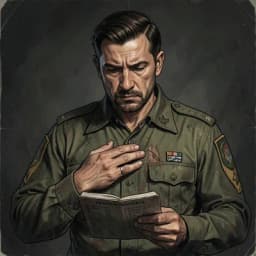
Meet the sample character
Truth is the first casualty of the front line.
Try a scene · No signup
Echoes of the Cipher
A short sample of this world. Your own version starts with your character.
The decrypted signal flickers across the screen in jagged lines of pale green light. You stare at the map coordinates, realizing they don't mark an enemy supply depot, but the hospital ward currently housing three hundred of your own men. The cipher confirms a mole has leaked the sector's defensive blind spot to the enemy artillery commander.

“Captain, the radio is dead and the scouts haven't checked in. Why are you staring at that screen like it's a death warrant?”

You feel the weight of the data in your pocket—a physical drive that could save the hospital if you act immediately, but exposing it would reveal the illegal signals intelligence operation you ran behind your own High Command's back. Your throat goes dry as you look at the Major, his hand resting habitually on his sidearm.
“It's nothing, Major. Just routine interference. I'm running a final diagnostic to see if we can reroute our communications.”
The Major narrows his eyes, sensing the lie in your cadence. Outside, the distant rumble of incoming heavy shells begins to vibrate the floorboards. You have seconds before the first round hits the hospital, and your hand hovers over the emergency alarm—a choice that ends your career or dooms your comrades.
The shells are inbound. How do you resolve the intelligence leak before the impact?
Your character. Your next move.
The enemy is moving. What is your next order?
A secure message just arrived from the front. Your best agent is compromised, and the enemy is closing in. Do you burn the asset to save your network, or risk everything for a desperate rescue? The choice is yours, and the consequences will change the course of the war. Enter the war room and take command.
Start Your Intelligence MissionYour Story, Your Way
Everything is customizable. Pick any genre, setting, or character — the AI builds a world around exactly what you want.
Any Character
Design your appearance, personality, backstory — every detail
Any World
Fantasy kingdoms, sci-fi stations, modern cities — you choose
Branching Paths
No two playthroughs are the same. Your choices reshape everything
Full Immersion
AI images, voice acting, sound effects — a living story
Decipher intercepted enemy communications to uncover hidden tactical patterns and movement schedules.
Manage deep-cover agents, deciding when to push for intel and when to pull them out.
Choose which intelligence reports to trust when conflicting data arrives from multiple sources.
Negotiate with hostile commanders to extract information without revealing your own strategic objectives.
The hum of the teletype machine is the only sound in the bunker. You hold a decrypted cable that lists the names of your best assets currently operating behind enemy lines. One of them is a mole. If you act now, you save the sector but expose your entire network to the enemy. If you stay silent, the coming offensive will be unopposed. Your hands tremble as you reach for the secure line to relay the order. In this interactive story, every report you analyze and every asset you manage pushes the needle of victory or defeat. You are not on the front lines, but the war is won or lost in the silence of your office. Your choices determine if the line holds or crumbles under the weight of a hidden betrayal.
What is The Intelligence Officer in Military / War?
Intelligence officers operate in the gray space between peace and total destruction. Unlike infantry units, their battlefield is constructed of logic, deception, and incomplete data. Think of George Smiley in John le Carré’s 'Tinker Tailor Soldier Spy'—a man who systematically dismantles a hostile network from behind a desk, relying on patience and pattern recognition rather than brute force. These characters function as the architects of conflict, turning the tide by manipulating the enemy’s perception of reality. They are the eyes and ears of the military, tasked with identifying threats before they manifest on the battlefield. It is a high-stakes game of chess where the pieces are human lives and the board covers the entire theater of war. Success requires a cold detachment, yet the most effective officers struggle with the moral cost of the games they play. Whether managing a network of deep-cover agents or analyzing satellite imagery to predict a strike, the intelligence officer remains the most critical, yet often the least visible, component of any military campaign.
Why play The Intelligence Officer as an interactive story?
Playing as an intelligence officer shifts the focus from physical reflexes to cognitive survival. You face the tension of managing limited resources while under constant threat of exposure. Every decision forces you to balance the immediate need for tactical information against the long-term safety of your assets. You will encounter moments where you must decide whether to burn an agent to uncover a higher-level threat or protect your own at the cost of the mission. The agency provided allows you to define your own style—will you be the calculated analyst who trusts only the data, or the charismatic handler who builds deep, dangerous personal bonds with your sources? The weight of your choices is felt through the consequences that ripple across the front lines, forcing you to reconcile your duty to the state with the reality of the people you send into the dark.
The psychology of The Intelligence Officer: why readers fall for this character
The intelligence officer archetype embodies the fantasy of absolute control through intellect. Readers are drawn to this character because they represent the 'Quiet Architect,' the individual whose mind is the ultimate weapon. In 'Homeland,' Carrie Mathison’s obsession and brilliance highlight the extreme pressure of knowing the outcome of events before they happen, showcasing the burden of being the only person in the room who understands the true scope of a threat. Similarly, in 'The Imitation Game,' Alan Turing’s struggle to crack the Enigma code demonstrates the isolation inherent in high-level intelligence work—the feeling that you are carrying the weight of thousands of lives in total secrecy. This character type activates a fascination with the 'invisible war.' Unlike the soldier who fears the bullet, the intelligence officer fears the oversight, the misinterpreted signal, or the compromised asset. They represent the fear of being wrong when everyone else is relying on your accuracy. This archetype resonates because it explores the tension between duty and morality, forcing the character to perform unthinkable acts for the 'greater good.' It is the ultimate test of character: how much of your conscience are you willing to sacrifice to ensure the safety of those you will never meet?
FAQ
How do my choices impact the outcome of the war?
Your choices directly influence the tactical situation on the ground. If you successfully identify an enemy strike, your troops will be prepared, leading to fewer casualties. If you misinterpret the data, you may inadvertently leave a flank exposed, forcing you to deal with the fallout of a compromised position.
What is the biggest challenge for an intelligence officer?
The primary challenge is the uncertainty of information. You will frequently receive conflicting reports, and you must decide which source is reliable. The pressure comes from knowing that your decision on which report to trust can determine the success or failure of a major campaign.
Does this role involve combat or only paperwork?
While the role focuses on analysis and asset management, your decisions carry life-or-death consequences. You may find yourself in field scenarios where you must personally extract an agent or navigate hostile territory to secure a document, requiring quick thinking under extreme pressure.
Is this story suitable for those who prefer strategy over action?
Yes. The experience is designed for players who enjoy logical deduction, moral dilemmas, and long-term planning. It rewards players who pay attention to details and think several moves ahead, prioritizing strategic impact over traditional combat mechanics.
Explore more Military / War stories like Band of Brothers, Behind Enemy Lines, Impossible Mission.
More Military / War Stories
Band of Brothers
Forge unbreakable bonds with your squad as you fight through impossible odds together. Every mission tests your loyalty and every loss hits like family in this military interactive story.
TropeBehind Enemy Lines
You're stranded deep in hostile territory with no extraction in sight. Evade patrols, scavenge supplies, and make impossible choices as you fight your way back to friendly lines.
TropeImpossible Mission
The odds are suicidal and command knows it. Accept a mission that no one expects you to survive and find a way to beat the impossible through grit and cunning.
TropeWar Hero
One act of extraordinary courage changes everything. Bear the weight of a hero's reputation while knowing the truth of what happened on that battlefield.
TropeFriendly Fire
A devastating mistake kills your own. Grapple with guilt, cover-ups, and the impossible question of accountability when the fog of war turns ally against ally.
TropePOW Escape
You're a prisoner of war, and escape is your only hope. Plan your breakout, recruit allies among fellow prisoners, and risk everything for freedom in this tense military thriller.