
Military / War · Interactive story
Cross the Rubicon: Command Rome’s Legions
The Senate waits in Rome, but the Rhine demands your blood and iron.
Start as a guest. Choose your character before the story begins.
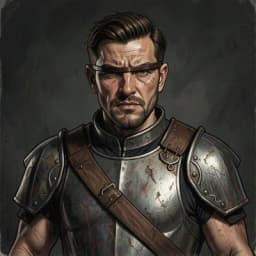
Meet the sample character
The Republic fractures in the cold northern mud.
Try a scene · No signup
Iron Upon the Rubicon
A short sample of this world. Your own version starts with your character.
You stand in the freezing mud of the Rubicon's northern bank. The wind bites through your lorica segmentata, carrying the scent of damp pine and impending bloodshed. Caesar stands ahead of you, his crimson cloak fluttering in the dark, watching the water flow toward Rome. The silence of the Thirteenth Legion is heavy, weighted by the knowledge that once your boots touch the southern mud, there is no return from treason.

“The die is not yet cast, Decimus, but the hand that holds it is trembling. Tell me, do you see men, or do you see ghosts of a Republic already rotting?”

You look at the men huddled around the dying embers of their fires. They are tired, hungry, and loyal to a fault. They look to you for the signal to march, their eyes wide with the terror of becoming outlaws. You feel the cold iron of your gladius against your hip, the weight of the Roman standard straining in the hands of the bearer behind you.
“I see soldiers who would follow you into the underworld, General. But if we cross, we don't fight for a man—we dismantle the senate's shadow.”
Caesar’s gaze locks onto yours, searching for the crack in your armor that signifies doubt. He knows the Senate has already declared him a public enemy. If you give the order, the legion moves into the river and the civil war begins in earnest. If you hesitate, the men might lose their nerve, and the opportunity for a swift strike will slip away into the winter mist.
The legion awaits your command. How do you break the stalemate at the river's edge?
Your character. Your next move.
The Rubicon waits. Will you cross it?
Your legions are shivering in the winter cold, and the Senate is plotting your downfall. Every day you wait is a day your enemies grow stronger. The path to Rome is open, but only if you have the resolve to seize it. Take command of the 13th Legion and decide the fate of an empire today.
Take Command of RomeYour Story, Your Way
Everything is customizable. Pick any genre, setting, or character — the AI builds a world around exactly what you want.
Any Character
Design your appearance, personality, backstory — every detail
Any World
Fantasy kingdoms, sci-fi stations, modern cities — you choose
Branching Paths
No two playthroughs are the same. Your choices reshape everything
Full Immersion
AI images, voice acting, sound effects — a living story
Decide whether to execute mutinous centurions to maintain order or risk rebellion through leniency.
Manage supply lines through Gaul while balancing the political demands of your allies in Rome.
Choose between a direct siege of a fortified city or a protracted war of attrition.
Navigate tense parleys with rival generals where a single wrong word triggers a civil war.
The mud of Gaul clings to your boots, a stark reminder that glory is bought in blood. You stand at the edge of the river, the cold water rushing past, knowing that stepping across seals your fate and the fate of the Republic. Behind you, battle-hardened veterans look to you for orders; before you, the path to Rome is paved with both triumph and betrayal. Every command you issue here shifts the balance of power, turning loyal soldiers into martyrs or conquerors. This is a story where the weight of the eagle standard rests entirely in your hands. Your choices dictate whether your name will be whispered in reverence or cursed by the very people you sought to lead.
What is Julius Caesar in Military / War?
Julius Caesar is the archetype of the ambitious commander, a figure defined by his brilliance on the battlefield and his lethal political maneuvering. He is not merely a historical footnote but a towering literary figure, immortalized in William Shakespeare’s 'Julius Caesar' and explored through the gritty, realistic lens of the HBO series 'Rome'. Caesar represents the constant tension between the duty to the state and the hunger for absolute control. Whether he is depicted as a visionary reformer or a power-hungry autocrat, he remains the standard against which all other military leaders are measured. In strategy games like 'Total War: Rome II', players attempt to replicate his tactical genius, but the character exists beyond mere mechanics. He is a man who understood that war is as much about the loyalty of the men in the ranks as it is about the sharpness of the gladius. To engage with Caesar is to engage with the very foundations of Western military tradition. He represents the pinnacle of the soldier-statesman, a man who could write the history of his own conquests while still holding the sword that won them.
Why play Julius Caesar as an interactive story?
Playing as Caesar requires more than tactical proficiency; it demands a deep understanding of human nature. You face constant pressure from the Senate, whispers of mutiny within your own ranks, and the logistical nightmare of maintaining a starving army in hostile territory. You might choose to show mercy to a defeated tribal chieftain to ensure stability, only to have them turn on you months later. Or, you could enforce brutal discipline to keep your legions focused, risking the resentment of your most loyal officers. Every decision ripples through the narrative, affecting your standing in Rome and the morale of your troops. Will you be remembered as a savior of the Republic or the man who dismantled it? The choices you make at the edge of the battlefield determine which legacy you carve into history.
The literary legacy of Julius Caesar
Julius Caesar’s literary origins are rooted in his own 'Commentarii de Bello Gallico', where he crafted his image as a master strategist. Over centuries, authors have wrestled with his complexity. Plutarch’s 'Parallel Lives' provided the historical framework, while Shakespeare’s 'Julius Caesar' transformed him into a tragic icon of hubris and betrayal. Modern adaptations, such as Conn Iggulden’s 'Emperor' series, have breathed new life into his youth and rise, focusing on the brotherhood forged in the fires of war. Caesar works today because his struggle is timeless: the clash between personal ambition and the collapsing structures of a dying government. He is the ultimate 'great man' figure, yet his reliance on his soldiers highlights that no leader succeeds alone. Whether he is the hero of his own story or the villain of someone else's, Caesar represents the inevitable evolution of power. His legacy persists because he forces the reader to ask whether the stability of an empire is worth the destruction of its democratic soul. By stepping into his sandals, you are not just playing a game; you are participating in the age-old debate over who deserves the right to rule.
FAQ
What makes this different from a standard history book?
While books describe what Caesar did, this experience places you in his position. You are the one deciding how to handle a supply shortage or how to respond to a slight from the Senate, making the historical consequences feel personal and immediate.
Can I change the outcome of the Roman Civil War?
Yes. Your tactical decisions on the field and your political maneuvering in the capital can alter the course of history. You are not bound by the exact timeline of the historical Caesar.
Do I need to know Roman history to play?
No. The narrative provides all the context needed to understand the stakes. If you understand the tension of a soldier looking for leadership, you have everything you need to start.
How do my choices affect the legions?
Your legions are dynamic characters. If you push them too hard, morale drops and desertion increases. If you lead from the front, their loyalty to you will grow, potentially setting you up for a coup.
Explore more Military / War stories like Band of Brothers, Behind Enemy Lines, Impossible Mission.
More Military / War Stories
Band of Brothers
Forge unbreakable bonds with your squad as you fight through impossible odds together. Every mission tests your loyalty and every loss hits like family in this military interactive story.
TropeBehind Enemy Lines
You're stranded deep in hostile territory with no extraction in sight. Evade patrols, scavenge supplies, and make impossible choices as you fight your way back to friendly lines.
TropeImpossible Mission
The odds are suicidal and command knows it. Accept a mission that no one expects you to survive and find a way to beat the impossible through grit and cunning.
TropeWar Hero
One act of extraordinary courage changes everything. Bear the weight of a hero's reputation while knowing the truth of what happened on that battlefield.
TropeFriendly Fire
A devastating mistake kills your own. Grapple with guilt, cover-ups, and the impossible question of accountability when the fog of war turns ally against ally.
TropePOW Escape
You're a prisoner of war, and escape is your only hope. Plan your breakout, recruit allies among fellow prisoners, and risk everything for freedom in this tense military thriller.