
Military / War · Interactive story
Command the Dead Line: DMZ Warfare
One wrong step across the wire triggers a war that ends the world.
Start as a guest. Choose your character before the story begins.
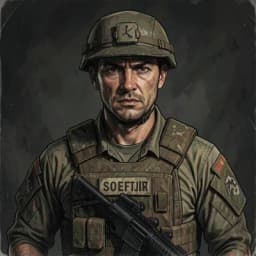
Meet the sample character
The wire holds, until it doesn't.
Try a scene · No signup
Static at Sector Four
A short sample of this world. Your own version starts with your character.
Your boots crunch on frozen gravel as you scan the treeline. Beyond the triple-stacked concertina wire, the forest is a wall of ink. You adjust your thermal optics, but the heavy mist smears the image into a kaleidoscope of grey noise. Somewhere out there, movement ripples through the tall grass, silent and deliberate.

“Sarge, sensors just spiked near the culvert—three heat signatures, moving fast toward the fence.”

You grip your rifle, the cold metal biting through your gloves. If you call in a mortar strike, you might stop them, but the flash will illuminate your position for every sniper in the valley. You weigh the lives of the three figures against the safety of your entire watch team.
“Hold fire, Miller. I need a visual confirmation before we start a war over a patrol of ghosts.”
A metallic snap echoes from the perimeter. A flare suddenly illuminates the sky, turning the night into a blinding, shadowless white. Three figures stand frozen at the wire, hands raised, but behind them, a heavy armored vehicle begins to crest the ridge. You have seconds before they reach the gate.
The vehicle is pushing toward the gate. Do you engage, signal, or hold your ground?
Your character. Your next move.
Hold the line or break the peace.
The enemy is watching from the ridge. You have one chance to secure the perimeter before the sun rises and the patrols begin. Your squad is waiting for your orders, and the silence is becoming deafening. Will you maintain the peace at any cost, or will you be the one to fire the first shot? The outcome of this standoff rests entirely in your hands.
Lead your unit nowYour Story, Your Way
Everything is customizable. Pick any genre, setting, or character — the AI builds a world around exactly what you want.
Any Character
Design your appearance, personality, backstory — every detail
Any World
Fantasy kingdoms, sci-fi stations, modern cities — you choose
Branching Paths
No two playthroughs are the same. Your choices reshape everything
Full Immersion
AI images, voice acting, sound effects — a living story
Decide whether to engage an unidentified scout or maintain a strict, dangerous ceasefire.
Manage squad discipline when supplies are low and the enemy is taunting your position.
Navigate diplomatic standoffs where a single misinterpreted gesture could ignite a global conflict.
Choose to prioritize the safety of local civilians over the rigid objectives of command.
The air smells of wet pine and diesel. Sergeant Park checks the thermal feed, his knuckles white against the cold steel of his rifle. Fifty yards ahead, the perimeter fence sags under the weight of rusted concertina wire. Beyond it lies the silence of the No Man’s Land—a strip of earth where the grass grows tall over unexploded ordnance and the ghosts of forgotten skirmishes. You are not here to win a war; you are here to keep the peace, provided the other side does not decide that today is the day the stalemate breaks. Every directive you issue, from ordering a cautious patrol to calling in air support after a provocation, ripples through the rank and file. Your choices determine whether your squad returns home intact or becomes another casualty report filed in the archives of a shadow conflict. This is an interactive story where the weight of your authority dictates the survival of everyone under your command.
What is DMZ / Border Zone in Military / War?
The Demilitarized Zone (DMZ) represents the ultimate pressure cooker of modern geopolitics. It is a physical manifestation of a diplomatic failure, a vacuum where two heavily armed forces stare each other down across a sliver of neutral territory. Unlike open warfare, which is defined by movement and territory gain, the border zone is defined by stasis and intense, suffocating tension. The real-world Korean DMZ is the definitive archetype for this setting, a literal scar on the peninsula that has held its breath for decades. In fiction, this environment is masterfully captured in the film The Front Line, where the absurdity of fighting for a few meters of dirt highlights the psychological toll on soldiers. Similarly, the Metal Gear Solid series often explores the tactical nuances of infiltrating these high-stakes zones, where the goal is to observe, report, and avoid triggering a geopolitical catastrophe. It is a place where soldiers are trained to be invisible, yet they are the most watched individuals on the planet. Here, victory is not measured by the ground you take, but by the disaster you manage to prevent.
Why play DMZ / Border Zone as an interactive story?
Playing in a border zone setting shifts the focus from grand strategy to the granular, terrifying reality of individual agency. You are not just controlling a character; you are managing the morale of a squad that knows one wrong move leads to a firing squad or a total invasion. You will face dilemmas that do not have clear-cut, heroic outcomes. Do you return fire at a shadowy movement in the brush, knowing that opening fire breaks the ceasefire? Do you report a soldier who is stealing supplies to feed a local family, or do you look the other way to keep the peace? The weight of your decisions is felt in the silence of your men and the flickering lights of the enemy bunkers across the ridge. Agency here adds a layer of dread; you are the buffer between a frozen conflict and total annihilation.
What makes DMZ / Border Zone work: the worldbuilding
The DMZ setting thrives on the slow burn. It is a narrative space where the conflict is internal as much as it is external. The best examples of this setting, such as the classic novel The Quiet American or the tense atmosphere of Tom Clancy’s Splinter Cell, rely on the contrast between the mundane routines of soldiers and the sudden, explosive potential of violence. When building a story in this space, sensory details are paramount: the rhythmic hum of a generator, the blinding glare of searchlights at 3:00 AM, and the metallic taste of adrenaline. The characters who inhabit these zones are usually defined by their restraint. They are not action heroes—they are professionals waiting for an order that might destroy everything they know. The conflict arises from the friction between the soldier’s duty and their humanity. By focusing on the minutiae of the patrol—the weight of the gear, the quality of the radio signal, the shifting loyalties within the unit—the story becomes an intimate study of what it means to hold the line. The setting works because it forces the reader to acknowledge that peace is fragile, and the people tasked with protecting it are often the most exhausted by its demands.
FAQ
Is this a combat-heavy game or a strategy game?
It is both. You will handle tactical combat, but the core involves managing the tension between your unit and the opposition to avoid a total war.
Can I change the outcome of the war?
Your actions can prevent an escalation or trigger one, but the broader geopolitical forces are often beyond one soldier's control.
What makes this different from a standard war story?
Unlike a front-line infantry game, the DMZ setting forces you to prioritize caution, diplomacy, and moral restraint over pure firepower.
Are the characters randomized?
No, your unit is built with specific personalities and histories, and your leadership style directly impacts their trust and effectiveness.
Explore more Military / War stories like Band of Brothers, Behind Enemy Lines, Impossible Mission.
More Military / War Stories
Band of Brothers
Forge unbreakable bonds with your squad as you fight through impossible odds together. Every mission tests your loyalty and every loss hits like family in this military interactive story.
TropeBehind Enemy Lines
You're stranded deep in hostile territory with no extraction in sight. Evade patrols, scavenge supplies, and make impossible choices as you fight your way back to friendly lines.
TropeImpossible Mission
The odds are suicidal and command knows it. Accept a mission that no one expects you to survive and find a way to beat the impossible through grit and cunning.
TropeWar Hero
One act of extraordinary courage changes everything. Bear the weight of a hero's reputation while knowing the truth of what happened on that battlefield.
TropeFriendly Fire
A devastating mistake kills your own. Grapple with guilt, cover-ups, and the impossible question of accountability when the fog of war turns ally against ally.
TropePOW Escape
You're a prisoner of war, and escape is your only hope. Plan your breakout, recruit allies among fellow prisoners, and risk everything for freedom in this tense military thriller.