
Military / War · Interactive story
Command the Dunes: Desert Warfare Interactive Stories
The horizon is a blur of heat, and your ammunition is running low.
Start as a guest. Choose your character before the story begins.
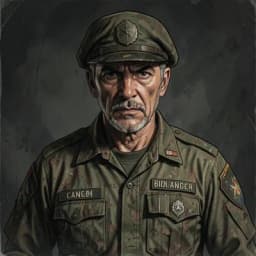
Meet the sample character
The desert doesn't forgive, and neither do the enemy's guns.
Try a scene · No signup
Steel and Salt
A short sample of this world. Your own version starts with your character.
The heat radiating from the tank’s hull is enough to blister skin through your tactical vest. You stare through the thermal optics, watching the white-hot blur of the horizon where the enemy line should be. The radio crackles with nothing but static, signaling that the jammer is still active, isolating you and your men in this desolate furnace.

“The scouts promised the ridge was abandoned, Sarge. If they’re lying, we’re sitting ducks in this open basin.”

You feel the weight of your sidearm pressing against your thigh, a cold contrast to the suffocating warmth of the cabin. Your squad is waiting for a command, their eyes fixed on your profile rather than the shifting dunes ahead. The smell of burning diesel and sweat fills the cramped space, thickening the air with the scent of impending violence.
“Stow the panic, Jenson. We aren't ducks; we're armor. We don't retreat until the fuel lines run dry.”
A sudden, sharp metallic thud vibrates through the chassis—a sniper round impacting the external armor. Before you can signal for movement, the dust cloud behind the ridge begins to roil, revealing the silhouettes of two opposing scout vehicles closing the gap. You have seconds to commit to a maneuver, or the entire squad becomes target practice.
The enemy is closing in fast. How do you respond to the incoming threat?
Your character. Your next move.
The dunes are waiting, Commander.
Your unit is currently pinned down in a valley with failing comms. The enemy is closing in, and the water supply is nearly empty. Will you hold your ground and risk everything, or lead a desperate breakout through the shifting sands? Your command, your consequences.
Take Command NowYour Story, Your Way
Everything is customizable. Pick any genre, setting, or character — the AI builds a world around exactly what you want.
Any Character
Design your appearance, personality, backstory — every detail
Any World
Fantasy kingdoms, sci-fi stations, modern cities — you choose
Branching Paths
No two playthroughs are the same. Your choices reshape everything
Full Immersion
AI images, voice acting, sound effects — a living story
Order a risky night flank against armored positions to save your pinned platoon.
Manage limited water and fuel supplies during a grueling week-long desert trek.
Decide whether to trust a local scout or rely on potentially compromised satellite intelligence.
Coordinate air support strikes while under heavy fire in a featureless valley.
Sand clogs the action of your rifle, and the relentless sun turns your canteen into a radiator. You are holding a ridge overlooking a dried-up wadi, waiting for an armor column that was supposed to arrive two hours ago. Every decision you make here—whether to conserve water, push through the exhaustion, or risk a night patrol—shapes the survival of your men. This is a story where your tactical choices determine who comes home and who remains in the sand. You are the commander on the ground, and the desert is an adversary that never sleeps.
What is Desert Battlefield in Military / War?
Desert battlefields serve as a crucible for military fiction. Unlike urban environments, there is no cover behind a brick wall. The terrain is flat, unforgiving, and vast. Think of the intense tank engagements in the film 'Sahara' (1943) or the desperate survival depicted in 'Three Kings' (1999). It forces commanders to rely on logistics, long-range reconnaissance, and the sheer grit of their soldiers. In this setting, the environment acts as an additional adversary. Temperatures swing from lethal heat by day to bone-chilling cold by night, forcing units to adapt their equipment and tactics constantly. The lack of natural concealment means that movement is a high-stakes gamble, and the ability to maintain supply lines often determines the outcome of the entire campaign. Whether you are leading a mechanized infantry unit or a small scouting party, the desert demands constant vigilance.
Why play Desert Battlefield as an interactive story?
You aren't just following a script; you are the one deciding the fate of your company. Do you prioritize the safety of your supply line or push for a tactical advantage in the valley? You will manage morale when the radio goes silent and the sandstorms roll in, making navigation impossible. The tension stems from the scarcity of resources and the knowledge that one wrong turn in the featureless expanse could lead your unit into an ambush. You must weigh the lives of your soldiers against the objective, knowing that every choice has a ripple effect on your unit's survival.
What makes Desert Battlefield work: the worldbuilding
The desert battlefield removes the luxury of complexity, leaving only the raw essence of war. It creates a unique open-space tension. In works like 'Lawrence of Arabia' or the game 'Spec Ops: The Line,' the desert is a character itself—a vast, indifferent force that punishes the unprepared. The lack of cover makes movement a high-stakes gamble. Conflicts in this setting thrive on the threat of being spotted from miles away. When writing or playing in this theater, focus on the sensory: the grit of sand in your teeth, the hum of heat haze, and the silence before an artillery strike. Characters are forced to rely on each other because there is nowhere else to turn. The isolation breeds a specific type of brotherhood, one built on the shared terror of a landscape that wants you dead. Good worldbuilding in this genre focuses on the logistical reality: how do you keep a tank running when fine sand is destroying the engine? How do you keep a squad focused when the heat makes them hallucinate? By focusing on these granular details, you make the stakes of the conflict feel immediate and personal.
FAQ
How do desert warfare stories handle the lack of cover?
They shift the focus from static cover-based combat to movement, suppression, and vehicle-based tactics. You must use the terrain—wadis, dunes, and ridges—to mask your approach rather than hiding behind a wall.
Can I influence the outcome of the war?
Yes, your choices determine whether you successfully capture objectives or suffer heavy casualties. Every tactical decision impacts your unit's readiness and the overall campaign trajectory.
Is this setting only about tank battles?
While armored combat is a staple, it also covers infantry patrols, special operations, and logistics management. The desert challenges every branch of the military differently.
What makes the desert a difficult environment for soldiers?
The extreme temperature fluctuations, the difficulty of resupply, and the navigational challenges make it one of the most physically demanding environments for any combatant.
Explore more Military / War stories like Band of Brothers, Behind Enemy Lines, Impossible Mission.
More Military / War Stories
Band of Brothers
Forge unbreakable bonds with your squad as you fight through impossible odds together. Every mission tests your loyalty and every loss hits like family in this military interactive story.
TropeBehind Enemy Lines
You're stranded deep in hostile territory with no extraction in sight. Evade patrols, scavenge supplies, and make impossible choices as you fight your way back to friendly lines.
TropeImpossible Mission
The odds are suicidal and command knows it. Accept a mission that no one expects you to survive and find a way to beat the impossible through grit and cunning.
TropeWar Hero
One act of extraordinary courage changes everything. Bear the weight of a hero's reputation while knowing the truth of what happened on that battlefield.
TropeFriendly Fire
A devastating mistake kills your own. Grapple with guilt, cover-ups, and the impossible question of accountability when the fog of war turns ally against ally.
TropePOW Escape
You're a prisoner of war, and escape is your only hope. Plan your breakout, recruit allies among fellow prisoners, and risk everything for freedom in this tense military thriller.