
Military / War · Interactive story
Command the Iron Age: Lead Your Legion to Victory
Shield walls hold or break—where will your name be written in the dust?
Start as a guest. Choose your character before the story begins.
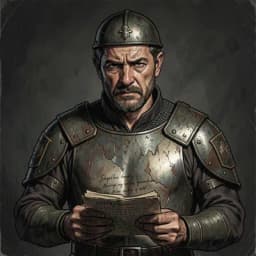
Meet the sample character
Before the empire falls, the shield wall must hold.
Try a scene · No signup
The Broken Phalanx
A short sample of this world. Your own version starts with your character.
The heat ripples off the sand, distorting the enemy formation into a wavering mass of iron and hate. Your throat is raw, coated in grit, and your greaves chafe against scarred skin. Across the hundred yards of scorched earth, the enemy heavy infantry locks shields, their standard-bearer taunting you with a rhythmic, mocking drumbeat that vibrates through your very boots.

“They are baiting us into a charge, Centurion. The sun is in our eyes and the slope is against us. If we move now, the formation will crumble before we even reach their line.”

You look back at your men. Their faces are masks of exhaustion, eyes wide and searching for a command that won't lead them to a shallow grave. The weight of your short sword feels like lead in your palm, and the silence from the command tent behind you confirms that you are entirely alone in this decision.
“Hold the line. We don't advance until they overextend. Let them tire themselves out in the heat while we conserve our strength for the breach.”
A sudden, frantic horn blast echoes from your own rear—an order to charge. It contradicts everything you know of the terrain and the enemy's trap. If you follow the order, you risk the lives of every man under your command. If you disobey, you face the gallows for mutiny before the battle even begins.
Do you heed the command from the rear or hold your position and defy your superiors?
Your character. Your next move.
Command the Front Line
Your troops are waiting for the order. Will you lead them to glory or into the history books as a cautionary tale? Every decision you make on the field changes the fate of your army.
Start Your CommandYour Story, Your Way
Everything is customizable. Pick any genre, setting, or character — the AI builds a world around exactly what you want.
Any Character
Design your appearance, personality, backstory — every detail
Any World
Fantasy kingdoms, sci-fi stations, modern cities — you choose
Branching Paths
No two playthroughs are the same. Your choices reshape everything
Full Immersion
AI images, voice acting, sound effects — a living story
Coordinate shield walls to withstand a cavalry charge against overwhelming odds.
Decide whether to execute prisoners or offer mercy to secure a local alliance.
Allocate limited water rations before a grueling march through the desert heat.
Choose between aggressive flanking tactics or a defensive turtle formation for survival.
The sun beats down on the bronze shields, reflecting a blinding heat that makes the air shimmer above the plain. You stand at the vanguard, the weight of a hundred men’s lives pressing against your armor, waiting for the signal to charge. Dust chokes the lungs, and the rhythmic thud of sandals on dry earth signals the coming collision. Here, your choices determine if you return to your hearth or leave your bones to bleach under an uncaring sky. This is an interactive story where your tactical maneuvers and moral fortitude dictate the outcome of the war. You are not a god looking down from the heavens; you are the commander standing in the mud, feeling the vibration of the enemy’s approach through the soles of your boots.
What is Ancient Battlefield in Military / War?
Ancient warfare is defined by the proximity of the kill. Unlike modern conflict, which relies on distance and technology, the ancient battlefield forces you to look your enemy in the eye. It is the era of the phalanx, the short sword, and the desperate struggle for a few yards of dirt. Think of the brutal, visceral combat seen in films like Gladiator or the tactical formations portrayed in the HBO series Rome. This setting captures the raw, physical reality of pre-industrial combat where the strength of a commander's will was the only thing holding a wavering line together. Whether you are leading a hoplite unit or a legion of scouts, the focus remains on the immediate, terrifying reality of close-quarters combat. You are the strategist on the front line, dealing with the limitations of the era where communication is limited to the sound of a horn and the reach of your own voice.
Why play Ancient Battlefield as an interactive story?
You face decisions that go beyond simple victory or defeat. When the enemy retreats, do you pursue them into a trap, or hold your position to protect the wounded? When supplies run thin, do you ration the grain for the veterans or share it with the raw recruits? Every decision carries a cost. You will feel the tension as you decide whether to hold the high ground at the expense of your flank or push into the valley to break the enemy’s morale. The stakes are personal—every soldier under your command has a name, a home, and a fear of the dark. Agency in this setting means you own the consequences of your orders; if your strategy fails, you witness the collapse of your line firsthand.
What makes Ancient Battlefield work: the worldbuilding
Ancient warfare thrives on the tension between individual heroism and collective discipline. The primary conflict is often found in the collision of two rigid, clashing systems. Works like Steven Pressfield’s Gates of Fire perfectly capture the agonizing discipline of Spartan life, while the Total War game series highlights the importance of terrain and positioning. The worldbuilding here relies on sensory details: the smell of sweat and iron, the deafening roar of a shield wall, and the heavy thud of boots against packed earth. Characters should be defined by their loyalty to their unit and their internal struggle with the brutality they must inflict. The environment is a character itself; a muddy ridge can be a fortress, while a dry riverbed is a death trap. By focusing on the physical limitations of the era—no radios, no long-range artillery—the story forces the commander to be present, visible, and vulnerable. This vulnerability is the engine of the narrative, forcing you to lead by example rather than from a map-table miles away. You must manage the morale of your men as carefully as you manage your spear points, knowing that one panicked soldier can break an entire formation.
FAQ
What makes ancient warfare stories different from modern war settings?
Ancient warfare is defined by physical proximity and lack of long-range communication. Your survival depends on direct leadership, hand-to-hand combat skills, and maintaining formation discipline rather than coordinating airstrikes or artillery.
Can I command different types of armies?
Yes. Depending on your choices, you can command various historical or fantasy-inspired units, ranging from heavy infantry phalanxes to light cavalry scouts, each requiring different tactical approaches.
How does soldier morale affect my gameplay?
Morale is a core mechanic. If your soldiers lose faith in your leadership or are pushed beyond their endurance, they may break formation, abandon their posts, or refuse orders, leading to catastrophic losses.
Are these stories historically accurate?
The setting focuses on historical realism regarding combat mechanics, terrain, and social hierarchies. While the narrative is fictional, it prioritizes the authentic feel of the era over pure academic history.
Explore more Military / War stories like Band of Brothers, Behind Enemy Lines, Impossible Mission.
More Military / War Stories
Band of Brothers
Forge unbreakable bonds with your squad as you fight through impossible odds together. Every mission tests your loyalty and every loss hits like family in this military interactive story.
TropeBehind Enemy Lines
You're stranded deep in hostile territory with no extraction in sight. Evade patrols, scavenge supplies, and make impossible choices as you fight your way back to friendly lines.
TropeImpossible Mission
The odds are suicidal and command knows it. Accept a mission that no one expects you to survive and find a way to beat the impossible through grit and cunning.
TropeWar Hero
One act of extraordinary courage changes everything. Bear the weight of a hero's reputation while knowing the truth of what happened on that battlefield.
TropeFriendly Fire
A devastating mistake kills your own. Grapple with guilt, cover-ups, and the impossible question of accountability when the fog of war turns ally against ally.
TropePOW Escape
You're a prisoner of war, and escape is your only hope. Plan your breakout, recruit allies among fellow prisoners, and risk everything for freedom in this tense military thriller.