
Haunted Places · Interactive story
The Last Train to Nowhere
The tracks hum with the voices of those who never reached their destination.
Start as a guest. Choose your character before the story begins.
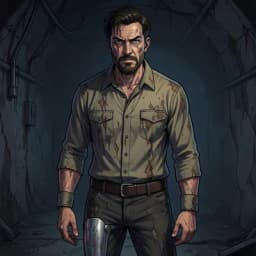
Meet the sample character
The tracks don't end where the map says they do.
Try a scene · No signup
The Last Train to Nowhere
A short sample of this world. Your own version starts with your character.
Your flashlight beam cuts through the thick, stagnant air of the service tunnel, illuminating a wall of mismatched bricks. You shouldn't be here. The city maps marked this station as demolished decades ago, yet the vibration in your soles suggests otherwise. A faint, high-pitched whistle drifts from the darkness behind the masonry, too sharp to be a draft.

“Keep your hands off the mortar, boy. The last man who tried to open this wall ended up as nothing but a smear on the third rail.”

The hair on your neck stands up. Silas, a man who has spent forty years working these subterranean veins, refuses to look at the wall. You feel the cold metal of your pry bar in your coat pocket. Your father went missing in this exact sector thirty years ago, and for the first time, you sense the walls of this city exhaling a long-held secret.
“My father didn't just vanish into thin air, Silas. If this wall is the only thing standing between me and the truth, I’m taking it down.”
You approach the mortar line, the smell of sulfur and wet iron intensifying with every step. Suddenly, the ground beneath you trembles violently as a gust of impossibly cold wind blasts from a hairline fracture in the brickwork. A massive, rusted train light flickers into existence on the other side, bathing the tunnel in a sickly, jaundiced glow. Do you force your way inside?
The wall groans under the pressure of the arriving train. How do you respond to the phantom engine?
Your character. Your next move.
The doors are closing. Will you stay or run?
The train is pulling into the station, and the platform is colder than it was a moment ago. Your flashlight is flickering, and you hear a whisper from the empty carriage. Don't wait for the lights to die completely—make your move now to see if you can escape the terminal.
Board the Ghost TrainYour Story, Your Way
Everything is customizable. Pick any genre, setting, or character — the AI builds a world around exactly what you want.
Any Character
Design your appearance, personality, backstory — every detail
Any World
Fantasy kingdoms, sci-fi stations, modern cities — you choose
Branching Paths
No two playthroughs are the same. Your choices reshape everything
Full Immersion
AI images, voice acting, sound effects — a living story
Choose to board a ghost train or trek through the pitch-black service tunnels.
Decide whether to assist a trapped spirit or prioritize your own escape.
Manage limited light sources as the subway's power grid slowly fails around you.
Interpret cryptic messages left by previous commuters to find the hidden exit.
The smell of ozone, damp concrete, and metallic decay hangs heavy in the air. You stand on the platform of a station marked 'Closed' on every map, watching the darkness of the tunnel swallow the flickering light of your dying flashlight. Silence is a lie here; the walls vibrate with the rhythmic, grinding screech of wheels against rusted steel, even though no transit authority schedule lists a train this late. You realize too late that the graffiti on the walls isn't paint, but scratch marks from those who tried to escape before the doors slid open. Every decision you make—whether to board the carriage or run back toward the surface—shapes your survival. The platform is empty, save for you and the shadows that seem to detach themselves from the bricked-up archways, waiting for the next passenger to step into their trap.
What is Haunted Subway in Haunted Places?
The haunted subway setting functions as a claustrophobic pressure cooker, trapping characters in a liminal space between the living world and whatever waits in the dark. It is a place of transit that has been frozen in time, where the infrastructure of a modern city becomes a labyrinthine tomb. Unlike a traditional haunted house, the subway offers nowhere to run; the only path leads further into the tunnels or deeper into the belly of a train that may never return to the surface. This trope relies on the inherent fear of being trapped underground, where the lack of natural light and the oppressive weight of the earth create a sense of inevitable doom. In works like Clive Barker’s 'The Midnight Meat Train,' the subway serves as a hunting ground, while in games like 'Silent Hill 4: The Room,' the underground areas represent the corruption of the protagonist's psyche. The setting is effective because it exploits the familiar—a commute everyone recognizes—and twists it into an alien, hostile environment where the rules of reality no longer apply. The subway is not merely a location; it is an active predator that feeds on the anxiety of those who wander off the platform.
Why play Haunted Subway as an interactive story?
Agency transforms this setting from a passive observation into a desperate struggle for control. You are not just reading about a character’s panic; you are the one deciding whether to trust the conductor’s hollow voice or force the emergency doors open before the train reaches the abyss. The tension lies in the scarcity of information. Do you follow the trail of personal items left on the tracks, or do you stay in the light of the platform, praying the power doesn't cut out? Your choices force you to weigh the risk of the unknown against the certainty of the horror you are already facing. You might choose to hide in a maintenance room, only to realize the walls are breathing, or attempt to communicate with the passengers who look like they died decades ago. Every split-second decision alters the trajectory of the train, determining who survives the ride and what remains of you once you finally reach the end of the line.
What makes Haunted Subway work: the worldbuilding
The effectiveness of a subway-based horror narrative relies on sensory deprivation and the subversion of modern utility. The subway is built on logic, schedules, and safety protocols; when these fail, the psychological impact is magnified. Worldbuilding in this space requires a focus on auditory cues—the distant, rhythmic thumping of an approaching train that never arrives, or the sound of footsteps that stop exactly when you do. Character types that thrive here are those who possess a reason to be out late, such as a night-shift worker, an urban explorer, or a desperate traveler who took the wrong turn. The conflict arises naturally from the setting’s isolation. There is no cell service, no witnesses, and no rescue. The environment acts as an antagonist, with flickering lights, shifting tunnel layouts, and sudden drops in temperature. Real-world examples demonstrate the power of this setting; the film 'Train to Busan' uses the confined space of a train carriage to heighten the intensity of its threat, forcing characters into impossible social dilemmas. Similarly, the 'Metro 2033' series leverages the claustrophobia of tunnels to emphasize the fragility of life. What makes the haunted subway work is the transition from the mundane to the macabre. By grounding the story in the reality of a city transit system, the introduction of supernatural elements feels more intrusive and threatening. A successful subway story treats the station as a living entity, with its own history of tragedy and a hunger for those who wander too far from the turnstiles.
FAQ
What makes a haunted subway setting different from a haunted house?
A haunted house is a contained space, but a subway is a network of tunnels that implies a lack of exit. The claustrophobia is constant, and the 'train' element adds a ticking clock. Unlike a house, where you can often lock a door to find safety, the subway is designed for movement, making it difficult to find a place that is truly secure.
Can I influence the outcome of the ghost train's destination?
Yes. Your decisions regarding which tunnel to follow, whether to interact with entities, and how you manage your resources directly influence the narrative. Certain choices can lead to a successful escape to the surface, while others might result in being trapped on the train indefinitely.
Is this story setting appropriate for psychological horror fans?
Absolutely. The setting focuses heavily on isolation, the breakdown of reality, and the fear of the unknown. It is designed for those who enjoy tension-filled narratives where every choice has a consequence and the environment plays as much of a role as the characters themselves.
How do I know if I am making the right choice?
In this environment, there is rarely a 'right' choice, only the one you can live with. You must weigh the immediate danger against the long-term risks. The story rewards careful observation and the ability to adapt to changing circumstances rather than following a single path to safety.
Explore more Haunted Places stories like Haunted Hotel, Haunted Hospital, Haunted School.
More Haunted Places Stories
Haunted Hotel
You checked in but the hotel has no intention of letting you check out. You must survive a stay where every room holds a different ghost and the building itself remembers every terrible thing that ever happened within its walls.
TropeHaunted Hospital
The patients who died here never truly left. You must navigate dark corridors where spectral figures in hospital gowns reenact their final moments and the machinery turns on by itself to perform procedures on the living.
TropeHaunted School
The bell rings in an empty school and footsteps echo through deserted hallways. You must uncover what tragedy binds the spirits of students and teachers to a building where the lessons never ended and detention is eternal.
TropeHaunted Theater
The curtain rises on an empty stage and the performance begins without actors. You must survive a theater where the ghosts demand an audience and anyone who tries to leave before the final act becomes part of the show forever.
TropeHaunted Ship
The vessel drifts with no living crew aboard, yet lights flicker in the portholes. You must board a ghost ship and unravel the fate of its passengers while the ocean offers no escape and the dead sailors want company.
TropeHaunted Prison
The inmates were executed but their rage never left the cellblock. You must survive a decommissioned prison where the spirits of the condemned patrol the tiers and solitary confinement holds something worse than ghosts.