
Haunted Places · Interactive story
The Grand Victoria Has No Vacancy
The lobby clock stopped at midnight, and the hallway stretches on for miles.
Start as a guest. Choose your character before the story begins.
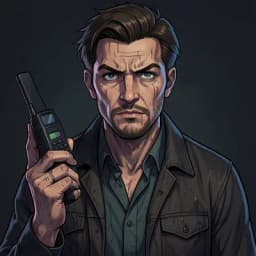
Meet the sample character
Room 412 is always occupied.
Try a scene · No signup
Dust and Damask
A short sample of this world. Your own version starts with your character.
The lobby of the Blackwood Grand is a tomb of velvet and marble, frozen in a decade that died fifty years ago. You pull your collar tight against a sudden, bone-deep chill. Dust motes hang suspended in the dim light of a chandelier that groans with every gust of wind from the mountain pass, yet the air remains unnaturally still.

“Most guests find the midnight silence of the Blackwood quite difficult to reconcile with their own memories, Mr. Vane.”

Sterling’s skin looks like translucent parchment stretched over jagged bone, and his eyes never seem to track your movement. The heavy brass key on the counter bites into your palm, vibrating with a rhythmic, low-frequency hum. Behind him, the locked door to the basement service area rattles, though no one is standing on the other side.
“I didn't come here for the quiet, Mr. Sterling. I came for the truth about what happened in the east wing.”
The lobby lights flicker and die, plunging you into a darkness so heavy it feels physical. From the upper floors, the rhythmic, wet thud of something being dragged across floorboards begins—a sound that grows louder, descending the grand staircase toward you. The elevator gate behind you begins to swing open on its own, revealing only a pitch-black shaft.
The thumping sound grows closer, rhythmic and deliberate. What is your next move?
Your character. Your next move.
The front desk is closed. Will you survive the night?
The hallways are shifting, and the shadows are closing in. Every room holds a different secret, and every choice could be your last. Step inside, lock your door, and see if you have what it takes to check out of the Grand Victoria alive.
Check In and PlayYour Story, Your Way
Everything is customizable. Pick any genre, setting, or character — the AI builds a world around exactly what you want.
Any Character
Design your appearance, personality, backstory — every detail
Any World
Fantasy kingdoms, sci-fi stations, modern cities — you choose
Branching Paths
No two playthroughs are the same. Your choices reshape everything
Full Immersion
AI images, voice acting, sound effects — a living story
Decide whether to trust the voice whispering through the ventilation system.
Scavenge for keys in rooms that rearrange their furniture when you look away.
Choose to confront the hotel's history or hide until the sun rises.
Manage your remaining sanity as the hotel walls begin to bleed memories.
Arthur dragged his heavy suitcase over the threadbare carpet of the lobby. The air tasted of ozone and rotting lilies, thick enough to coat his throat. A brass bell sat on the mahogany desk, but the clerk had been gone for decades, judging by the grey dust settling on the ledger. Behind him, the heavy revolving doors groaned shut, the bolt sliding home with a finality that made his blood run cold. He reached for the handle, but the glass was cold as ice, and the street outside had vanished, replaced by an endless, swirling fog. This is no ordinary stay. Every choice you make dictates whether you find a way back to the living world or become part of the building’s permanent, restless collection of ghosts.
What is the Haunted Hotel trope?
The haunted hotel trope functions because it traps characters in a liminal space. You cannot flee, and the environment itself acts as a hostile entity. Think of the Overlook Hotel in Stephen King’s The Shining, where the architecture conspires with the past to break the sanity of its guests. Unlike a standard haunted house, a hotel is a place of transit—a temporary residence that suddenly becomes a permanent tomb. It disrupts the safety of the traveler, turning a place designed for rest into a high-stakes psychological battlefield. In these narratives, the infrastructure is as dangerous as the spirits. The elevators go to floors that shouldn't exist, the mirrors reflect people who died years ago, and the telephone lines connect only to the dead. By weaponizing the familiar aspects of hospitality—the room service, the concierge, the guest registry—the story forces you to question what is real and what is merely a projection of your own mounting panic.
Why play Haunted Hotel as an interactive story?
Agency transforms the terror from a passive observation into a visceral struggle for survival. You are not watching a protagonist make mistakes; you are the one deciding how to handle the spectral activity. Do you investigate the rhythmic pounding coming from the service elevator, or do you barricade your bedroom door with the heavy oak dresser? The game tracks your sanity and your physical stamina. You might choose to barter with a spirit trapped in the ballroom or attempt to solve the mystery of the hotel’s original architect to break the curse. Your decisions alter the layout of the building, revealing new rooms or sealing off exits when you need them most. Every interaction carries weight, and the hotel responds to your curiosity with increasing hostility.
Famous examples of Haunted Hotel in books, film, and games
The allure of the haunted hotel lies in its isolation. In Stephen King's The Shining, the Overlook Hotel acts as a vessel for generational trauma, using the history of the location to corrupt the mind of Jack Torrance. The hotel is not just a setting; it is a malevolent force that demands sacrifice. Similarly, the film 1408 focuses on a single room, turning the hotel into a claustrophobic puzzle box where the walls change shape to prevent escape. The room itself is the antagonist, stripping away the protagonist's belief in reality until he is forced to face his own grief. American Horror Story: Hotel approaches the trope through the lens of a hungry organism that feeds on the moral failings of its guests, turning the building into a labyrinth of addiction and violence. These narratives succeed because they utilize the paradox of the hotel: it is a place where you are supposed to be safe and anonymous, yet you are surrounded by the remnants of those who came before you. The trope persists because the fear of being trapped in a place you do not recognize is a fundamental human anxiety, and the hotel provides the perfect architecture for that nightmare.
FAQ
How does the hotel change based on my choices?
The environment reacts to your actions. If you choose to explore restricted areas, the hotel may lock doors behind you or manifest new, more dangerous entities. Your decisions impact the building's layout and the intensity of the paranormal phenomena you encounter.
Is this a horror game or a mystery game?
It is both. You must uncover the history of the hotel to understand why you are trapped, but you are also actively being hunted. Survival requires balancing investigative work with defensive tactics to stay alive.
Can I save my progress if I need to step away?
Yes, the story tracks your progress, allowing you to return to the hotel whenever you are ready. Your current state of health and sanity will be preserved exactly as you left them.
Are the ghosts in the story randomized?
The hotel features both scripted encounters essential to the narrative and randomized spectral threats that respond to your specific playstyle, ensuring that no two stays are exactly the same.
Explore more Haunted Places stories like Haunted Hospital, Haunted School, Haunted Theater.
More Haunted Places Stories
Haunted Hospital
The patients who died here never truly left. You must navigate dark corridors where spectral figures in hospital gowns reenact their final moments and the machinery turns on by itself to perform procedures on the living.
TropeHaunted School
The bell rings in an empty school and footsteps echo through deserted hallways. You must uncover what tragedy binds the spirits of students and teachers to a building where the lessons never ended and detention is eternal.
TropeHaunted Theater
The curtain rises on an empty stage and the performance begins without actors. You must survive a theater where the ghosts demand an audience and anyone who tries to leave before the final act becomes part of the show forever.
TropeHaunted Ship
The vessel drifts with no living crew aboard, yet lights flicker in the portholes. You must board a ghost ship and unravel the fate of its passengers while the ocean offers no escape and the dead sailors want company.
TropeHaunted Prison
The inmates were executed but their rage never left the cellblock. You must survive a decommissioned prison where the spirits of the condemned patrol the tiers and solitary confinement holds something worse than ghosts.
TropeHaunted Amusement Park
The rides still run at midnight but no one is at the controls. You must navigate an abandoned amusement park where the ghosts of children who never made it home play on rusted attractions and the funhouse mirrors show things that are not reflections.