
Haunted Places · Interactive story
The Blackwood Grand: A Hotel That Never Checks Out
The elevator doors open, but the hallway ends in a wall of wet, rotting velvet.
Start as a guest. Choose your character before the story begins.
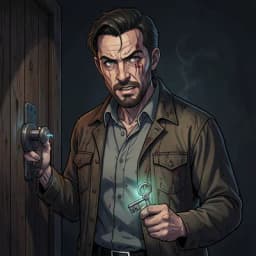
Meet the sample character
Check-in is permanent.
Try a scene · No signup
The Ledger of Lost Guests
A short sample of this world. Your own version starts with your character.
You stand in the lobby of the Blackwood Grand, the air heavy with the scent of rot and expensive cologne. The velvet carpets are damp, muffling your footsteps as you approach the reception desk. A chandelier overhead groans, its crystals shivering like teeth against the ceiling. You aren't here for a vacation; you are here for the ledger that vanished fifty years ago.

“We haven't had a guest check out since the last century, Mr. Vane. Are you quite certain you want to join them?”

The brass bell on the desk rings once, though no hand touched it. You feel a sudden, frigid pressure on the back of your neck, as if someone is standing inches behind you, watching your pulse flutter at your throat. The lobby lights dim, casting erratic shadows that detach themselves from the ornate pillars.
“I didn't come to check out, Arthur. I came to settle the account once and for all.”
Arthur’s grin widens, revealing teeth that look far too gray for a living man. He pushes a heavy, iron-bound register toward you, but the ink upon the page is wet, pulsing like a heartbeat beneath the parchment. You hear the elevator doors behind you shudder open, revealing not a hallway, but a sheer drop into a void that smells of rain and ancient secrets.
The elevator doors groan, offering a path into the impossible, while Arthur waits for your signature. How do you proceed?
Your character. Your next move.
Will you check out, or become part of the history?
The lobby lights are dimming, and the elevator is moving on its own. You have a choice: hide in your room and hope for dawn, or head to the penthouse to face the source of the rot. Your next decision could be your last. Begin your stay at the Blackwood Grand now.
Check into the HotelYour Story, Your Way
Everything is customizable. Pick any genre, setting, or character — the AI builds a world around exactly what you want.
Any Character
Design your appearance, personality, backstory — every detail
Any World
Fantasy kingdoms, sci-fi stations, modern cities — you choose
Branching Paths
No two playthroughs are the same. Your choices reshape everything
Full Immersion
AI images, voice acting, sound effects — a living story
Decide whether to answer the ringing lobby phone or flee to the stairs.
Choose to investigate the sound of weeping coming from the locked penthouse suite.
Attempt to decode the messages hidden within the hotel's vintage room service menus.
Choose which floor to explore first, knowing the ghosts change based on your location.
Arthur pulled the brass handle of the heavy mahogany doors, expecting the hum of a lobby. Instead, he found silence so thick it tasted of copper. The chandelier above flickered, casting long, erratic shadows across the frayed crimson carpet. He did not know why he had taken the night shift, but as the front desk phone began to ring—despite the hotel being shuttered since 1954—he realized the choice to leave was no longer his to make. Every step you take across these floorboards alerts the unseen residents to your presence. In this interactive story, your decisions determine whether you become another permanent guest in the ledger or find a way to escape the lobby before the clock strikes midnight.
What is Grand Haunted Hotel in Haunted Places?
The Grand Haunted Hotel is a horror trope that traps the protagonist in a space designed for luxury, now twisted into a cage. Unlike a haunted house, which feels like a private residence, the hotel is a public space frozen in transition. Think of the Overlook Hotel in Stephen King’s The Shining or the claustrophobic terror of the Dolphin Hotel in the film 1408. These locations rely on architectural isolation—endless corridors, identical rooms, and the anonymity of a place where thousands have slept before. It acts as a liminal space, caught between the living and the dead, where the history of the building is as much an antagonist as any phantom. The grandeur of the architecture serves only to highlight the decay, making the isolation feel more profound as you realize that no one is coming to check you out.
Why play Grand Haunted Hotel as an interactive story?
Agency transforms the hotel from a passive setting into a reactive trap. You are a witness to the building’s slow consumption of your sanity. You might find yourself debating whether to follow a trail of wet footprints toward the ballroom or barricade your room door after hearing a phantom lullaby play through the vents. The tension lies in the hotel’s shifting geography—a hallway that was straight ten minutes ago might now lead to a locked service stairwell. You choose whether to trust the concierge who seems to have been dead for forty years, or the frantic notes left by the previous guest. Every interaction forces you to weigh your curiosity against your survival, turning the grand architecture into a series of life-or-death puzzles.
What makes Grand Haunted Hotel work: the worldbuilding
The horror of a grand hotel comes from the contrast between its former opulence and its current rot. Gold-leaf molding peels like dead skin, and the scent of expensive perfume masks the underlying stench of decay. This setting thrives on the uncanny—the feeling that everything is slightly wrong. Films like The Shining master this by using wide, tracking shots that emphasize how small the human is against the hotel’s architecture. In literature, Shirley Jackson’s The Haunting of Hill House demonstrates how a building can possess a personality, actively manipulating its inhabitants. To make this setting work, focus on the sensory details: the hum of an old radiator, the muffled sound of a party that isn't happening, and the way light dies in the lobby. The best stories in this genre treat the hotel as a living organism. It remembers every guest who ever died within its walls, and it wants to add your story to its collection. By focusing on the historical weight of the building—the dated decor, the ghosts of past eras, and the structural impossibility of the floor plan—you create a sense of dread that remains long after the reader finishes the last page.
FAQ
What makes a grand hotel scarier than a haunted house?
A house is personal, but a hotel is impersonal. The vast, echoing corridors and the knowledge that thousands of strangers have walked those same halls create a sense of existential dread. You are a guest in a place that has seen too many endings.
How do choices affect the outcome in this setting?
Your choices determine your sanity and your physical path. If you stay in the lobby, you encounter different entities than if you explore the service tunnels. One wrong turn could trap you in a room that hasn't existed since 1920.
Are the ghosts in the hotel human?
Not always. While some specters are lingering spirits of past guests, the hotel itself often manifests entities that are purely atmospheric, feeding off your fear and confusion.
Is this setting appropriate for psychological horror?
It is ideal for psychological horror. The isolation of a hotel room, combined with the loss of time and direction, allows the narrative to focus on the protagonist's internal breakdown as much as the external threats.
Explore more Haunted Places stories like Haunted Hotel, Haunted Hospital, Haunted School.
More Haunted Places Stories
Haunted Hotel
You checked in but the hotel has no intention of letting you check out. You must survive a stay where every room holds a different ghost and the building itself remembers every terrible thing that ever happened within its walls.
TropeHaunted Hospital
The patients who died here never truly left. You must navigate dark corridors where spectral figures in hospital gowns reenact their final moments and the machinery turns on by itself to perform procedures on the living.
TropeHaunted School
The bell rings in an empty school and footsteps echo through deserted hallways. You must uncover what tragedy binds the spirits of students and teachers to a building where the lessons never ended and detention is eternal.
TropeHaunted Theater
The curtain rises on an empty stage and the performance begins without actors. You must survive a theater where the ghosts demand an audience and anyone who tries to leave before the final act becomes part of the show forever.
TropeHaunted Ship
The vessel drifts with no living crew aboard, yet lights flicker in the portholes. You must board a ghost ship and unravel the fate of its passengers while the ocean offers no escape and the dead sailors want company.
TropeHaunted Prison
The inmates were executed but their rage never left the cellblock. You must survive a decommissioned prison where the spirits of the condemned patrol the tiers and solitary confinement holds something worse than ghosts.