Gothic · Interactive story
The Spiral Descent: A Gothic Staircase Interactive Story
The higher you climb, the more the house changes beneath your feet.
Start as a guest. Choose your character before the story begins.

Meet the sample character
Some houses possess lungs that breathe, and a throat that hungers.
Try a scene · No signup
The Iron Helix
A short sample of this world. Your own version starts with your character.
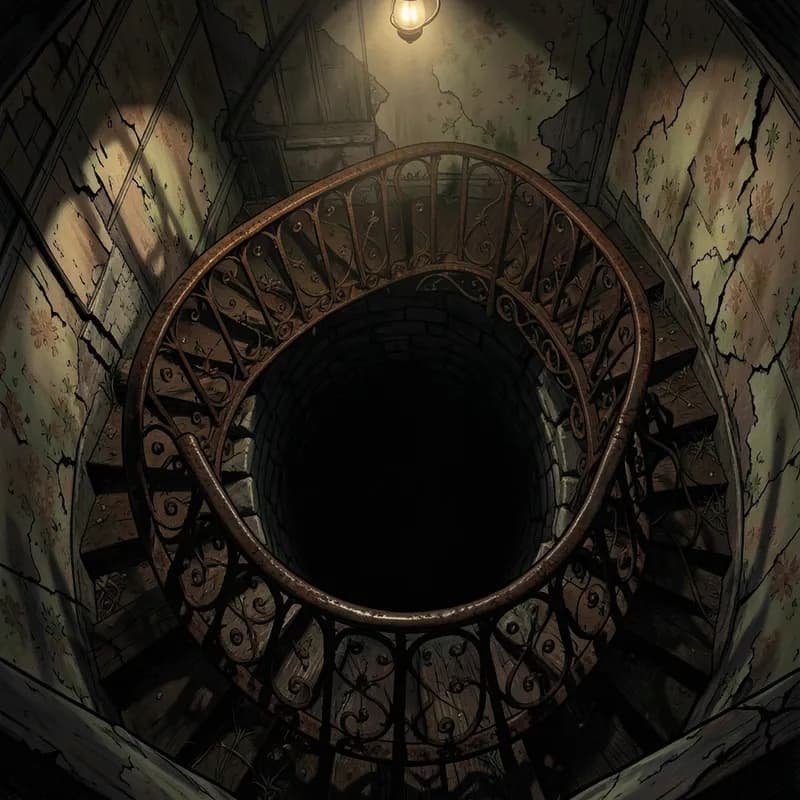
You stand at the precipice of the rotunda, the iron steps groaning under your boots like rusted joints. Below, the staircase spirals into a throat of absolute, light-swallowing black. It shouldn't be here; the house plans show only a cellar, yet the air rising from the depths reeks of wet copper. Your lamp flickers, struggling against a draft that should not exist in a windowless hall.
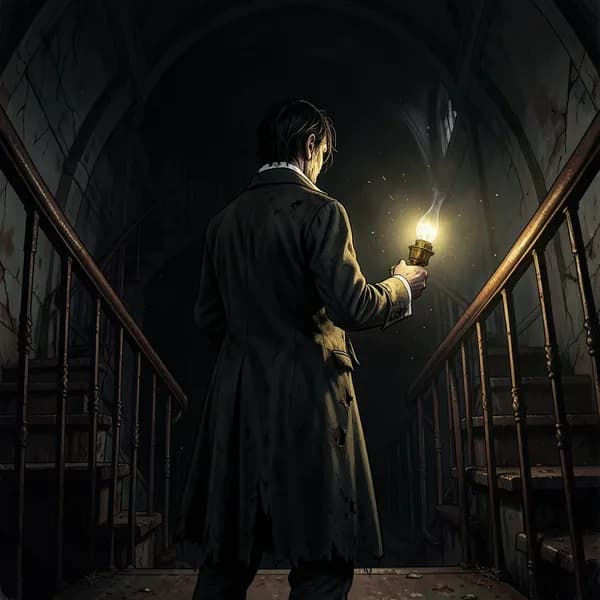
“Do not count the steps, Arthur. The geometry of this house has never favored the living.”
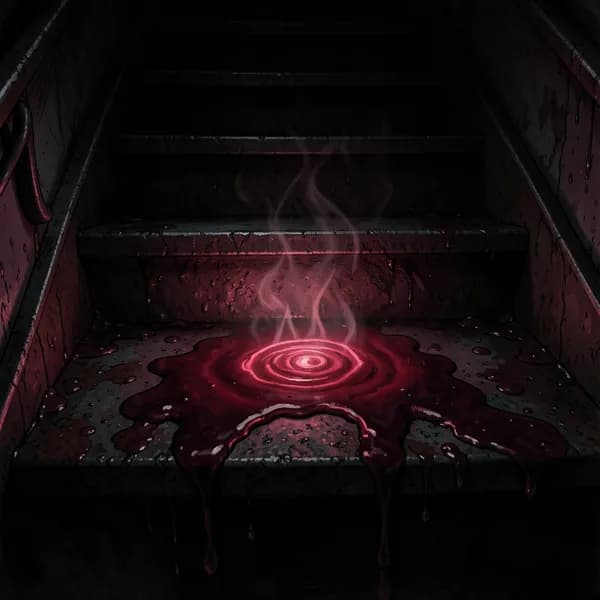
The cold settles into your marrow. You turn to look back at the parlor door, but the hallway has vanished, replaced by a blank, weeping plaster wall. There is no going back. Your heart hammers against your ribs, synchronized with a rhythmic, wet dripping sound echoing from the abyss. You are trapped between the suffocating architecture of the manor and the yawning void below.
“If this geometry is a lie, then tell me, Beatrice—what is the truth hiding at the bottom?”
She smiles, a thin, paper-dry expression that fails to reach her eyes. She points a trembling finger toward the seventh step, which is stained a deep, impossible crimson. The stain pulses—a slow, wet expansion and contraction. To descend is to enter the house's digestive system; to stay is to be crushed as the stone walls close in by the second.
The walls are drawing nearer, and the pulsing step demands a sacrifice. How will you proceed?
Your character. Your next move.
Will you reach the top floor?
The staircase is waiting, and the lights are flickering. Every step you take defines whether you uncover the manor's dark history or vanish into its impossible corridors. Step onto the landing and make your choice—before the house decides for you.
Begin your descentYour Story, Your Way
Everything is customizable. Pick any genre, setting, or character — the AI builds a world around exactly what you want.
Any Character
Design your appearance, personality, backstory — every detail
Any World
Fantasy kingdoms, sci-fi stations, modern cities — you choose
Branching Paths
No two playthroughs are the same. Your choices reshape everything
Full Immersion
AI images, voice acting, sound effects — a living story
Decide whether to investigate the rhythmic tapping echoing from the floor above.
Choose to follow the scent of ozone and rot deeper into the dark.
Attempt to map the impossible geometry of the house before you become permanently lost.
Confront the spectral presence waiting at the top of the final, crumbling flight.
The iron railing is cold against your palm, slick with a dampness that does not belong indoors. You stand in the foyer, staring up into the throat of the manor. The staircase does not merely climb; it coils, a calcified spine of mahogany and shadow, disappearing into the rafters where the moonlight fails to reach. Every riser groans under your weight, a low, rhythmic protest that mimics the beating of your own heart. You came here for answers about the inheritance, but the house has its own agenda. You decide whether to press upward toward the locked nursery or retreat into the suffocating silence of the cellar. Your choices determine if you reach the top or find yourself trapped in a loop of shifting, impossible hallways.
What is the Winding Staircase in Gothic Fiction?
In gothic literature, the staircase is rarely just a means of vertical movement. It functions as a bridge between the rational world of the ground floor and the repressed secrets of the attic or the forbidden depths of the basement. Think of the impossible, shifting geometry in Shirley Jackson’s The Haunting of Hill House or the blood-red, skeletal architecture in Guillermo del Toro’s Crimson Peak. The staircase creates a physical manifestation of a character’s descent into madness or their climb toward enlightenment. It forces the protagonist to confront the height of their isolation, physically distancing them from help while exposing them to the house's peculiar, shifting anatomy. This setting strips away the safety of a flat, predictable floor plan, forcing you to acknowledge that the building itself is alive and watching.
Why play the Winding Staircase as an interactive story?
Agency transforms the staircase from a static set piece into a high-stakes gauntlet. When the floorboards shift beneath your feet, you decide whether to investigate the scratching sound behind the wainscoting or to keep your eyes fixed on the path ahead. You might choose to light a candle, drawing the attention of something watching from the landing, or navigate the dark in silence, risking a misstep on the treacherous, splintered wood. Every decision compounds the tension. Will you trust the architectural logic of the manor, or will you realize that the staircase has changed direction while your back was turned? You are forced to weigh the cost of curiosity against the necessity of survival.
What makes the Winding Staircase work: the worldbuilding
Gothic architecture serves as an antagonist as much as any phantom. The winding staircase works because it creates extreme vulnerability. It is a choke point. In Daphne du Maurier’s Rebecca, the staircase is a site of social maneuvering and psychological warfare; in The Woman in Black, it is a place of sudden, terrifying encounters. The staircase forces a character into a vertical axis of power. To look down is to acknowledge the void; to look up is to acknowledge the unknown. Sensory details are paramount: the smell of dry rot, the phantom draft that blows from nowhere, the way your own footsteps seem to echo a split second too long, as if someone is trailing you exactly one flight behind. Characters who thrive here are often those searching for lost history—disinherited heirs, skeptical investigators, or desperate relatives. They are defined by their curiosity and their refusal to turn back when the architecture itself begins to defy physical laws. The tension thrives on the expectation that the house is not just a building, but a trap designed to keep secrets buried.
FAQ
What makes the winding staircase so effective for horror?
It restricts movement and visibility. By forcing you into a vertical path, the environment creates a sense of being trapped, where you can neither easily retreat nor safely advance.
Can I change the outcome of the haunting?
Yes. Your decisions dictate how the house responds to you. Choosing to ignore the signs might keep you safe for a moment, but investigating secrets could lead to a deeper, more dangerous truth.
How does the house change as I climb?
The architecture is non-Euclidean. As you move, doors may disappear, windows might reveal views that don't match the exterior, and the staircase itself can lengthen or loop, disorienting your sense of progress.
Is this setting right for me?
If you enjoy psychological tension, atmospheric dread, and the feeling that your environment is actively working against you, this setting provides a uniquely claustrophobic experience.
Explore more Gothic stories like Ancestral Curse, Dark Family Secret, Doppelganger.
More Gothic Stories
Ancestral Curse
Your bloodline carries a curse that has destroyed every generation before you. Now it is your turn to either break the cycle or succumb to the same dark fate that consumed your ancestors.
TropeDark Family Secret
Something terrible happened in this family and everyone is determined to keep it buried. You unravel layers of deception that reveal a truth more horrifying than the silence that hid it.
TropeDoppelganger
Someone who looks exactly like you has appeared, and they are living a life that mirrors yours in disturbing ways. The closer you get to the truth, the less certain you are which one of you is real.
TropeMadwoman in the Attic
Strange sounds drift from the upper floors and the servants will not meet your eyes. Someone is locked away above you, and the secret of who they are threatens to destroy everything.
TropeDecaying Estate
The manor crumbles around you, its walls rotting like the family that built it. Every sagging beam and peeling wall reflects the moral decay of those who dwell within.
TropeSupernatural Portrait
A painting watches you from the wall with eyes that seem to follow. The portrait holds a supernatural connection to its subject, and its changes reveal truths that should remain hidden.