
Gothic · Interactive story
The Hubris of Creation: A Victor Frankenstein Tale
You reached for the spark of God and grasped only cold, rotting anatomy.
Start as a guest. Choose your character before the story begins.
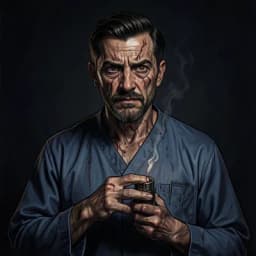
Meet the sample character
Some prayers are answered by monsters.
Try a scene · No signup
The Galvanic Debt
A short sample of this world. Your own version starts with your character.
The laboratory smells of sulfur and stagnant rain. Moonlight filters through the high, cracked windows, illuminating jars of translucent, preserved tissues that seem to watch you with clouded eyes. A low, dying hum resonates through the floorboards—the last, gasping effort of the galvanic coils. You clutch your leather medical bag, your knuckles white, as the shadows in the corner seem to lengthen and move with a deliberate, hungry grace.

“Do not touch the copper wiring, Silas! You have no conception of the agony that current carries when it fails to find its true path.”

Your heart hammers against your ribs, a frantic rhythm that matches the flickering sparks in the ceiling. You glance at the surgical table, where the anatomy of a giant lies partially obscured by moldy linen. The creature is not here, yet the heavy, wet thud against the iron-reinforced door confirms that you are not alone. The air grows frigid, and your breath plumes in the dim light.
“Victor, if we do not dismantle this equipment tonight, the local guards will find us—and they will not be as merciful as the laws of nature.”
The door groans under a massive, unnatural weight, the iron hinges screaming in protest. Victor collapses to his knees, clutching a vial of concentrated ether, his eyes wide and hollow. You must decide whether to finish the work that keeps the horror at bay or abandon the laboratory to the shadow pounding at the gate.
The door is buckling. How do you confront the arrival of the creation?
Your character. Your next move.
The Spark of Life Demands a Reckoning
The creature is waiting in the wings, its eyes fixed on your every move. Will you be the father it needs, or the monster it fears? Your hands are stained with the ink of your own undoing. Enter the laboratory and face the consequences of your hubris before the final, icy confrontation in the Arctic.
Begin Your ExperimentYour Story, Your Way
Everything is customizable. Pick any genre, setting, or character — the AI builds a world around exactly what you want.
Any Character
Design your appearance, personality, backstory — every detail
Any World
Fantasy kingdoms, sci-fi stations, modern cities — you choose
Branching Paths
No two playthroughs are the same. Your choices reshape everything
Full Immersion
AI images, voice acting, sound effects — a living story
Scour the cemeteries of Ingolstadt for the materials required to complete your forbidden work.
Choose between total isolation in the mountains or seeking refuge within your family home.
Negotiate with your creation as it tracks your movements across the frozen Arctic wastes.
Rain lashes against the stained glass of your laboratory, the rhythmic thrumming echoing your own frantic pulse. On the slab lies your work—a patchwork of stolen limbs and stolen dreams—now twitching with a life that defies nature. You intended to cheat death, to carve your name into the annals of science, but the yellow eyes that snap open are filled with a sorrow that makes your blood run cold. Every choice you make from this moment will define whether you are a visionary or a murderer. In this interactive story, the consequences of your ambition are not merely written; they are felt as the creature begins its escape into the storm.
What is Victor Frankenstein in Gothic?
Victor Frankenstein is the quintessential tragic scientist, a man whose intellectual fervor blinded him to the ethical cost of his ambition. Born from Mary Shelley’s 1818 novel Frankenstein, he serves as the archetype for the mad scientist. He is defined by his obsession: the desire to conquer death. Unlike the brutish creature often depicted in films like James Whale’s 1931 Frankenstein, the literary Victor is a nervous, brilliant, and deeply flawed aristocrat. He is a character who suffers from the weight of his own secrets, haunted by the knowledge that he birthed a sentient being only to abandon it to the world. Whether seen in the original text, the faithful BBC miniseries, or modern reinterpretations like Penny Dreadful, Victor remains a warning about the dangers of playing God. He is a man caught between the enlightenment of his discoveries and the primitive terror of the fallout.
Why play Victor Frankenstein as an interactive story?
Playing as Victor is not about winning; it is about managing the psychological collapse of a brilliant mind. You will decide how to handle the creature’s first steps: do you flee in terror, leaving it to wander the moors, or do you attempt to teach it the nuances of human language? The tension arises from the binary between your cold, analytical brain and the horror of your actions. You must manage the social pressures of Geneva, the suspicion of your peers, and the encroaching madness that threatens to consume you. When the creature demands a companion, you will face the ultimate dilemma: repeat your original sin or risk your own destruction at the hands of your creation.
The literary legacy of Victor Frankenstein
Mary Shelley wrote Frankenstein; or, The Modern Prometheus as a response to the scientific fervor of the late 18th century, drawing heavy inspiration from the myth of Prometheus who stole fire from the gods. The story captures the Gothic essence of the period—the isolation of the individual, the sublime terror of nature, and the corruption of the human spirit. Over the last two centuries, Victor has been reimagined countless times. In Kenneth Branagh’s 1994 adaptation, he is portrayed as a man driven by grief after the death of his mother, adding a layer of tragic motivation. Conversely, in the video game The Order: 1886, the character is integrated into a steampunk alternate history, showing his versatility. The enduring power of Victor Frankenstein lies in his relatability; he represents the human desire to overcome our limitations, tempered by the inevitable, crushing guilt that follows when we succeed. He is the ultimate cautionary tale for the modern age of technological advancement.
FAQ
How does the moral alignment system work?
Your decisions shift your character from a sympathetic creator to a desperate, cold-hearted fugitive, directly influencing how the monster interacts with you.
Is this game historically accurate to the 1818 novel?
It honors the tone and philosophical themes of the original book while allowing you to deviate from the established plot through your own choices.
Can I choose to destroy the monster earlier?
Your path is entirely your own; however, every action carries a weight that may lead to unexpected, darker outcomes for yourself and your family.
What is the focus of the gothic atmosphere?
We prioritize the sense of impending doom, the isolation of the laboratory, and the psychological decay that defines Victor’s descent into madness.
Explore more Gothic stories like Ancestral Curse, Dark Family Secret, Doppelganger.
More Gothic Stories
Ancestral Curse
Your bloodline carries a curse that has destroyed every generation before you. Now it is your turn to either break the cycle or succumb to the same dark fate that consumed your ancestors.
TropeDark Family Secret
Something terrible happened in this family and everyone is determined to keep it buried. You unravel layers of deception that reveal a truth more horrifying than the silence that hid it.
TropeDoppelganger
Someone who looks exactly like you has appeared, and they are living a life that mirrors yours in disturbing ways. The closer you get to the truth, the less certain you are which one of you is real.
TropeMadwoman in the Attic
Strange sounds drift from the upper floors and the servants will not meet your eyes. Someone is locked away above you, and the secret of who they are threatens to destroy everything.
TropeDecaying Estate
The manor crumbles around you, its walls rotting like the family that built it. Every sagging beam and peeling wall reflects the moral decay of those who dwell within.
TropeSupernatural Portrait
A painting watches you from the wall with eyes that seem to follow. The portrait holds a supernatural connection to its subject, and its changes reveal truths that should remain hidden.