
Gothic · Interactive story
The Masterpiece of Ruin: A Gothic Artist’s Descent
Your brush strokes bleed ink; your symphony demands a sacrifice. How much remains of you?
Start as a guest. Choose your character before the story begins.
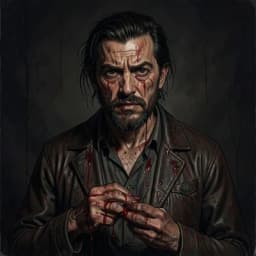
Meet the sample character
The final brushstroke demands a price paid in spirit.
Try a scene · No signup
The Ochre Stain
A short sample of this world. Your own version starts with your character.
The attic air is thick with turpentine and the copper scent of your own blood. You stare at the canvas, a hollow representation of Clara that mocks your hands. Her face is a blur of charcoal smudges and forgotten promises, yet the portrait seems to pulse with a low, rhythmic heartbeat. Your fingers tremble; the palette knife feels heavy, as if it were forged from leaden grief instead of steel.

“Julian, the light is failing, and the house is beginning to echo with things that do not belong to the living.”

Jagged shadows lengthen across the peeling wallpaper, stretching like fingers toward the easel. You feel the temperature drop, a phantom breath grazing your neck. The entity living within the oils demands a final sacrifice, its hunger rattling the floorboards. You possess the last of the pigment, but the cost of applying it is a secret you have hidden from the world for years.
“If I stop now, Beatrice, the memory of her will dissolve into the rafters, leaving me with nothing but this silence.”
Outside, thunder rattles the leaded glass, but inside, the only sound is your own ragged breathing. A drop of fresh crimson beads on your thumb—the final pigment required. You stare at the empty, sightless space where Clara's eyes should be. You know that the single stroke you are about to make will either tether her ghost to the canvas or shatter your mind entirely.
The canvas is waiting. Do you dare complete the masterpiece?
Your character. Your next move.
The Canvas Awaits Your Final Sacrifice
The ink is fresh, but the shadows are closing in. Your magnum opus is nearly complete, yet you barely recognize the face in the mirror. Will you finish the piece and lose yourself, or burn the manor to the ground to keep your secrets buried? The choice is yours to make, but the clock is ticking.
Begin Your DescentYour Story, Your Way
Everything is customizable. Pick any genre, setting, or character — the AI builds a world around exactly what you want.
Any Character
Design your appearance, personality, backstory — every detail
Any World
Fantasy kingdoms, sci-fi stations, modern cities — you choose
Branching Paths
No two playthroughs are the same. Your choices reshape everything
Full Immersion
AI images, voice acting, sound effects — a living story
Sacrifice personal relationships to gain the focus required for your most haunting masterpiece.
Choose whether to obey the whispers of the Muse or silence them with madness.
Manage your dwindling sanity while the environment shifts to reflect your internal decay.
Decide if your legacy is worth the permanent loss of your own identity.
The candle flickers, casting long, skeletal shadows against the canvas where your latest obsession takes shape. You haven't slept in three days. The pigment under your fingernails isn't just oil and charcoal; it is the residue of something nameless that whispers in the silence of this drafty manor. You reach for the palette knife, your hands trembling, knowing that every detail you refine drains a fraction of your sanity. In this story, your choices dictate whether you complete your magnum opus or shatter under the weight of the inspiration that haunts you. The ink is drying, but the cost of your creation is just beginning to manifest in the mirrors of the hall.
What is The Tortured Artist in Gothic?
The Tortured Artist is a pillar of gothic literature, representing the fine line between transcendent genius and total psychological collapse. This archetype suggests that true beauty requires agony, and that profound creation is often a pact with forces beyond human comprehension. Think of Dorian Gray, whose portrait absorbs the rot of his moral decay, or the obsessive protagonists in H.P. Lovecraft’s tales, where the act of translating forbidden knowledge into art leads to inevitable insanity. Unlike the romanticized heroes of modern fiction, the gothic artist is not looking for fame. They are looking for an outlet for an internal darkness that threatens to consume them entirely. Whether it is a writer scribbling in a decaying asylum or a composer hearing music in the wails of the wind, the artist’s work is an extension of their own trauma, reflecting a world that is inherently hostile to their existence.
Why play The Tortured Artist as an interactive story?
Playing as the Tortured Artist means balancing your waning grip on reality with the relentless demands of your craft. You will face moments where the Muse—a spectral, intrusive force—offers you brilliance in exchange for your memories, your health, or your morality. Will you choose to alienate your loved ones to finish that final movement, or will you destroy your work to save your own soul? Agency here is a double-edged sword; you decide what secrets go onto the page, but the story reacts to your growing obsession. You might find yourself locked in a room, forced to choose between starvation and the completion of a portrait that seems to blink when you look away. Each decision pulls you further from the light, turning the manor into both your sanctuary and your cage.
The psychology of The Tortured Artist: why readers fall for this character
Why does the image of the suffering creator hold such power? We are drawn to the Tortured Artist because they externalize the internal struggle between creation and destruction. They embody the fantasy that our pain is not meaningless, but the fuel for something lasting. In gothic fiction, this is a dangerous game. Consider Guy de Maupassant’s The Horla, where the narrator’s journal becomes a testament to his possession, or the tragic decline of the protagonist in The Phantom of the Opera, where unrequited love and artistic brilliance spiral into violent obsession. These characters touch on a universal fear: that we might lose ourselves in the very things we love most. The Tortured Artist archetype validates the idea that great work comes at a cost, but it also warns of the isolation that follows. Readers and players are fascinated by the what-if scenario—the brink of total ego dissolution. It is a mirror for our own creative impulses, scaled up to a terrifying, supernatural degree. We fear the madness, yet we are addicted to the brilliance that only such madness can provide.
FAQ
Can I complete my work without going insane?
The path to perfection is rarely clean. While you can attempt to maintain your sanity, the forces at play in this gothic setting demand a piece of you for every stroke of genius.
What is the role of the Muse in this story?
The Muse is not a benevolent inspiration. It is a spectral entity that feeds on your distress, pushing you toward completion while slowly eroding your boundaries.
How does the gothic setting influence my art?
The manor acts as a living character. Its architecture, history, and hidden secrets will directly bleed into your work, changing the tone and impact of your creations.
What happens if I stop creating?
Stagnation is a choice. If you refuse to feed the Muse, the story shifts, forcing you to confront the void you were trying to escape through your art.
Explore more Gothic stories like Ancestral Curse, Dark Family Secret, Doppelganger.
More Gothic Stories
Ancestral Curse
Your bloodline carries a curse that has destroyed every generation before you. Now it is your turn to either break the cycle or succumb to the same dark fate that consumed your ancestors.
TropeDark Family Secret
Something terrible happened in this family and everyone is determined to keep it buried. You unravel layers of deception that reveal a truth more horrifying than the silence that hid it.
TropeDoppelganger
Someone who looks exactly like you has appeared, and they are living a life that mirrors yours in disturbing ways. The closer you get to the truth, the less certain you are which one of you is real.
TropeMadwoman in the Attic
Strange sounds drift from the upper floors and the servants will not meet your eyes. Someone is locked away above you, and the secret of who they are threatens to destroy everything.
TropeDecaying Estate
The manor crumbles around you, its walls rotting like the family that built it. Every sagging beam and peeling wall reflects the moral decay of those who dwell within.
TropeSupernatural Portrait
A painting watches you from the wall with eyes that seem to follow. The portrait holds a supernatural connection to its subject, and its changes reveal truths that should remain hidden.