
Gothic · Interactive story
The Sinister Priest: Faith as a Weapon
Your collar is pristine, but your soul is stained with the weight of ancient sins.
Start as a guest. Choose your character before the story begins.
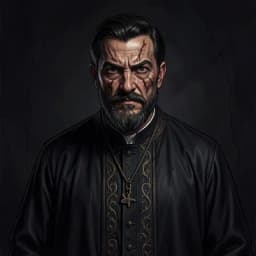
Meet the sample character
Penance is never enough.
Try a scene · No signup
The Liturgy of Ash
A short sample of this world. Your own version starts with your character.
You press your palm against the weeping stone of the confessional, the chill of the masonry sinking into your skin. Outside, the cathedral bells toll for the magistrate’s funeral, but your mind is consumed by the lockbox hidden beneath the floorboards. The scent of rotting lilies fills the air, masking the metallic tang of the dried blood still staining your cuffs.
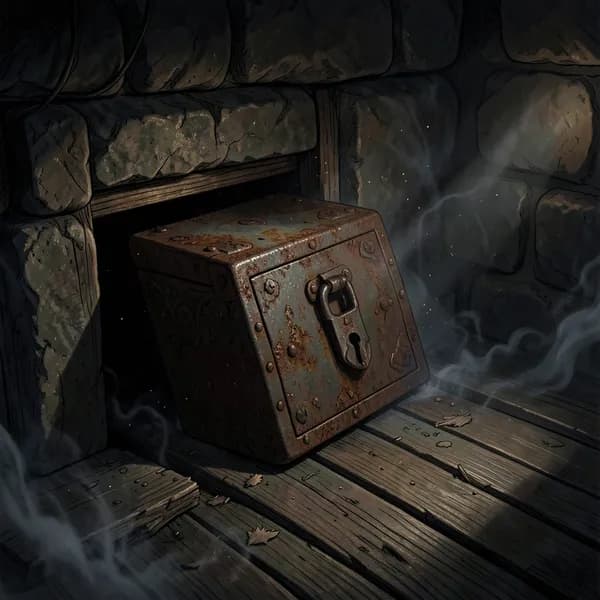
“Father, I saw you by the crypt at midnight. The whispers... they aren't from God, are they?”
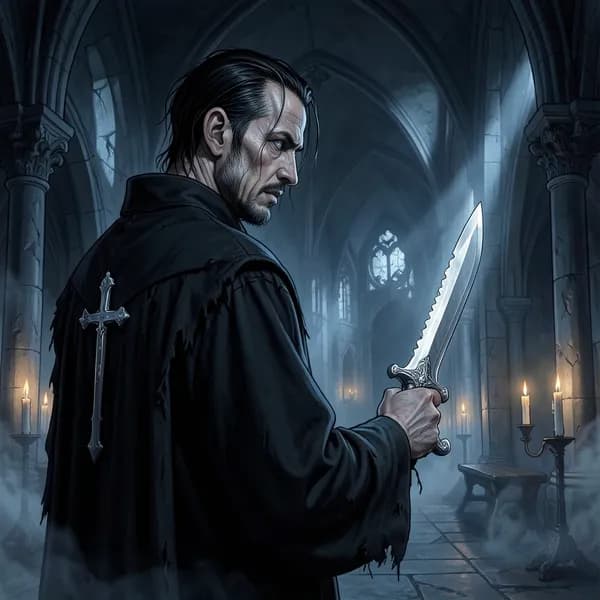
Her voice cracks, a jagged splinter of sound in the heavy silence of the nave. She knows the weight of your vestments is a thin veneer of holiness draped over a soul that has long since bartered its light for forbidden secrets. The candle flame flickers, casting distorted shadows that lean in, waiting for your next move.
“Sister, the path to salvation often winds through places where light fears to tread. You would do well to forget your insomnia, lest your soul be burdened by truths it cannot carry.”
You reach into your sleeve, your fingers brushing the cold, serrated edge of a silver ritual blade. The silence stretches, suffocating and heavy, as she stares at your hand with wide, terrified eyes. Outside, the fog begins to seep through the stained glass, turning the interior of the church into a colorless tomb. You must act before she screams, or worse, before she kneels and begs you to show her the dark.
Agnes stares at the blade trembling in your grip; how do you silence her doubt?
Your character. Your next move.
Claim your power behind the pulpit.
The parish is waiting for your sermon, and the manor’s secrets are buried deep. Will you maintain the facade, or will your true nature shatter the peace of the village? Your influence is absolute, but your time is running out. Decide your legacy now.
Begin your dark sermonYour Story, Your Way
Everything is customizable. Pick any genre, setting, or character — the AI builds a world around exactly what you want.
Any Character
Design your appearance, personality, backstory — every detail
Any World
Fantasy kingdoms, sci-fi stations, modern cities — you choose
Branching Paths
No two playthroughs are the same. Your choices reshape everything
Full Immersion
AI images, voice acting, sound effects — a living story
Choose whether to offer genuine solace or manipulate a confession for political leverage.
Manage the town’s suspicion levels by balancing public charity with quiet, calculated menace.
Decide the fate of ancestral artifacts hidden in the church’s forbidden basement vaults.
Deceive high-ranking officials to protect your position while orchestrating a dark ritual.
The scent of beeswax and cold stone clings to your heavy wool robes. In the dim light of the confession booth, you hear the frantic whispers of a parishioner, their sins spilling out like dark ink on parchment. You hold the power to grant absolution or to use their deepest shames as leverage for your own hidden agenda. Every word you speak from the pulpit is a carefully measured performance, designed to keep the townspeople kneeling while you secure your influence over the crumbling estate on the hill. As the village bells chime for vespers, you must decide whether to maintain your mask of sanctity or allow the shadow of your true ambition to bleed into the light. In this story, your choices dictate whether you remain a shepherd of the flock or become the wolf that devours them from within.
What is The Sinister Priest in Gothic?
The sinister priest represents the ultimate corruption of authority. This archetype thrives on the tension between public piety and private depravity. They are the figures who use the language of heaven to justify the horrors of the earth. Unlike a standard villain, the dark clergyman possesses institutional power, allowing them to exert control over a community through fear, tradition, and the psychological weight of the confessional. You see this archetype masterfully portrayed in literature and film, such as Claude Frollo in Victor Hugo’s *The Hunchback of Notre Dame*, whose obsession with control leads to his unraveling, or Father Brennan in *The Omen*, whose quiet, unsettling involvement suggests that the church itself has been compromised by forces beyond human comprehension. These characters do not merely commit crimes; they frame their actions as divine mandates, making them all the more difficult for the protagonist to challenge. By occupying the role of the moral compass, they effectively gaslight those around them, turning the very structures of society into a cage.
Why play The Sinister Priest as an interactive story?
Playing as the sinister priest shifts the focus from resisting evil to managing the slow rot of a soul. You are tasked with maintaining a delicate facade; one wrong word at the altar could unravel years of carefully constructed deception. You will navigate the treacherous waters of local politics, deciding whether to protect a vulnerable follower to maintain your reputation or sacrifice them to keep your secret archives hidden. The pressure comes from the need to balance your public holiness with the dark, tangible goals you have set for the manor. You will face moments where you must choose between a genuine moment of empathy—which risks your standing—and a calculated act of cruelty that secures your safety. The thrill lies in the proximity to discovery. Every interaction with the townspeople is a game of chess where your opponent is playing for their salvation, and you are playing to keep your sins buried beneath the floorboards.
The psychology of The Sinister Priest: why readers fall for this character
The attraction to the sinister priest archetype stems from our fascination with the intersection of power and hypocrisy. We are drawn to the idea of someone who has mastered the art of the performance, someone who can keep a straight face while their world burns. This character embodies the fear of institutional betrayal—the realization that those we trust to protect us may be the very people who prey upon us. In Matthew Lewis’s *The Monk*, the protagonist Ambrosio serves as a chilling example of how unchecked ego and a lack of true conviction can transform a man of God into a monster of lust and pride. Similarly, the archetype explores the concept of the 'pious shell,' where the character is so deeply committed to their role that they begin to believe their own lies. This creates a compelling psychological conflict: as the player, you are forced to ask if you are truly in control of your dark impulses, or if the role you have assumed has begun to dictate your behavior. The archetype thrives because it forces the reader to look at the shadows cast by the church steeple and wonder what is being hidden from the congregation. It is the ultimate exploration of how easily authority can be distorted when the individual holding it has no fear of judgment, human or divine.
FAQ
What is the core conflict for a character in this archetype?
The primary conflict is the constant struggle to maintain a facade of holiness while pursuing personal, often dark, ambitions. You must balance your public reputation with your secret actions, as one slip-up can lead to your exposure and downfall.
Can I choose to be a truly benevolent priest instead?
The story allows for moral complexity. While the archetype is defined by its sinister nature, your choices can lead you down paths of redemption or deeper into corruption, depending on how you handle the pressures of your position.
How do my choices affect the village and the manor?
Every choice creates a ripple effect. Manipulating the townspeople might give you short-term power, but it could lead to an uprising, while protecting the manor’s secrets might require you to make increasingly difficult moral sacrifices.
Is this story suitable for fans of classic gothic horror?
Yes. The experience is designed for those who appreciate atmospheric dread, crumbling settings, and the slow-burn psychological tension found in classic gothic literature.
Explore more Gothic stories like Ancestral Curse, Dark Family Secret, Doppelganger.
More Gothic Stories
Ancestral Curse
Your bloodline carries a curse that has destroyed every generation before you. Now it is your turn to either break the cycle or succumb to the same dark fate that consumed your ancestors.
TropeDark Family Secret
Something terrible happened in this family and everyone is determined to keep it buried. You unravel layers of deception that reveal a truth more horrifying than the silence that hid it.
TropeDoppelganger
Someone who looks exactly like you has appeared, and they are living a life that mirrors yours in disturbing ways. The closer you get to the truth, the less certain you are which one of you is real.
TropeMadwoman in the Attic
Strange sounds drift from the upper floors and the servants will not meet your eyes. Someone is locked away above you, and the secret of who they are threatens to destroy everything.
TropeDecaying Estate
The manor crumbles around you, its walls rotting like the family that built it. Every sagging beam and peeling wall reflects the moral decay of those who dwell within.
TropeSupernatural Portrait
A painting watches you from the wall with eyes that seem to follow. The portrait holds a supernatural connection to its subject, and its changes reveal truths that should remain hidden.