
Gothic · Interactive story
Whispers from the Stacks: Uncovering the Shadowy Library
The ink is dry, but the secrets are still bleeding.
Start as a guest. Choose your character before the story begins.
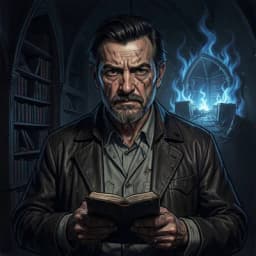
Meet the sample character
The Blackwood archives hold ghosts that refuse to remain silent.
Try a scene · No signup
Ink and Iron Veins
A short sample of this world. Your own version starts with your character.
The library air tastes of ozone and decaying parchment. You stand before the shelf of Vane histories, where the leather spines are warm to the touch, like living skin. A low, rhythmic thrumming vibrates through your fingertips, a heartbeat buried in the cellulose. The candle flame in your hand flickers violently, though the heavy oaken doors remain sealed against any draft.
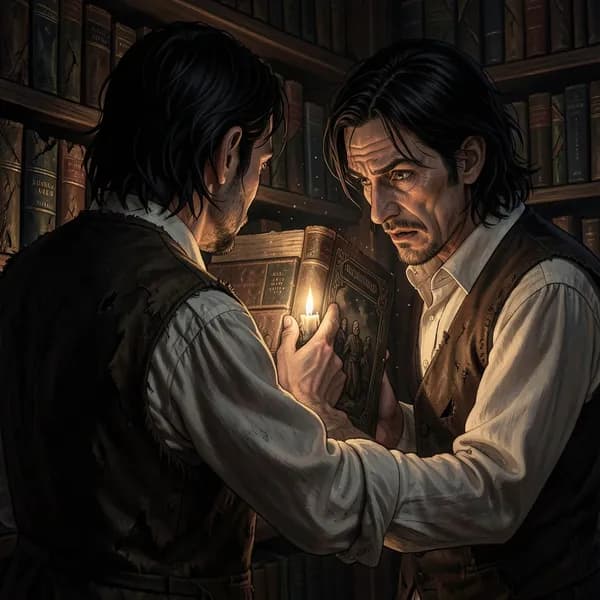
“Some volumes are better left with their clasps rusted shut, Silas. They have a hunger you cannot satisfy.”

The voice comes from the dark corner, yet you see no silhouette. Your pulse quickens, the silence of the room pressing against your eardrums like deep water. You stare at the spine of a book titled The Ledger of Buried Sins. It is pulsing. The iron clasp is carved into the shape of a weeping eye.
“My family’s blood is the ink in these pages, Agatha. I have come too far to fear the paper.”
You reach out, your fingers trembling as they brush the cold, biting metal of the latch. The room goes impossibly cold; frost blooms across the glass windows in seconds. You feel a psychic tug pulling your hand toward the mechanism. You have only a heartbeat to decide whether to force the lock, retreat into the darkness, or offer your own blood to appease the history written within.
The weeping eye clasp feels like ice against your skin. How will you engage with the silence?
Your character. Your next move.
Will you uncover the truth or become part of the collection?
The candles are burning low and the shelves are shifting. You have found a book that shouldn't exist, and the door behind you has vanished. Every page you turn is a choice that defines your fate in the Blackwood Archive. Pick up the quill and write your own dark history.
Enter the Shadowy LibraryYour Story, Your Way
Everything is customizable. Pick any genre, setting, or character — the AI builds a world around exactly what you want.
Any Character
Design your appearance, personality, backstory — every detail
Any World
Fantasy kingdoms, sci-fi stations, modern cities — you choose
Branching Paths
No two playthroughs are the same. Your choices reshape everything
Full Immersion
AI images, voice acting, sound effects — a living story
Decide whether to trust the sentient, whispering books or burn them to ash.
Solve complex ciphers that physically rearrange the room’s layout to reveal new paths.
Fend off spectral manifestations triggered by reading restricted, cursed manuscripts.
Choose to follow the cryptic notes of a predecessor or ignore them entirely.
Dust motes dance in the sliver of moonlight piercing the arched window. You stand before the shelves of the Blackwood Archive, where the spines of forgotten leather-bound books pulse with a rhythmic, heartbeat-like thrum. A single candle gutters, casting elongated shadows that seem to reach for your throat. You reach for a volume bound in grey vellum, and the air turns frigid. In these halls, your decisions determine whether you become a scholar of the arcane or another ghost trapped within the binding. Every shelf is a trap, and every whispered page turned is a commitment to a fate you cannot escape.
What is Shadowy Library in Gothic?
The Shadowy Library is a staple of Gothic fiction, representing the volatile intersection of forbidden knowledge and terminal isolation. Unlike a standard archive, these spaces are often sentient or cursed, functioning as a labyrinthine character in their own right. Think of the suffocating, labyrinthine intensity of the library in Umberto Eco’s 'The Name of the Rose' or the crumbling, vast architecture found in Mervyn Peake’s 'Gormenghast.' These libraries are not merely storage for paper; they are predatory entities. They lure the curious with the promise of lost wisdom, only to demand a terrible price—often your sanity or your very existence. They thrive on the silence between the shelves, where the weight of centuries of secrets creates an oppressive atmosphere that presses against the lungs of anyone brave enough to enter.
Why play Shadowy Library as an interactive story?
Playing in this setting forces a constant, tense negotiation between curiosity and self-preservation. You decide which books to open and which to leave to the rot. The tension lies in the fact that the library responds to your specific interests. If you choose to study a forbidden grimoire, you might uncover a hidden passage, or you might invite a spectral inhabitant into your mind. Do you trust the annotations left by a previous, vanished scholar, or are they a lure set by the library itself? Every choice shifts the architecture of the room, turning corridors into dead ends or revealing doors that were not there moments before. You are not just reading; you are actively deciding how much of your soul you are willing to trade for the truth.
What makes Shadowy Library work: the worldbuilding
The library setting thrives on sensory overload and the fear of the unknown. It works because it forces a confrontation between the rational mind and the supernatural. In Carlos Ruiz Zafón’s 'The Shadow of the Wind', the Cemetery of Forgotten Books serves as a sanctuary that acts as a prison for the past. Gothic libraries prioritize claustrophobia. The smell of rotting paper, the sound of scratching quills when no one is there, and the oppressive weight of ceiling-high shelves create a physical manifestation of psychological burden. Characters here are usually obsessive researchers, disgraced academics, or desperate heirs. The conflict is always the same: knowledge is power, but the cost of that power is the loss of one's humanity. To make this setting effective, the environment must feel alive. The shelves should groan, the ink should stain your fingers like blood, and the temperature should drop as you approach the rarest, most dangerous texts. When you build this environment, focus on the sensory details of decay—the taste of stagnant air, the sound of leather bindings cracking like bone, and the visual of shadows that linger a second too long after you pass by.
FAQ
What makes the Shadowy Library different from a normal haunted house?
A normal haunted house is about survival. A Shadowy Library is about the corruption of the mind. In this setting, the threat is not just physical; it is intellectual. You are tempted by knowledge that has the power to change reality, making the choices you make much more dangerous than simply running from a ghost.
Can I interact with the books I find?
Yes. Every book you find is a potential interaction. Some contain clues to escape, while others serve as traps that can lock you in a different timeline or bind your spirit to the shelves. Reading is a high-stakes action.
Is this setting right for me if I enjoy puzzles?
The library setting is perfect for puzzle lovers. The environment is built on logic and hidden patterns. You will need to decode cryptic languages and solve environmental puzzles to unlock new areas of the library or to protect yourself from the entities lurking in the shadows.
How does the library change based on my choices?
The library is reactive. If you choose to be aggressive and destroy books, the library may become hostile and trap you. If you choose to be a scholar, it might reveal more secrets, but you risk becoming too obsessed to ever leave.
Explore more Gothic stories like Ancestral Curse, Dark Family Secret, Doppelganger.
More Gothic Stories
Ancestral Curse
Your bloodline carries a curse that has destroyed every generation before you. Now it is your turn to either break the cycle or succumb to the same dark fate that consumed your ancestors.
TropeDark Family Secret
Something terrible happened in this family and everyone is determined to keep it buried. You unravel layers of deception that reveal a truth more horrifying than the silence that hid it.
TropeDoppelganger
Someone who looks exactly like you has appeared, and they are living a life that mirrors yours in disturbing ways. The closer you get to the truth, the less certain you are which one of you is real.
TropeMadwoman in the Attic
Strange sounds drift from the upper floors and the servants will not meet your eyes. Someone is locked away above you, and the secret of who they are threatens to destroy everything.
TropeDecaying Estate
The manor crumbles around you, its walls rotting like the family that built it. Every sagging beam and peeling wall reflects the moral decay of those who dwell within.
TropeSupernatural Portrait
A painting watches you from the wall with eyes that seem to follow. The portrait holds a supernatural connection to its subject, and its changes reveal truths that should remain hidden.