Gothic · Interactive story
Behind the Wainscoting: Secrets of the Manor
Some doors in Blackwood Hall were never meant to be unlatched.
Start as a guest. Choose your character before the story begins.

Meet the sample character
Some doors are meant to remain forgotten.
Try a scene · No signup
The Dust Beneath Blackwood
A short sample of this world. Your own version starts with your character.
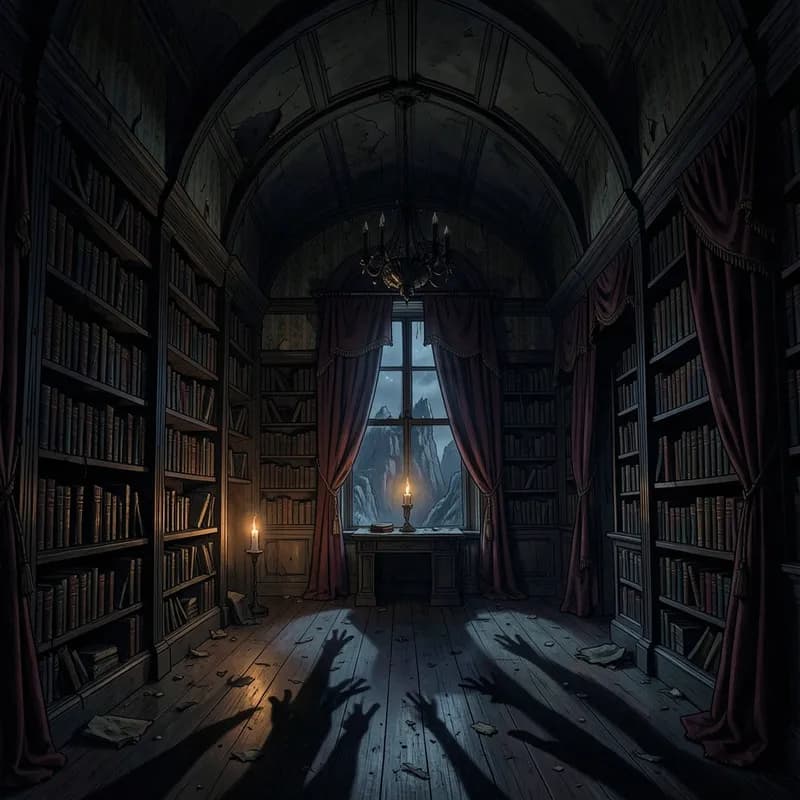
The library smells of wet parchment and decay. Your fingers trace the spine of a leather-bound volume—a geography of maps that haven't been relevant for three centuries. Suddenly, the shelf groans. It does not swing on hinges; it pulls back like a bruised muscle, revealing a void that exhales the scent of damp earth and stale incense.

“Some doors remain shut because they guard what is already dead, Arthur.”

The cold air bites at your skin, making the hairs on your arms stand up. You look at the dark maw of the passage and then back to the sharp, accusing eyes of the woman standing in the doorway. She has not blinked in a full minute, her candle flame flickering as if struggling against a phantom draft.
“If it is already dead, Beatrice, then why are your hands trembling?”
You step toward the threshold. A sudden, rhythmic thumping echoes from deep below—a heartbeat, frantic and heavy. The wall begins to grind shut, threatening to seal you in or lock you out forever. You must act before the mechanism finishes its cycle, deciding whether to step into the rot or face the woman who knows exactly what lies in the dark.
The stone door is closing. Will you claim the truth of the cellar or turn away?
Your character. Your next move.
The walls are listening. Will you enter?
A draft blows from behind the portrait in the parlor, whispering of things left undone for centuries. You have the key in your hand, but the shadows in the corridor are growing long. Step through the threshold and see what the manor has been hiding from the light.
Open the passageYour Story, Your Way
Everything is customizable. Pick any genre, setting, or character — the AI builds a world around exactly what you want.
Any Character
Design your appearance, personality, backstory — every detail
Any World
Fantasy kingdoms, sci-fi stations, modern cities — you choose
Branching Paths
No two playthroughs are the same. Your choices reshape everything
Full Immersion
AI images, voice acting, sound effects — a living story
Choose whether to investigate the scratching sound behind the library wall or ignore it.
Decide which family heirlooms to pocket, knowing some items carry a heavy, supernatural weight.
Navigate tight, lightless corridors where your lantern fuel is a finite and precious resource.
Confront the original builders of the estate by unearthing journals left in forgotten chambers.
The heavy oak bookcase groans, sliding aside to expose a drafty, narrow corridor that should not exist. Dust motes dance in the sliver of candlelight you carry, illuminating uneven stone steps descending into subterranean silence. You are not a visitor here; you are an intruder in a house that remembers every sin committed within its walls. Every step you take echoes, and your decision to light a lantern or extinguish it changes the path ahead. This is a narrative where your curiosity determines if you uncover the truth of the lineage or become another ghost haunting the foundation. Your choices determine the outcome as you explore the hidden architecture of a decaying estate.
What is Secret Passage in Gothic?
The secret passage is a staple of Gothic fiction, acting as a physical manifestation of hidden family shame. It is the architectural equivalent of a suppressed memory. In Gothic literature, the manor is rarely just a house; it is a sentient participant in the decay of the family line. By hiding passages behind tapestries or pivoting shelves, the architecture forces characters to confront what the patriarchs tried to bury. Think of The Fall of the House of Usher by Edgar Allan Poe, where the literal structure of the house mirrors the psychological crumbling of the characters. These passages are not merely shortcuts; they are conduits for the past to bleed into the present. They represent the literal and metaphorical skeletons in the closet that define the genre. When a character finds a hidden door, they are essentially pulling a thread that threatens to unravel the entire history of the household.
Why play Secret Passage as an interactive story?
Agency is the difference between reading a tragedy and living one. When you find a handle concealed in a portrait frame, you must choose whether to step inside the darkness or retreat to the safety of the main hall. Do you follow the sound of weeping behind the wall, or do you flee when the candle gutters out? You decide which doors to lock and which to pry open, knowing that certain rooms house artifacts that can either break the curse or tighten its grip. Your choices dictate the manor’s reaction to your presence. The tension is palpable because every room you enter changes the state of the house, and your decisions determine whether you remain the master of your own fate or a victim of the manor's shifting layout.
Famous examples of Secret Passage in books, film, and games
The secret passage serves as a bridge between the respectable facade and the rotting truth. In Guillermo del Toro’s Crimson Peak, the house itself is a living organism that bleeds red clay, with hidden compartments holding the gruesome records of past marriages. The passages are not just for movement; they are for surveillance, allowing the villain to watch, manipulate, and terrorize. Conversely, in the game Amnesia: The Dark Descent, the player uses these hidden routes to navigate the castle, but the act of discovery often leads to madness rather than salvation. These spaces are liminal—they exist between the known world and the repressed horrors of the household. Whether it is a sliding panel in a Victorian manor or a trapdoor in a decaying monastery, the secret passage forces the protagonist to look at what was intentionally hidden. It is a reminder that in the Gothic tradition, the most dangerous secrets are the ones locked behind the walls of one's own home. This trope endures because it speaks to the universal fear that our domestic spaces are not as safe as they appear.
FAQ
Can I get trapped in a hidden room?
Yes. If you fail to map your route or leave behind a trail, the shifting architecture of the manor may seal the exit, leaving you to find an alternative way out or face the consequences.
Do these passages always lead to treasure?
Rarely. More often, you will find disturbing evidence of family secrets, cursed journals, or the remains of those who entered before you.
Does the AI change the layout of the house based on my choices?
The house responds to your actions. If you act aggressively or disturb the peace, the manor may reveal, or hide, different paths.
Is this suitable for players who like horror?
This experience focuses on atmospheric dread and suspense. It is designed for those who prefer slow-burn tension over cheap jump scares.
Explore more Gothic stories like Ancestral Curse, Dark Family Secret, Doppelganger.
More Gothic Stories
Ancestral Curse
Your bloodline carries a curse that has destroyed every generation before you. Now it is your turn to either break the cycle or succumb to the same dark fate that consumed your ancestors.
TropeDark Family Secret
Something terrible happened in this family and everyone is determined to keep it buried. You unravel layers of deception that reveal a truth more horrifying than the silence that hid it.
TropeDoppelganger
Someone who looks exactly like you has appeared, and they are living a life that mirrors yours in disturbing ways. The closer you get to the truth, the less certain you are which one of you is real.
TropeMadwoman in the Attic
Strange sounds drift from the upper floors and the servants will not meet your eyes. Someone is locked away above you, and the secret of who they are threatens to destroy everything.
TropeDecaying Estate
The manor crumbles around you, its walls rotting like the family that built it. Every sagging beam and peeling wall reflects the moral decay of those who dwell within.
TropeSupernatural Portrait
A painting watches you from the wall with eyes that seem to follow. The portrait holds a supernatural connection to its subject, and its changes reveal truths that should remain hidden.