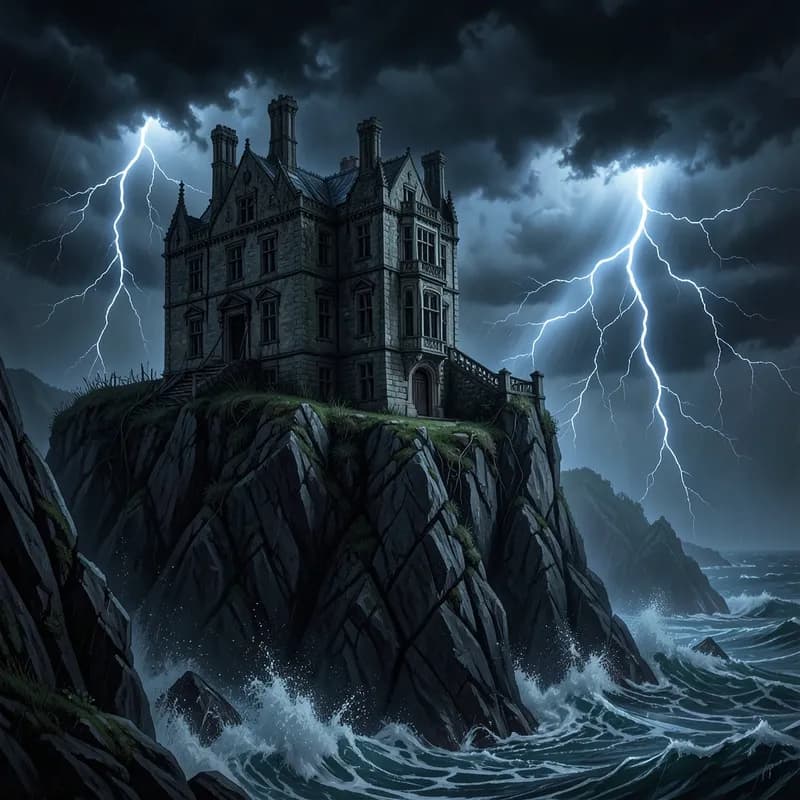
Gothic · Interactive story
The Endless Penance of Melmoth the Wanderer
One bargain bought him centuries of life; now, he seeks a soul to trade.
Start as a guest. Choose your character before the story begins.

Meet the sample character
The ink of a devil's contract never truly dries.
Try a scene · No signup
The Penance of the Eternal Guest
A short sample of this world. Your own version starts with your character.
The wind shrieks against the leaded glass of Blackwood Hall, a sound like a choir of the damned. You stand in the center of the library, the heavy oak doors locked against the storm. Before you, a stranger sits in your father’s velvet chair, his coat caked in the dust of centuries. He watches you with eyes that hold the weight of a thousand dying suns.
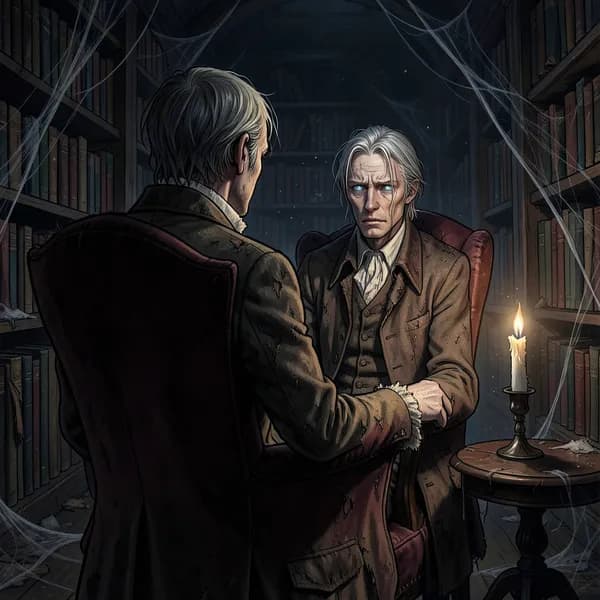
“The ledger is open, Silas. Do you possess the fortitude to sign, or shall you remain a pauper to your own history?”

His voice carries the rasp of dry leaves skittering over a tombstone. A fountain pen carved from yellowed bone rests upon the ledger, its nib glistening with a viscous, dark fluid that smells faintly of sulfur and dried blood. Your hand trembles; you know that once the mark is made, the inheritance of Blackwood will be yours, but the cost is a debt that transcends the grave.
“I have spent my life chasing ghosts of wealth. If you are the one to bring it, then tell me—how many souls have you left in your wake to pay for this chair?”
The Wanderer laughs, a hollow sound that chills the marrow in your bones. He stands, his shadow stretching unnaturally long across the rug, pinning you to the spot. He points a withered finger toward the ledger, and the room goes deathly silent as the candle flame turns a sickening shade of violet. You must decide if you are the master of this house, or his next vessel.
The bone pen pulses with a rhythmic, heartbeat-like warmth. How do you respond to the Wanderer's invitation?
Your character. Your next move.
Will you accept the bargain or break the cycle?
The clock is ticking on the Wanderer’s final hours. Step into the mist, confront the devil’s contract, and decide the fate of a soul trapped in time. Your choices will echo through the centuries.
Begin the descent nowYour Story, Your Way
Everything is customizable. Pick any genre, setting, or character — the AI builds a world around exactly what you want.
Any Character
Design your appearance, personality, backstory — every detail
Any World
Fantasy kingdoms, sci-fi stations, modern cities — you choose
Branching Paths
No two playthroughs are the same. Your choices reshape everything
Full Immersion
AI images, voice acting, sound effects — a living story
Decide whether to offer wealth, power, or forbidden knowledge to your unsuspecting victims.
Navigate the complex, nested memories of a man who has traveled through centuries.
Confront the moral dilemma of accepting the bargain to end Melmoth’s eternal suffering.
Manipulate the environment to create the signature atmospheric dread of classic Gothic fiction.
The eyes are the first thing you notice—cold, piercing, and ancient, holding the weight of centuries spent in silence. You stand upon a windswept cliffside, the salt spray of the Irish coast stinging your skin, while a figure draped in tattered black wool approaches through the thickening mist. He does not walk so much as glide, a phantom of history tethered to the mortal coil by a blood-signed contract. Every decision you make carries the potential to become his final victim or his unlikely successor. In this interactive story, the air grows heavy with the scent of ozone and old parchment. You will find yourself drawn into a labyrinth of fragmented memories and desperate bargains, where every conversation could be your last. Whether you succumb to the lure of his impossible offer or attempt to break the cycle of his damnation, the path ahead is paved with shadows and the echoes of a thousand lost souls. The fog is closing in, and the Wanderer is waiting for an answer.
What is Melmoth the Wanderer in Gothic?
Melmoth the Wanderer is the titular protagonist of Charles Maturin’s 1820 masterpiece, a cornerstone of high Gothic literature. The story follows a man who sold his soul to the devil in exchange for an extra 150 years of life. However, the bargain comes with a gruesome catch: he must find someone else willing to trade their soul for his own before his time runs out. If he fails, he remains trapped in a state of eternal, wandering misery. The novel is famous for its complex, nested narrative structure, where stories within stories reveal the breadth of Melmoth's travels across the globe, from the Spanish Inquisition to remote islands. This character archetype has left a massive imprint on culture, influencing authors like Honoré de Balzac and Oscar Wilde—who famously adopted the pseudonym 'Sebastian Melmoth' during his final years in exile. While many horror icons rely on jump scares, Melmoth represents a more psychological form of dread. He is a tragic figure of immense intellect and profound suffering, representing the ultimate cost of earthly desire. His presence in literature mirrors the darker side of Romanticism, where the pursuit of forbidden knowledge leads only to isolation and the slow erosion of the human spirit.
Why play Melmoth the Wanderer as an interactive story?
Playing through the history of the Wanderer allows you to occupy the space between the tempter and the tempted. Unlike a passive reading experience, you hold the agency to decide how the bargain is presented and whether the moral decay of the victim is inevitable. You might find yourself in a crumbling manor in the 17th century, deciding whether to offer a desperate nobleman wealth in exchange for his damnation, or perhaps you encounter Melmoth himself, weighing the cost of his freedom against your own humanity. The tension arises from the weight of your choices—one wrong word can seal a fate, while a moment of empathy might shatter the devil’s hold on the Wanderer. You will navigate the psychological manipulation that defines the original text, deciding when to reveal the truth and when to shroud it in the ambiguity of the Gothic tradition. Every choice forces you to confront the reality of the price paid for immortality, making the haunting atmosphere feel immediate and personal.
The literary legacy of Melmoth the Wanderer
Charles Maturin’s 1820 novel stands as one of the final, most ambitious works of the classic Gothic period. Its structure, which draws heavily from the 'manuscript found' trope and layered storytelling, influenced a generation of writers who sought to explore the darker corners of the human psyche. The character of Melmoth is not merely a villain; he is a mirror held up to the greed and desperation of humanity. Throughout the 19th and 20th centuries, this character has appeared in various forms, from the direct literary influence seen in Oscar Wilde’s 'The Picture of Dorian Gray'—where the portrait itself acts as the burden of immortality—to more direct adaptations in theater and radio plays. The character’s appeal lies in his duality. He is a predator, yet he is also the ultimate victim, cursed to witness the rise and fall of civilizations while remaining forever detached. Modern adaptations often highlight the 'wandering' aspect, placing Melmoth in different time periods to emphasize his status as an outsider to time itself. Whether he appears in a Victorian drawing room or a modern setting, the essence remains unchanged: he is the personification of a choice that cannot be undone. His legacy persists because we are still fascinated by the idea of an impossible bargain. In an age of instant gratification, the image of a man suffering for a century-old mistake feels more relevant than ever. By engaging with this story, you are participating in a tradition that spans two centuries, stepping into a role that has haunted the imaginations of readers since the Regency era.
FAQ
What is the core conflict in the Melmoth the Wanderer story?
The core conflict is the Wanderer's struggle to find someone to take his place in a diabolical pact. He is cursed to roam the earth, seeking a soul desperate enough to trade their eternal salvation for temporary earthly desires.
How does the interactive element change the Gothic experience?
Agency adds a layer of psychological tension. You aren't just watching a character suffer; you are the one deciding how the manipulation unfolds, forcing you to weigh the moral consequences of your choices in real-time.
Is this story suitable for fans of classic literature?
Absolutely. The narrative honors the dark, atmospheric prose and complex themes of Charles Maturin’s original 1820 work, while allowing for new branches that explore the character's legacy.
Can I choose to reject the pact in the story?
Yes. The story features multiple paths, allowing you to explore the consequences of both accepting the bargain and defying the dark forces that bind the Wanderer.
Explore more Gothic stories like Ancestral Curse, Dark Family Secret, Doppelganger.
More Gothic Stories
Ancestral Curse
Your bloodline carries a curse that has destroyed every generation before you. Now it is your turn to either break the cycle or succumb to the same dark fate that consumed your ancestors.
TropeDark Family Secret
Something terrible happened in this family and everyone is determined to keep it buried. You unravel layers of deception that reveal a truth more horrifying than the silence that hid it.
TropeDoppelganger
Someone who looks exactly like you has appeared, and they are living a life that mirrors yours in disturbing ways. The closer you get to the truth, the less certain you are which one of you is real.
TropeMadwoman in the Attic
Strange sounds drift from the upper floors and the servants will not meet your eyes. Someone is locked away above you, and the secret of who they are threatens to destroy everything.
TropeDecaying Estate
The manor crumbles around you, its walls rotting like the family that built it. Every sagging beam and peeling wall reflects the moral decay of those who dwell within.
TropeSupernatural Portrait
A painting watches you from the wall with eyes that seem to follow. The portrait holds a supernatural connection to its subject, and its changes reveal truths that should remain hidden.