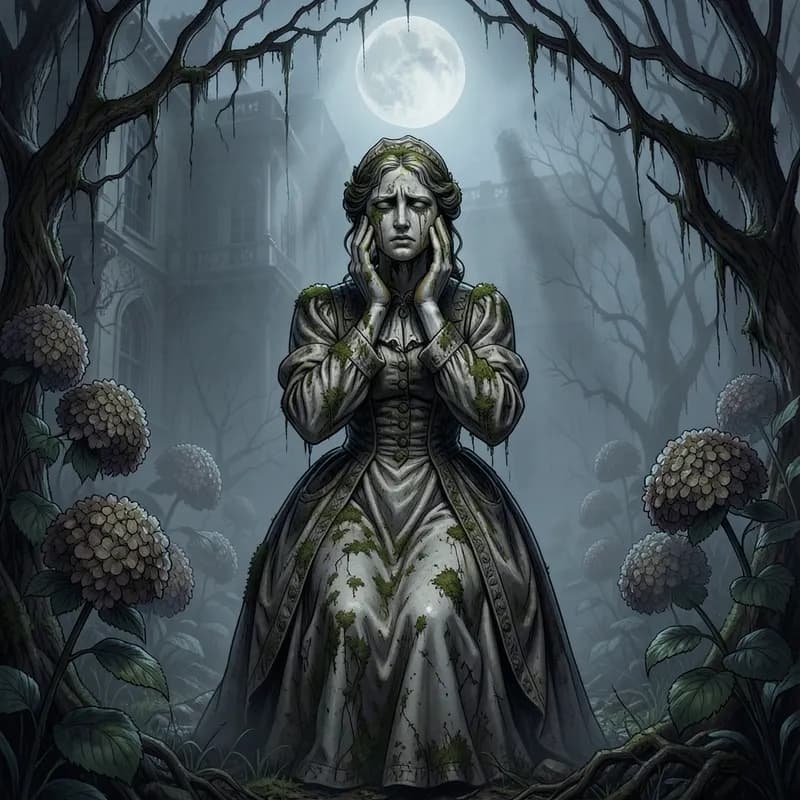
Gothic · Interactive story
The Marble Sentinel: A Gothic Tale of Stone and Sin
The garden is silent, but the stone eyes are watching your every move.
Start as a guest. Choose your character before the story begins.

Meet the sample character
Some burdens are heavier than marble.
Try a scene · No signup
The Stone’s Cold Gaze
A short sample of this world. Your own version starts with your character.
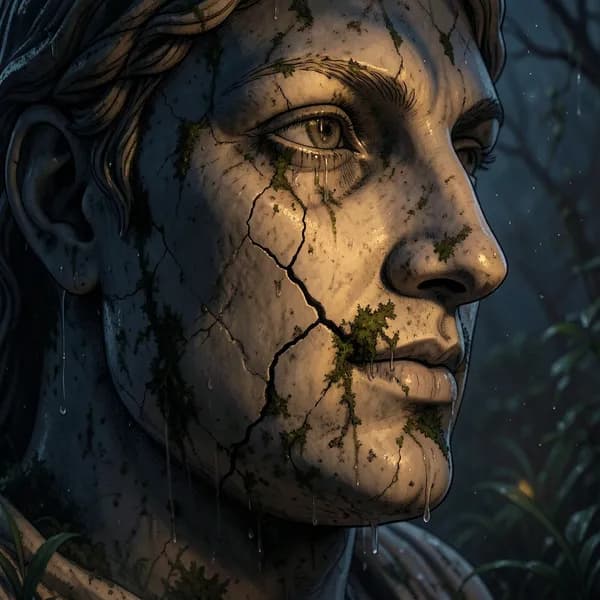
You stand amidst the overgrown hydrangeas of Blackwood, where the fog clings to your coat like damp wool. Before you, the marble statue of Lady Beatrice remains fixed in her eternal lament, her hands pressed against her cheeks. Your skin pricks with the sensation of being observed. You swear the hairline fracture near her jaw was not there when you passed by an hour ago.
“She doesn't like visitors who linger past the tolling of the bell, Master Arthur. Best you turn back before the frost settles in her eyes.”
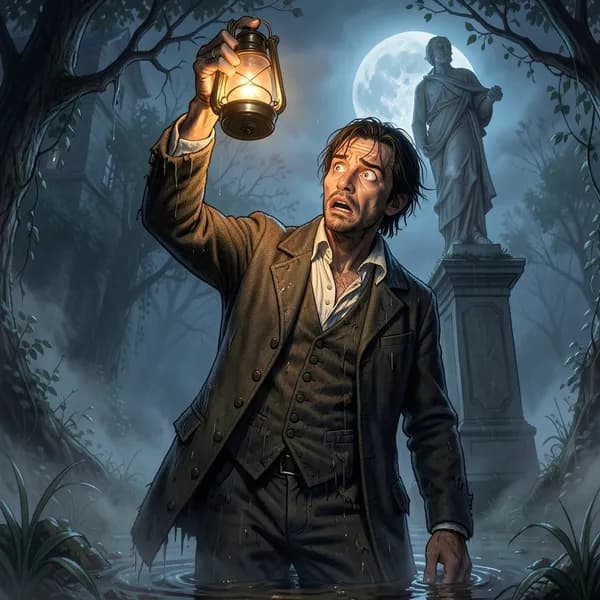
Silas vanishes into the gray, his footsteps swallowed by the mud. You remain, your lantern light flickering against the pitted stone. You look up, and your breath hitches. The statue’s hands have shifted; they now reach slightly forward, fingers curled as if she has just drawn a ragged, phantom breath.
“I know you are not merely rock. Show me what you have been hiding in the dark.”
The silence of the garden is suddenly broken by the grinding of calcified stone against stone. A sliver of moonlight catches the statue’s face, and for a heartbeat, her marble lids flutter. The decision hangs over you like a blade; remain to witness the impossible, or flee before the garden claims another soul.
The marble fingers twitch toward your throat. How do you respond to the awakening stone?
Your character. Your next move.
The Statue Is Turning. What Will You Do?
The moonlight hits the courtyard, and the marble figure has shifted again. You have only moments to decide: run for the gates, or confront the stone entity to learn the truth about the manor’s curse. Your next step could be your last.
Confront the Stone SentinelYour Story, Your Way
Everything is customizable. Pick any genre, setting, or character — the AI builds a world around exactly what you want.
Any Character
Design your appearance, personality, backstory — every detail
Any World
Fantasy kingdoms, sci-fi stations, modern cities — you choose
Branching Paths
No two playthroughs are the same. Your choices reshape everything
Full Immersion
AI images, voice acting, sound effects — a living story
Choose to touch the cold stone surface to reveal hidden, blood-stained engravings.
Decide whether to dismantle the statue before it fully awakens at midnight.
Interpret cryptic movements as warnings or lures to lead you into a trap.
Negotiate with the spirit trapped within the marble to uncover family secrets.
The frost bites at your ankles as you walk the perimeter of Blackwood Manor. In the center of the overgrown maze stands a figure carved from cold, gray marble—a woman clutching a broken locket. You turn to leave, but the scraping sound of stone against stone stops your breath. When you look back, her hand is no longer at her throat; it is outstretched, pointing toward the cellar door. In this interactive story, the environment reacts to your presence. Will you investigate the source of the movement, or will you flee the grounds before the sun sets? Your decisions dictate the outcome of this encounter with the impossible.
What is Living Statue in Gothic?
The living statue trope relies on the subversion of stasis. In Gothic horror, the home is a tomb, and the decor is often a silent observer of past atrocities. When a statue moves, it violates the boundary between the inanimate and the animate, forcing the protagonist to question their sanity and the history of the estate. It represents the lingering weight of ancestors who refuse to stay buried. Think of the Weeping Angels from Doctor Who, where the terror stems from the creature only moving when unobserved, or the classic short story The Sandman by E.T.A. Hoffmann, where the line between automaton and human becomes a source of profound psychological horror. By animating the inanimate, the narrative suggests that the setting itself possesses a malevolent, conscious intent.
Why play Living Statue as an interactive story?
Playing through this narrative requires more than just reading; it demands observation. You will face moments where you must decide whether to trust the statue’s guidance or treat it as a threat. Do you offer a sacrifice to appease the stone, or do you attempt to break the curse binding the figure to its pedestal? Every choice shifts the atmosphere, perhaps causing the statue to move closer, or to weep blood instead of rain. Agency adds a layer of dread that static media lacks: you are not just watching a character encounter the statue; you are the one deciding how to react to that impossible gaze.
Famous examples of Living Statue in books, film, and games
The living statue serves as a bridge between the physical and the supernatural. In Oscar Wilde’s The Picture of Dorian Gray, the painting acts as a surrogate for the living statue, changing to reflect the protagonist's moral rot. The horror comes from the static object bearing the burden of truth that the human refuses to acknowledge. Similarly, in the game Bloodborne, the statues in the Cathedral Ward create an oppressive atmosphere that suggests the city itself is watching the player’s descent into madness. These examples demonstrate that the trope is most effective when the statue acts as a mirror for the protagonist's guilt or a harbinger of inevitable doom. The trope endures because it exploits our primal fear of things that should be dead—or never alive—suddenly possessing agency. Whether it is a warning from the past or a predatory entity, the living statue forces us to acknowledge that the inanimate world is rarely as hollow as it seems.
FAQ
What makes a living statue scary?
It exploits the psychological tension of the uncanny, where a near-human form moves in ways that defy physics. This creates immediate dread because the observer can no longer trust the boundary between life and death.
How does an interactive story change the experience of this trope?
You become the protagonist, forcing you to make real-time decisions that dictate whether the statue remains a passive observer or becomes an active antagonist.
Can I communicate with the statue?
Depending on your choices, you may be able to decipher the statue's movements or find ways to interact with the entity bound within the stone.
Is this type of horror suitable for beginners?
Gothic horror focuses on atmosphere and psychological tension rather than constant action, making it an ideal entry point for those who enjoy slow-burning suspense.
Explore more Gothic stories like Ancestral Curse, Dark Family Secret, Doppelganger.
More Gothic Stories
Ancestral Curse
Your bloodline carries a curse that has destroyed every generation before you. Now it is your turn to either break the cycle or succumb to the same dark fate that consumed your ancestors.
TropeDark Family Secret
Something terrible happened in this family and everyone is determined to keep it buried. You unravel layers of deception that reveal a truth more horrifying than the silence that hid it.
TropeDoppelganger
Someone who looks exactly like you has appeared, and they are living a life that mirrors yours in disturbing ways. The closer you get to the truth, the less certain you are which one of you is real.
TropeMadwoman in the Attic
Strange sounds drift from the upper floors and the servants will not meet your eyes. Someone is locked away above you, and the secret of who they are threatens to destroy everything.
TropeDecaying Estate
The manor crumbles around you, its walls rotting like the family that built it. Every sagging beam and peeling wall reflects the moral decay of those who dwell within.
TropeSupernatural Portrait
A painting watches you from the wall with eyes that seem to follow. The portrait holds a supernatural connection to its subject, and its changes reveal truths that should remain hidden.