
Gothic · Interactive story
Beneath the Earth: The Labyrinthine Catacombs
The walls are made of calcified history, and they are listening to your heartbeat.
Start as a guest. Choose your character before the story begins.
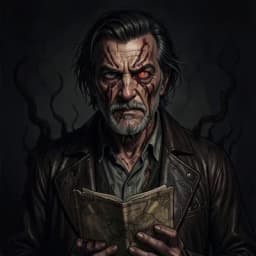
Meet the sample character
The dead hold the keys to a kingdom of silence.
Try a scene · No signup
Dust and Marrow
A short sample of this world. Your own version starts with your character.
Your lantern sputters, casting long, frantic fingers of light across walls crafted entirely from human femur and skull. You are deep beneath the Vane estate, where the air is thick with the scent of damp earth and centuries of stagnation. Ahead, the tunnel forks, the darkness in each passage heavier than the last, refusing to yield to your weak flame.

“Still hunting for your inheritance, boy? The bones don't hold maps; they only hold hunger.”

The voice sounds like grinding gravel, originating from nowhere and everywhere at once. A cold draft sweeps through the passage, extinguishing your lamp, leaving you in absolute, suffocating blackness. You press your back against a stack of ribs, your heart hammering against your ribs like a trapped bird.
“I am not afraid of the dead, nor am I afraid of the man behind the shadow.”
Your hand brushes against a loose stone in the wall behind you. It shifts with a sickening scrape, revealing a hidden cavity that smells of fresh ozone and something metallic—like blood. From the darkness, a heavy, wet footfall echoes, closing the distance between you and the unseen speaker.
The footsteps are inches away. Do you reach into the cavity, confront the voice, or plunge deeper into the suffocating dark?
Your character. Your next move.
The dead are waiting. Will you escape?
The lantern is dimming, and the walls are closing in. Every tunnel looks the same, and the sound of dragging footsteps grows louder behind you. Do you turn to fight whatever is following, or do you gamble on a narrow, crumbling passage that might lead to the surface? Your next move decides if you make it out alive. Start your story now.
Begin your descentYour Story, Your Way
Everything is customizable. Pick any genre, setting, or character — the AI builds a world around exactly what you want.
Any Character
Design your appearance, personality, backstory — every detail
Any World
Fantasy kingdoms, sci-fi stations, modern cities — you choose
Branching Paths
No two playthroughs are the same. Your choices reshape everything
Full Immersion
AI images, voice acting, sound effects — a living story
Choose to conserve your dwindling lantern oil or press onward into absolute darkness.
Decipher ancient inscriptions on stone sarcophagi to unlock hidden, secret passages.
Decide whether to disturb the remains of a long-dead knight for a potential key.
Navigate shifting tunnels that rearrange themselves based on your previous movements.
The flickering candle guttered, casting long, frantic shadows against the stacked tibias and skulls that lined the narrow corridor. You have wandered too far from the crypt’s iron gate, and the path behind you has shifted. Every turn looks identical, a repeating pattern of limestone and rot. The air is heavy with the scent of damp earth and stale incense. Here, your decisions dictate your survival; one wrong turn leads to a dead end, while another might reveal the hidden entrance to a forgotten ritual chamber. You must decide whether to follow the faint sound of weeping echoing from deep within the marrow-chilled dark or retreat toward the surface before your light fails entirely. The silence here is heavy, pressing against your chest as if the dead themselves are waiting for you to make a mistake. There is no map, only the instinct to keep moving when your legs feel like lead.
What is Labyrinthine Catacombs in Gothic?
In gothic literature, the catacombs represent the ultimate confrontation with mortality. Unlike a standard dungeon, these tunnels are not merely places of confinement; they are ossuaries where the physical remains of ancestors form the very architecture. Gaston Leroux utilized this claustrophobic environment in 'The Phantom of the Opera' to create a sense of inescapable dread, where the protagonist is forced into the bowels of the earth to confront a dark, subterranean reality. Similarly, the film 'As Above, So Below' showcases how the architecture of a catacomb can shift, reflecting the internal psychological state of those who enter. These spaces are defined by their lack of natural light, the overwhelming presence of the dead, and the inherent confusion of a maze that was never intended for the living. When you enter a labyrinthine catacomb, you are entering a space where time has stopped, and the boundary between the past and the present is eroded by the sheer density of human history layered in bone. It is a setting where the environment acts as an antagonist, reacting to your presence with collapsing ceilings, shifting passages, and the unsettling feeling of being watched by eyes that have long since vanished.
Why play Labyrinthine Catacombs as an interactive story?
Playing through a catacomb setting adds a layer of physical urgency to the narrative. Because the environment is a maze, your navigational choices carry immediate, life-or-death consequences. You are not just observing a character; you are managing their limited resources—fuel for your lantern, your waning sanity, and your physical endurance. You might encounter a sealed stone door covered in archaic runes; do you attempt to decipher the script, risking a trap, or do you search for a bypass, losing precious time? Perhaps you hear a rhythmic scratching behind a wall of femurs. Your choice to investigate or ignore the sound changes the path ahead. The tension stems from the knowledge that every corridor might lead to a dead end or a deeper, more dangerous level of the crypt. By placing the power of choice in your hands, the story becomes a test of your own nerves. Will you act with caution, meticulously marking your path, or will you sprint into the dark, hoping to find an exit before your light dies? Every decision influences whether you uncover the secrets buried in the mortar or become a permanent resident of the ossuary.
What makes Labyrinthine Catacombs work: the worldbuilding
The effectiveness of a catacomb setting lies in its sensory deprivation and the weight of history. Sensory details are paramount: the gritty texture of limestone dust, the metallic tang of old blood, and the oppressive, low-frequency hum of shifting earth. In 'The Fall of the House of Usher,' Poe uses the crumbling, subterranean vaults to reflect the decay of the family line itself. This is the core of gothic worldbuilding—the setting is an extension of the internal conflict. Characters who thrive in these environments are often those obsessed with the past, scholars chasing forbidden knowledge, or desperate refugees fleeing surface-level terrors. The conflict is naturally generated by the collision of the living and the dead. The catacombs force characters to confront the reality that they are small, temporary, and easily erased by time. When constructing these narratives, the focus remains on the psychological toll of the setting. The environment should feel indifferent to the character's survival. Works like the 'Catacombs' area in 'Dark Souls' masterfully demonstrate how a setting can feel hostile without ever needing a scripted cutscene; the architecture itself—the bottomless pits, the respawning skeletons, the confusing layout—tells the story. To succeed here, the narrative must treat the catacombs as a living, breathing organism that resents the intrusion of the living. It is not just a maze; it is a tomb that is still hungry.
FAQ
What is the primary danger in the Labyrinthine Catacombs?
The primary danger is the environment itself. Beyond the physical threat of collapsing tunnels and getting lost, the catacombs prey on your sanity. The lack of light, the isolation, and the constant presence of the dead create a psychological pressure that forces you to make rash, desperate choices.
How do choices impact the layout of the catacombs?
Your choices often determine which paths remain open. If you trigger a mechanism or disturb a specific tomb, you might cause a cave-in that permanently alters the map, forcing you to find an alternative route to your objective.
Is this setting suitable for horror enthusiasts?
Yes. This setting is designed for those who appreciate atmospheric, psychological dread rather than jump scares. The focus is on the slow-burn realization that you are trapped in a space that has existed for centuries and cares nothing for your survival.
Can I find items or lore within the tunnels?
Absolutely. The catacombs are filled with forgotten relics, journals left by previous explorers, and historical inscriptions. Searching for these items often requires taking risks, such as venturing into areas where the air is thin or the structural integrity is compromised.
Explore more Gothic stories like Ancestral Curse, Dark Family Secret, Doppelganger.
More Gothic Stories
Ancestral Curse
Your bloodline carries a curse that has destroyed every generation before you. Now it is your turn to either break the cycle or succumb to the same dark fate that consumed your ancestors.
TropeDark Family Secret
Something terrible happened in this family and everyone is determined to keep it buried. You unravel layers of deception that reveal a truth more horrifying than the silence that hid it.
TropeDoppelganger
Someone who looks exactly like you has appeared, and they are living a life that mirrors yours in disturbing ways. The closer you get to the truth, the less certain you are which one of you is real.
TropeMadwoman in the Attic
Strange sounds drift from the upper floors and the servants will not meet your eyes. Someone is locked away above you, and the secret of who they are threatens to destroy everything.
TropeDecaying Estate
The manor crumbles around you, its walls rotting like the family that built it. Every sagging beam and peeling wall reflects the moral decay of those who dwell within.
TropeSupernatural Portrait
A painting watches you from the wall with eyes that seem to follow. The portrait holds a supernatural connection to its subject, and its changes reveal truths that should remain hidden.