Gothic · Interactive story
The Final Performance: A Haunted Theater Gothic Story
The house lights dim, but the performance is only beginning. Will you take the stage?
Start as a guest. Choose your character before the story begins.

Meet the sample character
The performance never truly ends.
Try a scene · No signup
Dust and Broken Footlights
A short sample of this world. Your own version starts with your character.
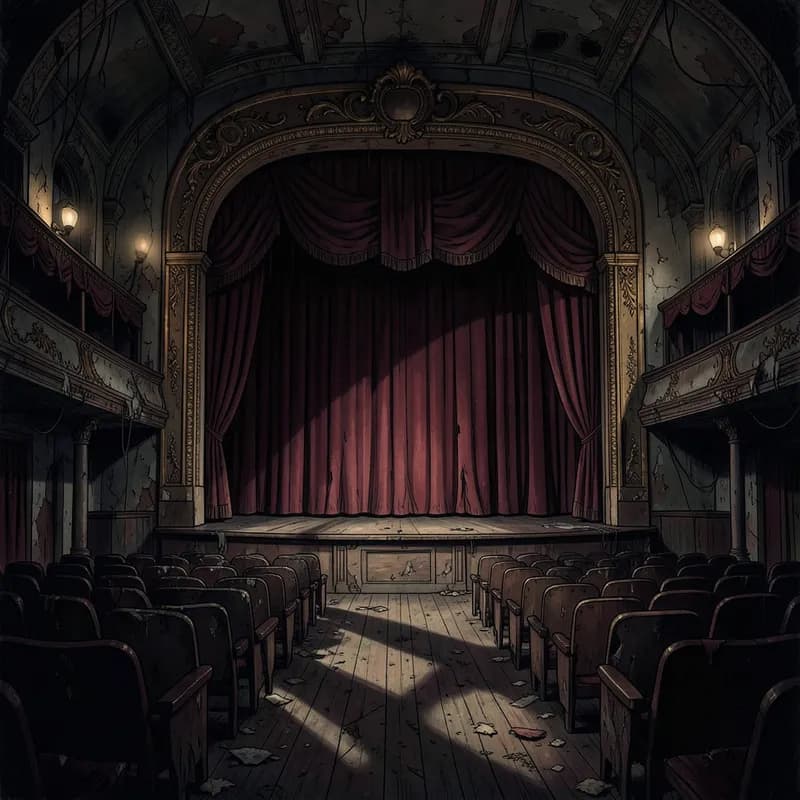
You stand alone in the orchestra pit of the Grand Orpheum. The house lights flicker, casting jagged, elongated shadows against the peeling gold leaf of the proscenium arch. The smell of stale dust and decaying cedar fills your lungs. High above, a heavy iron pulley groans in the rafters, swaying with the weight of unseen ghosts.

“You shouldn't have returned, Silas. The final act was meant to be yours alone.”
The voice drifts from behind the velvet curtains, lacking the cadence of the living. Your pulse thrums against the tight collar of your coat. Below your boots, the floorboards vibrate, mimicking the rhythm of a frantic, dying heartbeat. You grip the cold brass railing, feeling the metal bite into your skin through your gloves.
“The play didn't finish, Madame. I am here to close the curtain once and for all.”
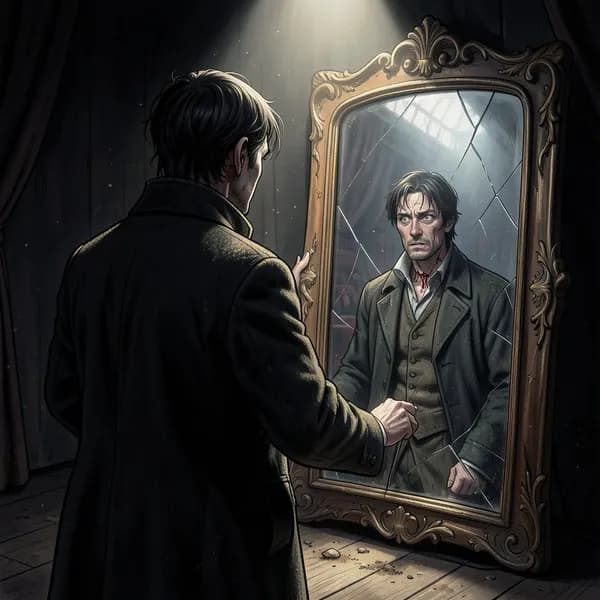
The heavy stage curtain quivers, though there is no wind to stir it. A single, blinding spotlight snaps on, illuminating a dusty prop mirror at center stage. Your reflection stares back, but it isn't moving in sync with you—it is holding a bloodied dagger, and the blade is currently pressed against your own mirrored throat.
The figure in the mirror smiles, a jagged expression that tears at your own skin. How do you respond to the reflection?
Your character. Your next move.
The audience is waiting for you.
Take your place on the stage. Will you uncover the secret behind the red velvet, or will you be silenced before the final act? Your performance begins now—don't miss your cue.
Step onto the stageYour Story, Your Way
Everything is customizable. Pick any genre, setting, or character — the AI builds a world around exactly what you want.
Any Character
Design your appearance, personality, backstory — every detail
Any World
Fantasy kingdoms, sci-fi stations, modern cities — you choose
Branching Paths
No two playthroughs are the same. Your choices reshape everything
Full Immersion
AI images, voice acting, sound effects — a living story
Investigate rhythmic, hollow thumping emanating from behind the locked stage door during a blackout.
Choose which prop to hold during the monologue—the rusted iron dagger or the silk veil.
Attempt to escape through the labyrinthine backstage corridors before the house lights fade to black.
Decide whether to confront the phantom performer or play along to survive the night.
Dust motes dance in the harsh glare of a single spotlight. You stand center stage in the Grand Orpheum, its velvet curtains heavy with the scent of rotting silk and long-forgotten perfume. Somewhere in the dark, cavernous wings, a heavy prop shifts on its own. You are not alone; the theater demands an audience, and it has waited decades for someone to fill the empty seats. Your choices dictate whether you become the star of this macabre production or another permanent fixture of the rafters. Every heartbeat echoing against the wooden floorboards brings you closer to the truth behind the theater’s closing night, provided you can avoid the shadows that follow your every move.
What is Haunted Theater in Gothic?
A haunted theater setting functions as a closed-loop trap. Unlike a manor or a forest, a theater is designed for performance—meaning the ghosts here often act out repetitive, gruesome cycles of their former lives. The architecture itself becomes a character, with trapdoors leading to nowhere, catwalks that groan under phantom weight, and dressing rooms where mirrors hold reflections of people who died before the house lights were last dimmed. Think of Gaston Leroux’s The Phantom of the Opera or the unsettling, shifting geography of the theater in the film Suspiria. These stories rely on the tension between the public artifice of the stage and the private, rotting backstage reality. It is a space of artifice turned into a tomb, where the boundary between the audience and the performer is erased by supernatural forces.
Why play Haunted Theater as an interactive story?
Playing through a theater-based story forces you to balance your curiosity with self-preservation. Do you investigate the rhythmic pounding coming from the costume trunk, or do you flee toward the flickering exit sign? You might find yourself auditioning for a role that has claimed the lives of every predecessor, or perhaps you are a skeptic uncovering the cold, mechanical truth behind the haunting. Every interaction with a prop—a rusted dagger, a blood-stained script, a shattered makeup mirror—triggers a new branch of the narrative. You manage your own sanity as the theater attempts to rewrite your personality to fit a tragic archetype. The agency you possess determines whether you escape the building before the final curtain call or become part of the permanent cast.
What makes Haunted Theater work: the worldbuilding
The power of a haunted theater lies in the collision of performance and reality. In Gaston Leroux’s The Phantom of the Opera, the theater is an extension of the phantom’s obsession. In the game Layers of Fear, the setting uses the theater’s structure to distort perception, turning hallways into canvases of madness. What makes this setting work is the inherent drama. Every character is a performer, and every death is a scene. To write effectively in this setting, treat the building as a director. The lights dim to signal danger; the curtains open to reveal a threat. Sensory details are paramount: the metallic tang of old greasepaint, the squeak of floorboards that sound like applause, and the sudden drop in temperature when the phantom steps into your light. Conflicts arise naturally from the tension between the professional duty of the stage and the encroaching supernatural dread. Whether you are an intruder or a reluctant performer, the theater forces you to play your part—or suffer the consequences of a missed cue. This setting thrives on the irony of being watched by an audience that no longer exists, turning the act of observing into a lethal gamble.
FAQ
What is a haunted theater story?
It is a subgenre of gothic horror where the setting is a decaying performance space. The conflict stems from the blurring line between acting and reality, often involving ghosts tied to past stage tragedies.
How do choices affect the story?
Your decisions determine your survival and the outcome of the performance. Choosing to confront a phantom versus hiding will alter the narrative path and the theater’s behavior toward you.
Is this setting scary?
Yes, it focuses on atmospheric dread, psychological tension, and the claustrophobia of being trapped in a space designed to keep you watching.
Can I be the villain?
Depending on your choices, you may become corrupted by the theater’s influence, eventually becoming the very presence that terrifies the next intruder.
Explore more Gothic stories like Ancestral Curse, Dark Family Secret, Doppelganger.
More Gothic Stories
Ancestral Curse
Your bloodline carries a curse that has destroyed every generation before you. Now it is your turn to either break the cycle or succumb to the same dark fate that consumed your ancestors.
TropeDark Family Secret
Something terrible happened in this family and everyone is determined to keep it buried. You unravel layers of deception that reveal a truth more horrifying than the silence that hid it.
TropeDoppelganger
Someone who looks exactly like you has appeared, and they are living a life that mirrors yours in disturbing ways. The closer you get to the truth, the less certain you are which one of you is real.
TropeMadwoman in the Attic
Strange sounds drift from the upper floors and the servants will not meet your eyes. Someone is locked away above you, and the secret of who they are threatens to destroy everything.
TropeDecaying Estate
The manor crumbles around you, its walls rotting like the family that built it. Every sagging beam and peeling wall reflects the moral decay of those who dwell within.
TropeSupernatural Portrait
A painting watches you from the wall with eyes that seem to follow. The portrait holds a supernatural connection to its subject, and its changes reveal truths that should remain hidden.