
Gothic · Interactive story
The Glass Never Forgets
Your reflection is no longer your own. What will you do when it blinks?
Start as a guest. Choose your character before the story begins.
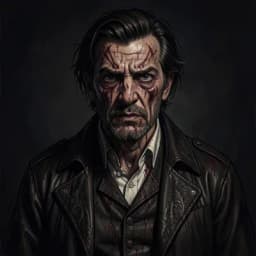
Meet the sample character
Some truths are better left in the dust.
Try a scene · No signup
The Silvered Reflection
A short sample of this world. Your own version starts with your character.
The velvet shroud falls away, revealing a mirror framed in tarnished silver. Your reflection appears, but the room behind you in the glass is not the attic. Instead, you see a nursery engulfed in amber flames, the wallpaper peeling in charred strips as heat ripples through the silvered surface. Your breath hitches, clouding the cold glass.

“Do not look too closely, Silas; the glass has a hunger for those who stare past their own skin.”

Aunt Martha stands in the doorway, her silhouette sharp against the dim hallway light. You reach out, your fingertips hovering inches from the icy surface. Within the burning nursery, the figure of a small child turns toward you. It has no eyes, only hollow craters that mirror the void in your own chest.
“This isn't a trick of the light—this memory, it belongs to this house, and it's trying to show me something.”
The child in the mirror raises a charred finger, pointing directly at the floorboards beneath your feet. A sudden, violent tremor shakes the manor, and the glass begins to crack outward in a spiderweb pattern. The flames from the mirror spill into the room, singeing your cuff, yet the air remains freezing. You must act before the glass shatters completely.
The mirror threatens to shatter and release the fire within. How will you confront the vision?
Your character. Your next move.
The reflection is waiting for you.
The silvered glass in the study is pulsing with a rhythmic, unnatural light. You hear your own voice calling from the other side, begging you to shatter the frame before the sun sets. Will you heed the warning, or will you step closer to see what else it has to show you?
Face the glass nowYour Story, Your Way
Everything is customizable. Pick any genre, setting, or character — the AI builds a world around exactly what you want.
Any Character
Design your appearance, personality, backstory — every detail
Any World
Fantasy kingdoms, sci-fi stations, modern cities — you choose
Branching Paths
No two playthroughs are the same. Your choices reshape everything
Full Immersion
AI images, voice acting, sound effects — a living story
Decide whether to smash the glass, risking the release of whatever dwells within.
Engage in a dialogue with your own reflection to uncover hidden family secrets.
Choose which heirlooms to sacrifice to appease the entity demanding your attention.
The silvered glass in the hallway of Blackwood Manor has always been cold. Tonight, the temperature drops further, frosting the edges in intricate, spider-web patterns. You stand before it, intending only to straighten your collar, but the image staring back is two seconds behind your movements. It smiles while you remain stone-faced. It reaches out a hand, pressing against the inner surface of the glass, and you feel the phantom chill of its touch against your own skin. This is not a trick of the candlelight. Every decision you make—whether to shatter the frame, whisper a secret to the entity, or run from the room—alters the path of your survival. Shadows lengthen, the house groans, and the face in the glass begins to whisper your name.
What is Haunted Mirror in Gothic?
A haunted mirror acts as a gateway to the uncanny. It represents the duality of the self and the intrusion of the past into the present. In many gothic narratives, the mirror is not merely an object of vanity, but a prison for spirits or a window into a decaying timeline. Think of Oscar Wilde’s The Picture of Dorian Gray; while the painting bears the physical degradation of his sins, the concept relies on the same psychological unease as a possessed mirror. The observer is forced to witness the truth of their moral corruption or the literal haunting of their lineage. It is the ultimate confrontation with the 'other' that lives inside one's own image. These stories thrive on the feeling of being watched by one's own likeness, creating a claustrophobic tension that makes the reader question the reality of their own surroundings. The mirror serves as a boundary between the world of the living and the forgotten echoes of the dead.
Why play Haunted Mirror as an interactive story?
Playing through a haunted mirror scenario forces you to confront the consequences of your curiosity. You are not just reading a description of terror; you are deciding how to interact with an entity that knows your history better than you do. Will you attempt to bargain with the spirit trapped behind the silvering, or will you seek out the original owner of the mirror to break the curse? You might choose to cover the glass with a heavy velvet cloth, only to hear the frantic pounding from the other side when you try to sleep. Every decision carries weight. If you provoke the reflection, you may find your own movements becoming sluggish, as if the mirror is slowly draining your agency. You will face moments where you must decide whether to trust the distorted version of yourself, knowing that every interaction brings you closer to being pulled into the glass entirely.
Famous examples of Haunted Mirror in books, film, and games
The haunted mirror is a staple of gothic horror because it exploits our fundamental relationship with ourselves. In the film Oculus, the Lasser Glass is a malevolent force that manipulates perception, forcing characters to see hallucinations and commit atrocities. It is not just a ghost story; it is a psychological breakdown orchestrated by a piece of furniture. Similarly, the short story The Mirror by Guy de Maupassant uses the object to explore the terror of aging and the vanity that leads to madness. These works demonstrate that the mirror is a tool for stripping away the facade of sanity. Whether it reflects a different time, a deceased relative, or a monster, the trope endures because it forces characters to look at the one thing they cannot escape: themselves. It turns the most mundane domestic activity—checking one's appearance—into a moment of existential dread. By placing the player in the center of this dynamic, the horror becomes personal rather than observational.
FAQ
What is a haunted mirror trope?
It is a narrative device where a mirror reveals supernatural truths, past events, or malevolent entities, forcing the protagonist to interact with a distorted reality.
How do choices impact these stories?
You decide whether to confront the entity, ignore the warnings, or investigate the mirror's origin, directly influencing the level of danger and the ultimate outcome you face.
Is this genre right for me?
If you enjoy psychological tension, atmospheric settings, and stories where the environment itself feels like an antagonist, you will find this highly engaging.
Can I interact with the reflection?
Yes, you can choose to speak to, threaten, or attempt to trap the entity, with each choice leading to different consequences for your character.
Explore more Gothic stories like Ancestral Curse, Dark Family Secret, Doppelganger.
More Gothic Stories
Ancestral Curse
Your bloodline carries a curse that has destroyed every generation before you. Now it is your turn to either break the cycle or succumb to the same dark fate that consumed your ancestors.
TropeDark Family Secret
Something terrible happened in this family and everyone is determined to keep it buried. You unravel layers of deception that reveal a truth more horrifying than the silence that hid it.
TropeDoppelganger
Someone who looks exactly like you has appeared, and they are living a life that mirrors yours in disturbing ways. The closer you get to the truth, the less certain you are which one of you is real.
TropeMadwoman in the Attic
Strange sounds drift from the upper floors and the servants will not meet your eyes. Someone is locked away above you, and the secret of who they are threatens to destroy everything.
TropeDecaying Estate
The manor crumbles around you, its walls rotting like the family that built it. Every sagging beam and peeling wall reflects the moral decay of those who dwell within.
TropeSupernatural Portrait
A painting watches you from the wall with eyes that seem to follow. The portrait holds a supernatural connection to its subject, and its changes reveal truths that should remain hidden.