
Gothic · Interactive story
The Vows of the Forsaken
A ring of iron, a heart of glass, and promises that outlive the grave.
Start as a guest. Choose your character before the story begins.
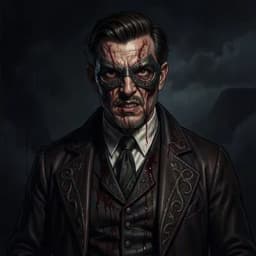
Meet the sample character
Before the tide turns, the debt must be paid.
Try a scene · No signup
The Salt-Stained Vow
A short sample of this world. Your own version starts with your character.
You stand at the altar of Blackwood Chapel, where the salt air of the coast eats away at the stonework. Every breath tastes of iron and damp earth. Beside you, Beatrice stands rigid, her wedding dress a shroud of yellowing lace that smells faintly of peat. The congregation behind you is silent, a collection of figures draped in heavy velvet who have not moved or breathed since the service began.
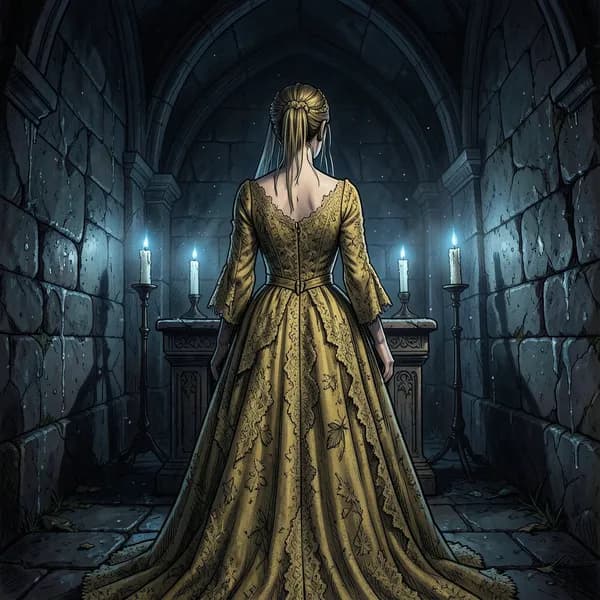
“Hold my hand, Julian. Do not look at their faces. If you catch their eyes, the bargain is forfeit.”

You feel the heavy gold band in your pocket, its surface etched with symbols you were told were meant to ensure prosperity. A tremor runs through your gut. You came to this estate for the inheritance, but as the candles flicker with a blue, unnatural flame, the weight of the gold feels like a brand against your palm. The air grows thick, suffocating.
“The congregation is not what I was promised, Beatrice. Tell me, who are these people beneath the veils?”
The priest turns, his face a hollow cavity hidden by a tattered cowl. He raises a rusted blade instead of a prayer book, and the heavy oak doors of the chapel slam shut, sealing you inside with the silent guests. Outside, the tide crashes against the cliffs, but here, the silence is absolute and hungry. You must act before the blade descends.
The priest approaches with the blade raised. How do you respond to the sanctity of this union?
Your character. Your next move.
Will you say 'I do' to your doom?
The chapel doors are locking. The priest is waiting for your response. Choose your words carefully, for one wrong answer will bind you to this manor forever. Step into the ceremony and face the darkness waiting at the altar.
Begin the Wedding CeremonyYour Story, Your Way
Everything is customizable. Pick any genre, setting, or character — the AI builds a world around exactly what you want.
Any Character
Design your appearance, personality, backstory — every detail
Any World
Fantasy kingdoms, sci-fi stations, modern cities — you choose
Branching Paths
No two playthroughs are the same. Your choices reshape everything
Full Immersion
AI images, voice acting, sound effects — a living story
Decide whether to trust your partner or sabotage the ceremony before the final blessing.
Investigate the hidden family history tucked away in the chapel’s forbidden archives.
Choose which guests to alienate to gain the information necessary for your escape.
The cathedral bells toll, but they sound like teeth grinding against bone. You stand at the altar, the lace of your sleeves heavy with damp, cold air that exists in this locked chapel. Beside you, your betrothed grips your hand—their skin is unnaturally cold, and their eyes reflect a history of violence you are only beginning to understand. The priest’s scripture is written in a language that makes your ears bleed. Every choice you make here decides whether you survive the night or become a permanent fixture in this family’s rotting lineage. This is a space where your decisions carry weight, forcing you to confront the shadows lurking behind the veil of a ceremony gone wrong.
What is Gothic Wedding in Gothic?
The Gothic wedding trope centers on the union of two figures within an atmosphere of decay, secrets, and impending doom. It acts as the antithesis of the fairy-tale marriage; instead of a beginning, it functions as a final seal on a dark pact. Think of the ceremony in Guillermo del Toro’s Crimson Peak, where the house itself seems to demand the bride’s submission to the family's twisted history. The wedding acts as a pressure cooker, forcing characters to confront ancestral curses or hidden motives just as they are meant to pledge their lives to one another. It is a moment of high tension where the social contract of marriage is weaponized, turning a celebration into a trap. In these narratives, the altar is not a place of joy, but a place of reckoning.
Why play Gothic Wedding as an interactive story?
Agency is the sharpest blade in this narrative. You are not observing a tragedy; you are the one deciding which secrets to ignore and which to unearth. Do you drink the ceremonial wine, knowing it tastes of copper and rot? Do you attempt to flee before the final amen, knowing the doors have been bolted from the outside? Your decisions determine whether you become a victim of the household’s suffocating traditions or if you manage to burn the altar down before the vows are sealed. You will face moments where you must choose between social propriety and your own survival. The tension rises as you realize that every guest in the pews has a stake in your failure, and the only path forward is the one you carve through the lies.
Famous examples of Gothic Wedding in books, film, and games
The Gothic wedding is a staple of dark romanticism. In Wuthering Heights by Emily Brontë, the marriage between Isabella and Heathcliff functions as a weaponized act of revenge, setting the stage for a lifetime of misery and spectral haunting. It demonstrates that marriage in Gothic literature is about possession and legacy rather than affection. Similarly, in the game Bloodborne, the Vileblood marriage ceremony represents a grotesque obsession with lineage and forbidden bloodlines, showing how the trope can be twisted into cosmic horror. In film, The Corpse Bride takes this trope to a literal extreme, where the boundaries between life and death are blurred by a ring placed on the wrong finger. These stories endure because they tap into the primal fear of being trapped in a life-altering commitment you cannot escape. Whether the threat is a vengeful ghost or a living spouse with a dark intent, the altar remains the most dangerous location in the house.
FAQ
How does the Gothic wedding trope differ from a standard romance?
Standard romance focuses on the union as a positive climax. Gothic weddings treat the union as a point of no return, often involving danger, supernatural elements, or the revelation of a dark, pre-existing secret.
Can I change the outcome of the marriage in these stories?
Yes, your choices dictate whether the ceremony succeeds, fails, or ends in a confrontation that changes the trajectory of your character's life.
Are these stories always focused on the bride?
No, the protagonist can be a groom, a guest, or even a spectral entity witnessing the ceremony, each perspective offering a different angle on the impending dread.
Is this type of story suitable for fans of psychological horror?
Absolutely. The focus on gaslighting, hidden motives, and the fear of being trapped makes it a perfect fit for anyone who enjoys psychological tension as much as supernatural dread.
Explore more Gothic stories like Ancestral Curse, Dark Family Secret, Doppelganger.
More Gothic Stories
Ancestral Curse
Your bloodline carries a curse that has destroyed every generation before you. Now it is your turn to either break the cycle or succumb to the same dark fate that consumed your ancestors.
TropeDark Family Secret
Something terrible happened in this family and everyone is determined to keep it buried. You unravel layers of deception that reveal a truth more horrifying than the silence that hid it.
TropeDoppelganger
Someone who looks exactly like you has appeared, and they are living a life that mirrors yours in disturbing ways. The closer you get to the truth, the less certain you are which one of you is real.
TropeMadwoman in the Attic
Strange sounds drift from the upper floors and the servants will not meet your eyes. Someone is locked away above you, and the secret of who they are threatens to destroy everything.
TropeDecaying Estate
The manor crumbles around you, its walls rotting like the family that built it. Every sagging beam and peeling wall reflects the moral decay of those who dwell within.
TropeSupernatural Portrait
A painting watches you from the wall with eyes that seem to follow. The portrait holds a supernatural connection to its subject, and its changes reveal truths that should remain hidden.