
Gothic · Interactive story
Secrets Buried in the Bricks
The dead never leave; they only wait for someone to hear their final confession.
Start as a guest. Choose your character before the story begins.
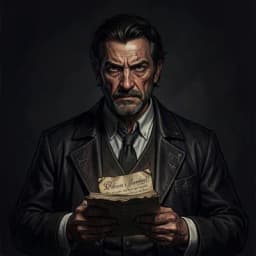
Meet the sample character
Some debts are paid in blood, not coin.
Try a scene · No signup
The Ledger of Ink and Marrow
A short sample of this world. Your own version starts with your character.
The damp cold of Blackwood Manor clings to your wool coat like a burial shroud. You stand in the center of the archive, where the smell of rotting parchment and wet earth is thick enough to taste. A single candle guttering on the desk casts long, frantic shadows against the sagging shelves. Something moves in the periphery of your vision—a smudge of gray ink, a shifting silhouette that refuses to be ignored.

“The ink is dry, Silas, but the debt remains unpaid.”

Your heart beats a frantic rhythm against your ribs. You clutch the leather-bound ledger, the very thing you traveled here to reclaim, yet the weight of it feels heavier than iron. The air grows frigid, frost etching unnatural, jagged patterns onto the surface of the mahogany desk. You are not alone, and the heavy silence is merely a prelude to the voice you hoped never to hear again.
“I came to erase the past, not to serve as its undertaker.”
A hand—translucent, pallid, and missing the ring finger—presses against the desk inches from your own. The shadow shifts, coalescing into the shape of a man who died thirty years ago. He points a trembling digit toward the basement trapdoor, his eyes hollow pits of regret. You must decide whether to follow the specter into the abyss or confront the truth trapped within these pages.
The specter lingers, his silent command hanging in the freezing air. How do you respond?
Your character. Your next move.
The Manor Awaits Your Arrival
A voice calls out from the cellar, muffled by decades of dust. Do you descend into the dark to learn the truth, or do you flee the property before the gates lock for the night? Your decision will determine if the spirit finds peace or if you become the next chapter in this manor's tragic history.
Begin Your InvestigationYour Story, Your Way
Everything is customizable. Pick any genre, setting, or character — the AI builds a world around exactly what you want.
Any Character
Design your appearance, personality, backstory — every detail
Any World
Fantasy kingdoms, sci-fi stations, modern cities — you choose
Branching Paths
No two playthroughs are the same. Your choices reshape everything
Full Immersion
AI images, voice acting, sound effects — a living story
Decide whether to trust the whispers echoing from the locked attic or ignore them entirely.
Gather fragments of a fractured family history to reconstruct the night of the manor's decline.
Choose between offering prayers for a restless soul or seeking a ritual to bind it.
Rain lashes against the leaded panes of Blackwood Manor, a sound like fingernails against glass. You stand in the foyer, the air thick with the smell of wet earth and copper. A portrait in the hallway seems to track your movement, its eyes hollowed by neglect. You are not alone here. A chill crawls up your spine—not a draft, but a presence. This is an interactive story where every decision echoes through the silent halls. Will you appease the spirit clinging to these floorboards, or will you become another secret buried beneath the foundation?
What is Ghost of the Past in Gothic?
The Ghost of the Past trope relies on the idea that history is never truly dead. In Gothic fiction, the protagonist often arrives at a remote location burdened by their own baggage, only to find the location itself suffers from a more literal, spectral weight. It is a physical manifestation of trauma or hidden sins. Think of The Turn of the Screw by Henry James. The ghosts are ambiguous; are they real manifestations of the past, or are they projections of the governess’s own unraveling psyche? The trope functions as a bridge between the living character’s internal conflict and the external, decaying environment. It demands that the protagonist act as an investigator, a confessor, or a medium to resolve a historical injustice that prevents the spirit from moving on. By focusing on the unfinished business of the deceased, the narrative forces the protagonist to confront the reality that the past is constantly shaping the present.
Why play Ghost of the Past as an interactive story?
Playing through a Ghost of the Past scenario transforms you from a passive reader into an active participant in a haunting. You are not just observing a tragedy; you are deciding how to interact with an entity that reacts to your temperament. Will you show compassion to a spirit demanding restitution for a betrayal, or will you attempt an exorcism that might trigger further violence? The tension arises from the ambiguity of the spirit's intentions. You might choose to burn a diary that holds the key to the haunting, potentially silencing the spirit but leaving the original crime unpunished. Your choices dictate whether the manor is cleansed or if you simply join the ranks of those who never left.
Famous examples of Ghost of the Past in books, film, and games
The Ghost of the Past trope serves as a mirror for the protagonist's own unresolved issues. In Guillermo del Toro’s Crimson Peak, the spectral figures are not necessarily the primary antagonists; they are desperate witnesses to a cycle of greed and murder. The ghosts serve as a violent, visceral warning to the living. Conversely, in the game Fatal Frame, the protagonist must use the Camera Obscura to capture the ghosts of the past, effectively forcing the spirit to relive its final moment to find peace. This mechanic turns the trope into a puzzle where the resolution of the spirit's agony is the primary objective. In Wuthering Heights, the haunting of Catherine Earnshaw is a manifestation of Heathcliff’s refusal to let go of the past, proving that the trope is often as much about the living person's obsession as it is about the dead. These examples illustrate that the trope endures because it forces us to confront the reality that we cannot escape our history. Whether through lens or prayer, the goal remains the same: to find the truth hidden in the silence of the dead.
FAQ
What is the Ghost of the Past trope?
It is a narrative device where a protagonist interacts with a spirit bound to a location by unresolved trauma or injustice. The story focuses on uncovering the truth to bring peace to the entity.
How do my choices impact the ghost's behavior?
Your interactions—whether empathetic, aggressive, or dismissive—change how the spirit manifests. Certain choices may soothe the entity, while others could escalate the haunting to dangerous levels.
Is this type of story meant for horror fans?
While it contains elements of dread and suspense, the focus is on psychological depth, atmosphere, and mystery rather than simple jump scares.
Can I fail to put the spirit to rest?
Yes. If you fail to uncover the correct historical context or make poor choices during the investigation, the spirit may remain trapped, or you may become a victim of the manor's cycle.
Explore more Gothic stories like Ancestral Curse, Dark Family Secret, Doppelganger.
More Gothic Stories
Ancestral Curse
Your bloodline carries a curse that has destroyed every generation before you. Now it is your turn to either break the cycle or succumb to the same dark fate that consumed your ancestors.
TropeDark Family Secret
Something terrible happened in this family and everyone is determined to keep it buried. You unravel layers of deception that reveal a truth more horrifying than the silence that hid it.
TropeDoppelganger
Someone who looks exactly like you has appeared, and they are living a life that mirrors yours in disturbing ways. The closer you get to the truth, the less certain you are which one of you is real.
TropeMadwoman in the Attic
Strange sounds drift from the upper floors and the servants will not meet your eyes. Someone is locked away above you, and the secret of who they are threatens to destroy everything.
TropeDecaying Estate
The manor crumbles around you, its walls rotting like the family that built it. Every sagging beam and peeling wall reflects the moral decay of those who dwell within.
TropeSupernatural Portrait
A painting watches you from the wall with eyes that seem to follow. The portrait holds a supernatural connection to its subject, and its changes reveal truths that should remain hidden.