
Gothic · Interactive story
Echoes in the Dust: Your Gothic Manor Awaits
The floorboards groan with the weight of secrets you were never meant to find.
Start as a guest. Choose your character before the story begins.

Meet the sample character
Nothing dies fully in these damp walls.
Try a scene · No signup
The Salt-Rotten Foundations of Blackwood
A short sample of this world. Your own version starts with your character.
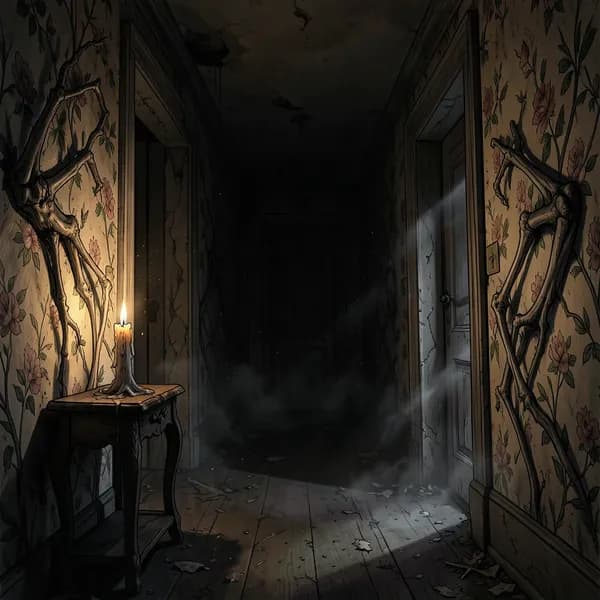
You stand in the foyer, the air smelling of stagnant water and shredded wallpaper. A single candle flickers against a draft that shouldn't exist behind the sealed, warped windows. Shadows pool in the corners, appearing to shift whenever you glance away, turning the peeling floral patterns into frantic, grasping hands.
“You are quite late, Mr. Vane. The house has already shifted its configuration for the night.”
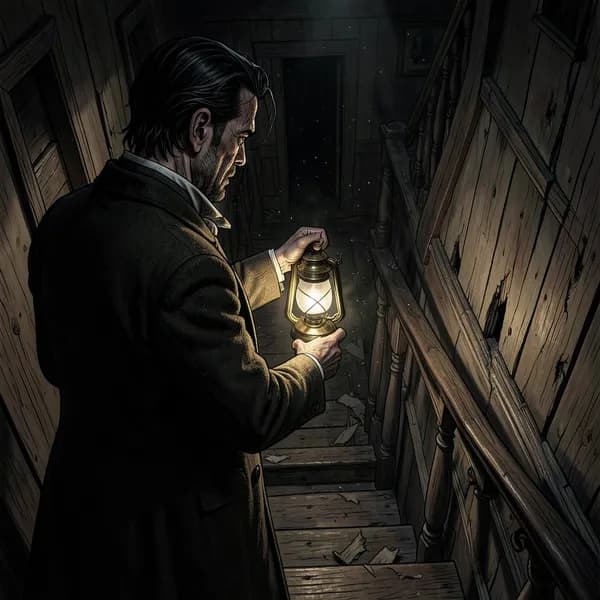
The grand staircase groans, its wood warping as if the manor were a skeletal beast settling into a new posture. Dust motes dance in the dying light like microscopic ghosts, and the silence is punctuated by the rhythmic, wet thumping echoing from somewhere deep within the foundations beneath your boots.
“I did not come here to play games with architecture, Arthur. Unlock the west wing, or I leave this ruins to rot.”
Arthur’s eyes widen, his lantern casting long, jagged shadows across the ceiling. He reaches into his coat, his hand trembling, while a sudden, sharp screech of metal scraping against metal erupts from the cellar door. You must decide whether to chase the source of that sound or force the steward to reveal the wing you came to claim.
The house is physically changing around you; how do you handle the steward and the encroaching decay?
Your character. Your next move.
Will you survive the night in Blackwood Hall?
The front gate has locked behind you, and the storm is intensifying. Every shadow in the foyer is shifting, and a faint, mournful melody is drifting down from the master bedroom. Do you head toward the sound, or do you search the library for a way out? Your choices define the outcome of this descent into darkness.
Begin your investigation nowYour Story, Your Way
Everything is customizable. Pick any genre, setting, or character — the AI builds a world around exactly what you want.
Any Character
Design your appearance, personality, backstory — every detail
Any World
Fantasy kingdoms, sci-fi stations, modern cities — you choose
Branching Paths
No two playthroughs are the same. Your choices reshape everything
Full Immersion
AI images, voice acting, sound effects — a living story
Decide whether to trust the whispers echoing through the abandoned servant quarters.
Choose which artifacts to salvage before the manor succumbs to the rising floodwaters.
Confront the spectral manifestations of ancestors who refuse to leave the dining hall.
Navigate the labyrinthine hallways as the architecture shifts in response to your presence.
The scent of damp stone and rotting velvet clings to your clothes the moment you cross the threshold of Blackwood Hall. Rain lashes against windows that haven't been cleaned in decades, casting frantic, skeletal shadows across the peeling wallpaper of the foyer. You came here seeking answers about your lineage, but the house seems to have its own agenda. Every locked door is a question, and every drafty corridor feels like a warning. In this interactive story, the path you choose dictates your survival. Do you investigate the rhythmic tapping coming from behind the heavy oak door in the basement, or do you flee back into the storm, abandoning the truth you traveled so far to uncover? Your instincts are your only compass in a house that breathes, watches, and waits for your next mistake.
What is a Crumbling Manor in Gothic fiction?
A crumbling manor is far more than a backdrop; it functions as the primary antagonist of the narrative. It represents the physical manifestation of a family’s decline, moral rot, and long-buried sins. Think of the sprawling, claustrophobic Manderley in Daphne du Maurier’s 'Rebecca' or the oppressive, sentient architecture found in Shirley Jackson’s 'The Haunting of Hill House.' In these stories, the mansion is alive, holding onto the past with a grip that refuses to let go. The decay—the cracked plaster, the overgrown gardens, the portraits that seem to follow you—serves as a mirror to the fractured psyches of those trapped within its walls. When you participate in a crumbling manor interactive story, you are engaging with a space that is actively hostile to your presence, slowly revealing its history through the physical degradation of its rooms. It is a setting defined by the tension between the grandeur of what used to be and the terrifying emptiness of what remains.
Why play a Crumbling Manor as an interactive story?
Agency transforms atmospheric dread into a high-stakes psychological test. When you are the one deciding which room to search or which cryptic diary entry to read, the fear becomes personal. You aren't just watching a character make a fatal error; you are the one holding the candle as it flickers out in the dark. You might choose to confront a spectral presence in the ballroom or attempt to piece together a torn letter found beneath a loose floorboard. Each decision alters the house’s response, potentially sealing off exits or revealing hidden passages that change the trajectory of the plot. The tension arises from the constant trade-off between curiosity and caution. Do you risk your sanity to uncover the truth about the estate’s final night, or do you prioritize your safety, leaving the manor's darkest secrets buried forever?
What makes a Crumbling Manor work: the worldbuilding
The effectiveness of the crumbling manor relies on sensory overload and the subversion of domestic safety. A home should be a place of protection, but in gothic literature, it is a site of imprisonment. The architecture itself—gargoyles, winding staircases, and hidden alcoves—creates a sense of claustrophobia that forces characters into confrontation with their own fears. In films like Guillermo del Toro’s 'Crimson Peak,' the house is a character defined by its red clay oozing through the floorboards, a visual metaphor for the blood spilled within. Similarly, Edgar Allan Poe’s 'The Fall of the House of Usher' utilizes the physical collapse of the building to mirror the psychological disintegration of its inhabitants. To succeed in this setting, the narrative must focus on the 'uncanny'—the feeling that something familiar has become fundamentally wrong. The manor should be filled with objects that evoke a sense of lost time: a piano that plays by itself, a clock that chimes at the wrong hour, or a mirror that reflects a room as it looked one hundred years ago. These details force the player to question their perception of reality. Is the house truly haunted, or is the isolation driving the protagonist toward madness? By maintaining a strict focus on the sensory decay—the smell of ozone, the chill of a room that should be warm, the sound of footsteps where no one walks—the setting becomes a living, breathing entity that demands respect and caution.
FAQ
What is the core conflict in a crumbling manor story?
The core conflict is usually the struggle between the past and the present. The manor holds the secrets of previous generations, and the protagonist must uncover these truths while resisting the house's attempts to consume them or trap them within its history.
How does agency change the experience of reading gothic horror?
Traditional gothic novels rely on the protagonist making inevitable, often fatal, mistakes. By giving you the power to choose, the story shifts from a passive observation of doom to a proactive struggle for survival, where your logic and intuition determine the outcome.
Are these stories purely supernatural?
Not necessarily. The best gothic manor stories often leave the line between the supernatural and the psychological blurred. You might be fighting ghosts, or you might be grappling with the weight of generational trauma manifesting as madness.
Can I play these stories at my own pace?
Yes. These interactive stories allow you to pause and reflect on your choices. The atmospheric dread is maintained through text and imagery, giving you the time to fully appreciate the setting before committing to your next move.
Explore more Gothic stories like Ancestral Curse, Dark Family Secret, Doppelganger.
More Gothic Stories
Ancestral Curse
Your bloodline carries a curse that has destroyed every generation before you. Now it is your turn to either break the cycle or succumb to the same dark fate that consumed your ancestors.
TropeDark Family Secret
Something terrible happened in this family and everyone is determined to keep it buried. You unravel layers of deception that reveal a truth more horrifying than the silence that hid it.
TropeDoppelganger
Someone who looks exactly like you has appeared, and they are living a life that mirrors yours in disturbing ways. The closer you get to the truth, the less certain you are which one of you is real.
TropeMadwoman in the Attic
Strange sounds drift from the upper floors and the servants will not meet your eyes. Someone is locked away above you, and the secret of who they are threatens to destroy everything.
TropeDecaying Estate
The manor crumbles around you, its walls rotting like the family that built it. Every sagging beam and peeling wall reflects the moral decay of those who dwell within.
TropeSupernatural Portrait
A painting watches you from the wall with eyes that seem to follow. The portrait holds a supernatural connection to its subject, and its changes reveal truths that should remain hidden.