
Gothic · Interactive story
The Guest Who Never Leaves
A carriage accident, a broken wheel, and a visitor who refuses to fade away.
Start as a guest. Choose your character before the story begins.
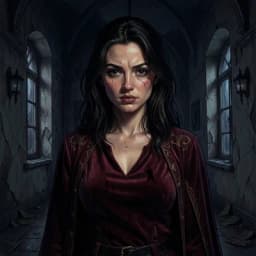
Meet the sample character
The Styrian bloodline ends in a whisper.
Try a scene · No signup
Pale Silk in the Parlor
A short sample of this world. Your own version starts with your character.
The manor air is stagnant, heavy with the scent of crushed lilies and wet stone. Since the carriage accident brought her into your home, the servants have fled the west wing, and the mirrors seem to hold shadows longer than they should. She sits across from you now, her skin luminous as milk against the dark velvet sofa. You watch her throat move as she sighs, a sound that feels like a physical weight pressing against your lungs.

“You look at me as if I am a ghost, Henrietta, yet your pulse tells a far more frantic tale.”
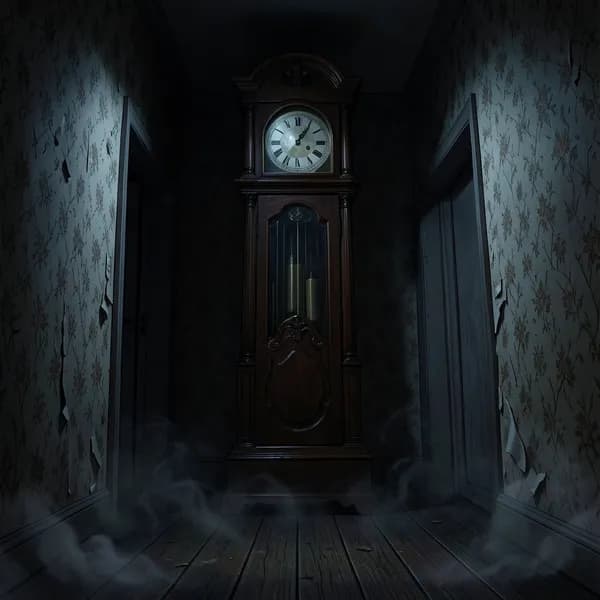
The drawing room dims, the candlelight guttering against a sudden, unseen draft. You feel the heat radiating from her, an unnatural warmth that defies the biting chill of the Styrian mountains outside the glass. Her hand rests near yours, fingers pale and slender, waiting for a signal you are not sure you possess the will to deny. Silence stretches, thick and suffocating, between the crackle of the dying hearth.
“I am not afraid of you, though I cannot say the same for my own heart.”
She leans closer, her eyes dark, bottomless voids that pull your resolve into the abyss. Her breath tickles your ear, smelling of rain-drenched soil and ancient iron. You are caught in the gravity of a predator, realizing that if you move, you might break the spell—or finally offer your neck to the silence. The weight of her gaze is absolute, leaving you paralyzed between salvation and an impossible end.
The candle flickers out, leaving the room in near-total darkness. How do you respond to her proximity?
Your character. Your next move.
The guest is waiting. Will you let her in?
The carriage is broken, the storm is worsening, and she is shivering on your doorstep. Every choice you make from this moment forward will determine if you survive the night or succumb to a languorous, eternal sleep.
Open the Manor GatesYour Story, Your Way
Everything is customizable. Pick any genre, setting, or character — the AI builds a world around exactly what you want.
Any Character
Design your appearance, personality, backstory — every detail
Any World
Fantasy kingdoms, sci-fi stations, modern cities — you choose
Branching Paths
No two playthroughs are the same. Your choices reshape everything
Full Immersion
AI images, voice acting, sound effects — a living story
Analyze the stranger’s cryptic diary entries to uncover the truth behind her arrival.
Choose whether to consult local folklore experts or rely on your own waning intuition.
Manage your household’s security protocols as the manor’s staff begin to disappear one by one.
The iron gates of your ancestral manor groan as they swing shut, sealing you off from the storm. A carriage has overturned in the mud, leaving its only passenger—a woman of startling, pale beauty—on your doorstep. She introduces herself as Carmilla. Her presence is heavy, smelling faintly of wilted lilies and cold earth. As the days pass, your exhaustion deepens, and strange, restless dreams begin to haunt your sleep. You are the protagonist in a house where the walls seem to listen and the shadows possess a hunger of their own. Every conversation you hold with this stranger is a dance on the edge of a blade; one wrong word could tether your soul to hers forever. Decide how much of your trust you will surrender before the sun sets for the final time.
What is Carmilla in Gothic?
Sheridan Le Fanu’s 1872 novella serves as the bedrock of vampire literature. Long before the Count arrived from Transylvania, Carmilla introduced the archetype of the predatory, seductive vampire. The story follows Laura, a young woman living in an isolated Styrian castle, who becomes the object of a haunting, obsessive affection from a mysterious houseguest. Unlike later depictions that focus on fangs and capes, Le Fanu’s work prioritizes atmosphere—the feeling of being watched, the physical toll of an unseen parasite, and the blurring line between friendship and predation. You can see her influence in everything from Hammer Horror films like The Vampire Lovers to modern queer-coded gothic media like the Castlevania animated series, where the name echoes through the halls of horror history.
Why play Carmilla as an interactive story?
Agency transforms the passive dread of the original text into a suffocating, active test of survival. In this version, you are not just reading Laura’s fate; you are managing the household’s defenses and your own deteriorating health. You will choose whether to indulge the stranger’s late-night confessions or investigate the local graveyards for answers that the villagers are too terrified to speak aloud. Will you lock your doors, or will you invite the darkness in, hoping to understand the strange, lethargic pull that keeps you tethered to her side? The tension lies in the ambiguity: is she a victim of circumstance, or are you the victim of a calculated, immortal design? Every decision affects your vitality and the suspicion of those around you.
The literary legacy of Carmilla
Sheridan Le Fanu’s Carmilla changed the trajectory of gothic fiction. Published twenty-five years before Bram Stoker’s Dracula, it established the vampire-as-seducer trope that remains a staple of the genre. The novella is rooted in the aesthetic of the 19th-century Austro-Hungarian Empire, utilizing the isolation of the Styrian mountains to emphasize the vulnerability of the protagonist. The character has been reimagined countless times. The 1960 Hammer film The Vampire Lovers brought her to the screen with a focus on stylized, Technicolor horror, while the 2014 web series Carmilla transposed the story into a modern university setting, proving the character’s adaptability. These adaptations consistently remove the Victorian artifice to reveal the core of the story: the terrifying intimacy of a predator who knows exactly what you desire. Why does she endure? Because she represents the fear of the outsider entering our most private spaces. She is not a monster hiding in a cave; she is a guest sitting at your table, drinking your wine, and slowly draining your life force. In an era where boundaries are increasingly porous, the story of a visitor who becomes an inescapable part of your existence remains as chilling today as it was in 1872.
FAQ
Is this based on the original Le Fanu book?
Yes, it draws heavily from the atmosphere and key plot beats of the 1872 novella while allowing you to change the outcome based on your decisions.
Can I play as someone other than the main protagonist?
You inhabit the role of the estate owner, placing you directly in the path of the vampire’s influence and forcing you to make the final call on her fate.
Does the story include combat or is it purely atmospheric?
It focuses on psychological dread and investigative choices, though your decisions can lead to life-or-death confrontations as the mystery reaches its peak.
How long is a typical playthrough?
Each story session is designed to be a tight, suspenseful experience that you can finish in one or two sittings, depending on how thoroughly you investigate the manor.
Explore more Gothic stories like Ancestral Curse, Dark Family Secret, Doppelganger.
More Gothic Stories
Ancestral Curse
Your bloodline carries a curse that has destroyed every generation before you. Now it is your turn to either break the cycle or succumb to the same dark fate that consumed your ancestors.
TropeDark Family Secret
Something terrible happened in this family and everyone is determined to keep it buried. You unravel layers of deception that reveal a truth more horrifying than the silence that hid it.
TropeDoppelganger
Someone who looks exactly like you has appeared, and they are living a life that mirrors yours in disturbing ways. The closer you get to the truth, the less certain you are which one of you is real.
TropeMadwoman in the Attic
Strange sounds drift from the upper floors and the servants will not meet your eyes. Someone is locked away above you, and the secret of who they are threatens to destroy everything.
TropeDecaying Estate
The manor crumbles around you, its walls rotting like the family that built it. Every sagging beam and peeling wall reflects the moral decay of those who dwell within.
TropeSupernatural Portrait
A painting watches you from the wall with eyes that seem to follow. The portrait holds a supernatural connection to its subject, and its changes reveal truths that should remain hidden.